Ethics, Staged
Carrie Noland, University of California, Irvine
In March 2016, I had the opportunity to attend three weeks of
rehearsals for the reconstruction of one of Merce Cunningham’s
most controversial works, Winterbranch, at the Lyon Opera
Ballet.[1] Winterbranch was choreographed for the Merce Cunningham Dance
Company’s first major tour and was first performed in New York,
just before the tour began, in 1964. It is a work that fell out of the
Merce Cunningham Dance Company’s repertory fairly early, perhaps
because it was too firmly connected not only to a particular phase in
the development of Cunningham’s aesthetic but also to the
particular historical moment known as “the 60s” when the
relation of art to context—especially political context—was
on everyone’s mind.[2] The Director of the
Lyon Opera Ballet conceived of the Ballet’s spring program as an
homage to the experimental dance of the 1960s; he chose to pair Winterbranch with Lucinda Childs’s Dance, a
bright, brisk, almost antiseptic minimalist piece from 1979 that
contrasts sharply with Cunningham’s somber, eery, and in some
ways more engaged minimalist work. Jennifer Goggans, a former
Cunningham dancer and presently an active reconstructor of his works,
arrived in Lyon in mid-March to begin training the dancers in
Cunningham technique. From the first day of rehearsals I was able to
watch her guide Lyon’s balletically trained, exquisitely skilled
dancers toward a performance of Winterbranch that, I believe,
remained faithful to its rebarbative, even gritty nature, despite the
unavoidable change in reception context.
As chance would have it—and when working on Cunningham one is
always attentive to chance—while attending the rehearsals at the
Lyon Opera I was also working on a paper for a conference on the ethics
of gesture, organized by the editor of this volume, Lucia Ruprecht; a
conference that would center on questions raised by Giorgio Agamben in
his famous essay, “Notes on Gesture” (2000, 49–59;
1996, 45–53). Naturally, my two objects of study— Winterbranch and the ethics of gesture—began to enter
into dialogue. The juxtaposition encouraged a comparison between
Agamben’s and Cunningham’s respective approaches to the
semiotics of dance, the way that dance can generate meaning but also
evade meaning in a way that Agamben deems “proper” to the
“ethical sphere” (2000, 56). For Agamben, dance is composed
of what he calls “gestures” that have “nothing to
express” other than expressivity itself as a “power”
unique to humans who have language (“Languages and
Peoples”) (2000, 68). For Cunningham, dance is composed of what
he calls “actions”, or at other times
“facts”—discrete and repeatable movements sketched in
the air that reveal the “passion,” the raw or naked
“energy” of human expressivity before that energy has been
directed toward a specific expressive project (1997, 86). I will look
more closely at what Cunningham means by “actions,” and to
what extent they can be considered “gestures” in
Agamben’s terms; I will also explore the “ethical
sphere” opened by the display of mediality, the
“being-in-a-medium” of human beings (“The
Face”) (2000, 57). But for the moment I want simply to note that
for both, dance involves the exposure on stage of an energy or, in
Agamben’s terms, a “power” (potere)
(“The Face”) (2000, 95), that derives from the
fundamentally “communicative nature of human beings,” their
“linguistic nature” (“Languages and
Peoples”) (2000, 68).[3] In addition, the
exposure of this communicative energy as energy has, for both,
important emancipatory, even utopian implications. That said, the
choreographer and philosopher understand the ethics of dance in
slightly different terms. The following essay constitutes my effort to
understand how these terms differ. I seek to clarify what Cunningham
shares with Agamben’s neo-phenomenological approach to gesture
but also the nuance he brings to the philosophical table as a
choreographer—that is, as someone who works through and with
movement as a theoretical tool.
Few scholars have been attentive to Agamben’s interest in dance
per se. This may be because Agamben’s interest in dance is
motivated neither by a deep knowledge of dance history nor by a
fascination with the work of a particular choreographer.[4] Rather, his interest
stems from an intuition that danced gestures throw into relief what is gestural in the gesture, its “media character”
(2000, 57)—and mediality, as we shall see, ensures the ethical,
or relational sphere of the human. Likewise, in the parallel universe
of dance studies, very little has been written on Winterbranch
as a study of gesture, although it has been recognized that, perhaps
more than most of Cunningham’s dances, Winterbranch
solicits on the part of the audience the act of interpretation, that
is, its gestures appear to spectators as charged with specific
meanings. Indeed, if there is a dance in Cunningham’s repertory
that conjures an ethical sphere, it is Winterbranch.
Juxtaposing Winterbranch with Agamben’s writings on
gesture allows for an exploration of critical theory through a specific
example of choreographic practice. Such a juxtaposition urges us to
question precisely what a dance gesture is, and whether gesture is in
essence an exposure of “communicability itself” (Agamben
2000, 83). What do dance gestures expose that ordinary gestures do not?
Why would such an exposure be “ethical” in Agamben’s
terms? And why would (his notion of) the ethical rely on a stage?
Part I: Agamben on Gesture
The first thing one notes when approaching Agamben’s “Notes
on Gesture” is the fluidity or vagueness of the term
“gesture.” By “gesture” Agamben does not
necessarily mean a communicative gesture, such as a thumbs up or a hand
extended. Nor is he talking about functional gestures à la
Leroi-Gourhan—elements of a chaîne opératoire
or a “habitus.”[5] Instead, I think
Agamben is getting at a larger category of gestures that, at least in
their familiar, non-spectacular contexts, disclose a project or an
intention (to use a Sartrean vocabulary), gestures that are part of an
“intentional arc” (Merleau-Ponty’s term), that
“always refer beyond” themselves “to a whole”
of which they are “a part” (Agamben 2000, 54).[6] This category
includes locomotion, which is not traditionally understood by dancers
as gestural. Rudolf Laban, for instance, considered
“gestures” to be an affair of the upper body and separated
them from “steps.” “Steps,” constitute a large
group encompassing all one can do with the feet—advance,
turn, hop, leap, and so on, whereas a “port-de-bras” and an
“épaulement” are gestures in Laban’s sense of
the term (see Laban 1960).
In contrast, Agamben appears to believe that dance—in its
totality—is the ultimate gesture. In “Notes on
Gesture,” he asserts that dance “exhibits” in
exemplary fashion what is gestural in the gesture: “If
dance is gesture, it is so, rather, because it is nothing more than the
endurance and the exhibition of the media character of corporal
movements” (57). “The gesture,” he
italicizes, “is the exhibition of a mediality: it is the process of making a means visible as such”
(57). Dance, it would appear, distills, in aestheticized, heightened
form what the essence of gesture is, namely, a medium that
exposes itself as such. But how does a medium expose itself as such?
What is it in dance that allows it to be the site of such an
exhibition?
To begin to answer this question, we need to refer to a lesser known
essay that, to my knowledge, has only appeared in a French version,
“Le Geste et la danse.”[7] The essay reiterates
certain passages found in “Notes on Gesture”—it was
published the same year, 1992—while emphasizing different terms.
Here, gesture appears as a kind of power (in French,
“pouvoir” or “puissance”), a power of
“expression.” Linking the two essays, Agamben writes that
the most precise definition he can give of the “pouvoir du
geste”—or the power that is gesture—is the
power to expose itself as “pure moyen” (pure means).
“Ce qui dans chaque expression, reste sans expression,” he
underscores, “est geste” (That which in each act of
expression remains unexpressed is gesture) (12). Another way to say
this would be that gesture, in its ideal state (before being
subordinated to what Agamben calls elsewhere “a paralyzing
power”) is the embodiment of a force or “dynamis
” (2000, 55, 54). Gesture is the medium of movement; it
is movement as a medium, a kind of kinetic surface of
inscription, as opposed to other media or supports, such as the painted
image or the written word. Gesture exhibits the movement that is mediality—crossing over, traversing space,
connecting points, communicating.
Insofar as gestures move, are themselves movement, they represent for
Agamben the very opposite of the static image. In Means Without End, the static image is associated with all
that is “stiffened” or hardened—an
“image” (“Notes on Gesture”), a
“character” (“The Face”), or a
“spectacle” as commodity (“Marginal Commentaries on The Society of the Spectacle”) (2000). In
contrast, gesture is associated with all that is dynamic,
fluid—in short, mediamnic, understood as both
support and in-between, intervalic.[8] In his essay
“The Face,” for instance, the “face” plays the
same role as gesture; it is a “revelation of language
itself.” “Such a revelation,” he proposes,
“does not have any real content and does not tell the truth about
this or that state of being, about this or that aspect of human beings
and of the world: it is only opening, only communicability. To walk in
the light of the face means to be this opening—and to
suffer it, and to endure it” (2000, 91). In contrast, a
“character” is produced when the face
“stiffens,” when it must protect itself from the
vulnerability, the openness and lack of finitude that is its nature
(96). The “face” is thus like gesture, which also
“suffers” and “endures,” or which is
the process of suffering or enduring one’s medial character,
one’s existence as a surface or support of communication.
As has been noted, Agamben’s understanding of the ethical is very
close to that of Emmanuel Levinas, whose chapter “Ethics and the
Face” (1979) is clearly an important influence on many of the
essays in Means Without End. Levinas maintains here that the
ways in which human beings appear to one another (their
“face,” but also all signifying surfaces and supports) are
necessarily flawed; they communicate a message about the person, but
they also hide what cannot be communicated, what is not exhausted in
the act of communication. The “face” both exposes and
betrays; it is “proper” and “improper” (Agamben
2000, 96–7). The exposure of this insufficiency or impropriety in
the signs that bear us is itself an ethical—even a
“political”—act, for it implies that what is known of
the human is never complete, that human mediality—our capacity to
become sign—is endless: “The task of politics is to return
appearance itself to appearance, to cause appearance itself to
appear” (“The Face”) (2000, 94). Agamben mirrors
Levinas when he writes in “Kommerell, or On Gesture” that
one gestures at the point where language appears “at a
loss” (1999, 78). Other essays in Means without End make
a similar point from a more politicized angle. For instance, in
“Marginal Notes on commentaries on the Society of the Spectacle,” Agamben is concerned with the
means and relations of production that prevent such an exposure of
“loss.” He describes capitalist modes of spectacle that
reduce gestures to flat, immobilized appearances severed from the
unpredictable continuum of intentions that once animated them.
Gestures, he claims, have become pure image; they appear on a screen,
limitlessly appropriable, combinatorial. If “Marginal
Notes” is concerned with the spectacularization of gestures,
Agamben presents the opposite scenario in “The Face” and
“What is a camp?” Here, in the fascist version of the same
predicament, the human being is seized as raw life lacking the capacity
to become image, to become something legible in the currency of the other (114–5). The human
being is reduced to pure self-identity, incapable of circulating as a
sign, and thus no longer a “being-in-a-medium”—no
longer human—at all. Thus, if in “Marginal Notes,”
the danger is that human beings will be reduced to pure surface,
“stiffened” into a circulating sign or commodity form, in
“The Face” and “What is a camp?” the danger is
that human beings will be robbed of that very surface-generating
capacity: they will be seized as “nature” tout court and thus deprived of their “linguistic nature,” their “mediality.”
In this context we should recall that for Agamben gesture is always
related not simply to the act of bearing but also, like the face, to
the process of exposing, or exhibiting. The Italian terms Agamben
employs are “esporre”—which means both
“express” and “exhibit” and
“esibizione,” a “show,” “display,”
or “performance” (1996, 52–3, 51). We can begin to
understand why Agamben privileges gesture, and dance gesture in
particular. As movement, gesture exceeds dynamically its signifying or
operational functions. It is highly visible—kinetically and
optically—and thus ideal for “making a means visible as
such.” Agamben’s examples of the gesture include ambulation
(the gait), Warburg’s pathosformel (or dynamograms) (1999, 89–103), the mime gestures of the
Commedia del’Arte (1999, 77–85), “everyday
gestures” (1999, 83), and of course dance gestures, or dance as a
series of gestures. Speech, too, can be gestural, just as there is in
gesture something of speech. As he insists, gesture “is not an
absolutely non-linguistic element,” it points to that
“stratum of language that is not exhausted in communication...” (1999, 77; my
emphasis). In all these cases, what makes gesture gesture is that it
carries something forward that is not equivalent to, or reducible to,
sense. As Agamben stresses, gesture “has precisely nothing to
say” (2000, 58).[9]
To expose this gestural quality of the act of communication—which
is not exhausted by semantics—is to open the
“ethical dimension” (2000, 57). The fact that many of his
examples of gestures capable of opening that ethical dimension are
those that occur on stage suggests the degree to which exposing relies
on performing. Twice-behaved behavior, gestures on stage, exemplify the
act—in both the practical and theatrical senses of the
word—that “cause[s] appearance itself to appear”
(2000, 94).
Part II: From the Ethics of Gesture to the Ethics of Dance
But why does dance embody that act of exposure par excellence? What are
the ethics—or, in another version, the politics—of the
gesture that is dance?[10] Let us recall that
dance enters Agamben’s account at precisely the moment when
“human beings [...] have lost every sense of naturalness,”
when they have “lost [their] gestures” (2000, 52). Despite
the emerging domination of capitalist relations which
“stiffen” gestures, dance remains an instrument of
liberation, or at least a form of critical nostalgia for a time when
gestures were both natural and under the subject’s control. If,
by the twentieth century, an entire generation has “lost its
gestures,” then how is it that the gestures of dancers have
managed to escape this pathological condition?
A glance in the direction of Agamben’s source for his
understanding of dance (and its relation to historical periods) might
help us answer this question. Agamben may very well have been
influenced by the work of Susanne Langer, whose Feeling and Form of 1953 was one of the first important
philosophical treatments of dance. Agamben seems to refer indirectly to
Langer’s book when he turns to dance in “Notes on
Gesture”:
The dance of Isadora Duncan and Sergei Diaghilev, the novels of Proust,
the great Jugendstil poetry from Pascoli to Rilke, and,
finally and most exemplarily, the silent movie trace the magic circle in which humanity tried for the last time to
evoke what was slipping through its fingers forever. (2000, 52–3;
my emphasis)
The phrase “the magic circle” is one that Agamben might
have borrowed from Langer, who in turn borrowed it from a text by Mary
Wigman (Langer 1953, 188–207).[11] Langer in fact
titles a chapter “The Magic Circle,” referring to what Curt
Sachs hypothesized was the oldest dance form, the circle dance (1953,
190). Within this circle, human beings first recognized the
“terrible and fecund Powers that surround” them and that
enter their very bodies, transforming them into a source of movement
power (196). Basing much of her argument on Sachs, Langer describes the
“magic circle” as implicit in all forms of dance, both
“primitive” and contemporary. Today, secular or ballroom
dance, she states, “enthrall the dancer almost instantly in a
romantic unrealism,” whereas “primitive” dance
achieves the ecstatic “by weaving the ‘magic circle’
around the altar of the deity, whereby every dancer is exalted at once
to the status of a mystic” (196). What Langer calls
“virtual gesture”—meaning gesture that has been
lifted out of its “common usage” and placed on the
stage—is “the appearance of Power” (52, 198). Dance
exhibits the “magnetic forces that unite a group” when
dancers exhibit this “Power” as such (202).
Agamben might have called on Langer’s (and Sachs’s) notion
of the “magic circle” to evoke a break between a pre-modern
and a modern relation to gesture. Like Agamben, Langer also maintains
that a loss has occured. In modernity, although the “magic around
the altar” has been broken, modern dance in particular is still
animated with that “Power,” it is still serving the same
function (207). However, she qualifies, “we”—the
moderns—”evoke [that same Power] with full knowledge of its
imaginary status” (206). Langer’s words help us understand
why Agamben strings together turn-of-the-century dance (e.g.,
“Duncan and Diaghilev”) with Proust and Rilke, for they
share—at least according to Agamben—a nostalgia for an
experience that has moved from the realm of ritual communion to the
realm of the stage (an “imaginary status” [206]). However,
Agamben departs from the type of primitivist rhetoric that Langer could
be accused of perpetuating when he insists that gesture contains a
linguistic element, that it is “closely tied to language,”
to “the stratum of language that is not exhausted in
communication” (1999, 77).[12] Presumably, then,
dance would not be any more primitive than language itself; and yet, as
visibly and undeniably movement, it promises to expose more
dramatically that which moves in language, the inexhaustible
“stratum” that language is “at a loss” to
convey. It is perhaps for this reason that in “Le Geste et la
danse,” instead of evoking what has been irrevocably lost, dance
exemplifies what is not lost—at least not to
dance—that which dance alone can continue to exhibit, namely, the
human potential to be a “milieu pur” (2000, 57). [13] Agamben presents
concert dance in particular as the last refuge of
“communicability”: “Ce qui dans chaque expression, reste sans expression, est
geste. Mais ce qui, dans chaque expression, reste sans expression,
c’est l’expression elle-même, le moyen expressif en
tant que tel” (That which in each act of expression remains without expression, is gesture. But that which, in each expression, remains without
expression, is expression itself, the means of expression as such).
Dance gestures, it would appear, are a hypostatized form of gesture, or
the gestural; they evoke that “Power” (Langer) to express a
world, to have a world, the “Power” that is our
“linguistic nature” and that holds us within the
“magic circle” of the human. Sounding much like Langer,
Agamben concludes “Le Geste et la danse” by affirming that
“la danse des danseurs qui dansent ensemble sur une scène
est l’accomplissement de leur habilité à la danse et de
leur puissance de danser en tant que puissance” (the dance of
dancers who dance together on a stage is the accomplishment of their
skill in dancing and their power to dance as power) (12; my
emphasis).
It is not clear to me that in “Le Geste et la danse”
Agamben has provided a convincing portrait of dance, or that he has
revealed its nature as a gestural form “closely tied to
language” (not “not linguistic”) (1999, 77;
my emphasis). In his treatment, dance retains too much of its relation
to a primitive, pre-verbal world of ritual, even if only from the
perspective of a modernist “imaginary.” What is perhaps
more useful for our purposes—especially as we move toward a
reading of Winterbranch—is Agamben’s account of how the gesturality of the gesture is exposed, that is, how
“le moyen expressif en tant que tel” (the means of
expression as such) might be made to appear. Ironically, in
“Notes on Gesture” he associates such an appearance or
display with the act of interruption, not with the fluid
movements of the dancer, bathing blissfully in the “milieu
pur” of a “power to dance as power.” To close this
part of my argument, and to prepare for my reading of Winterbranch, let us return briefly to a passage in which
Agamben takes up the example of the pornographic, the gestures of which
can be suspended, he argues, to reveal their intrinsic and irreducible
“mediality”:
The gesture is the exhibition of a mediality: it is the process of
making a means visible as such
[original emphasis]. It allows the emergence of the being-in-a-medium
of human beings and thus it opens the ethical dimension for them. But,
just as in a pornographic film, people caught in the act of
performing a gesture that is simply a means addressed to the end of
giving pleasure to others (or to themselves) are kept suspended in and by their own mediality—for the only
reason of being shot and exhibited in their mediality—and can
become the medium of a new pleasure for the audience (a pleasure that
would otherwise be incomprehensible) [my emphasis]... so what is
relayed to human beings in gestures is not the sphere of an end in
itself but rather the sphere of pure and endless mediality. (2000,
57–8)
I would like to keep in mind this scene as we move forward, one in
which the ethical dimension appears to open within the pornographic,
one in which something “pure” and without end is captured
in a filmed act that obviously has a very concrete end. As opposed to
his brief excursus on dance, which confuses dancing with an
uninterrupted “magic circle,” Agamben’s comments on
film (and the pornographic film in particular) allow us a firmer
purchase on what dance, as a form of gesture, might be—and what
it might be able to accomplish, or expose. Here, also, instead of
indulging in the fantasy of the “en tant que tel” (as
such), and the “moyen pur” (pure means), Agamben suggests,
albeit obliquely, that a means is never pure, that it can in fact never
be exposed as “an end in itself,” and that the means is
itself mediated by what it bears. That is, it is mediality
only insofar as it is actively mediating.
In sum, what is interesting and revealing about this passage on the
pornographic film is that, as in “The Face,” Agamben opens
the ethical dimension not at the point where communication is lost, but
rather at the point where saying “something in common” (the
clearly legible pornographic gesture) and saying “nothing”
(the gesture interrupted, exposed as a gesture) occur simultaneously
(“Form of Life”) (2000, 9). He points us toward that
ambiguous point where a narrative unfolds and yet that narrative is
suspended, revealing a “stratum” “not
exhausted” by a narrative (1999, 77), a point where the
communication is interrupted, yet still “endured.”.
I believe that it is in this type of
suspension—understood as a medium—that Agamben’s
ethics of gesture resides. In the next section I will argue that it is
in this type of suspension that we might discover Cunningham’s
ethics of gesture as well.
Part III. The Cunningham Gesture
 As is well known, Cunningham often expressed his intention to create
dances that would not impose a particular interpretation on his
audience: “We don’t attempt to make the individual
spectator think a certain way,” he stated in a 1979 interview:
“I do think each spectator is individual, that it isn’t a public. Each spectator as an individual can receive what we
do in his own way and need not see the same thing, or hear the same
thing, as the person next to him” (Cunningham and Lesschaeve
2009, 171–2).[14]
Earlier, in 1968, Cunningham had already advanced a similar view: dance
“can and does evoke all sorts of individual responses in the
single spectator” (1968, n.p.). “Any idea as to mood,
story, or expression entertained by the spectator is a product of his
mind, his feelings” (1970, 175).
As is well known, Cunningham often expressed his intention to create
dances that would not impose a particular interpretation on his
audience: “We don’t attempt to make the individual
spectator think a certain way,” he stated in a 1979 interview:
“I do think each spectator is individual, that it isn’t a public. Each spectator as an individual can receive what we
do in his own way and need not see the same thing, or hear the same
thing, as the person next to him” (Cunningham and Lesschaeve
2009, 171–2).[14]
Earlier, in 1968, Cunningham had already advanced a similar view: dance
“can and does evoke all sorts of individual responses in the
single spectator” (1968, n.p.). “Any idea as to mood,
story, or expression entertained by the spectator is a product of his
mind, his feelings” (1970, 175).
Cunningham’s resistance to conventional plot-lines and
psychological interpretations is well known. Influenced, as was John
Cage, by the reception theory of Marcel Duchamp, Cunningham aimed to
address—and thus create—a spectator who would
“complete” the work (see Duchamp 1975). This was in large
part a reaction against what he saw around him in the dance of the
1940s: “It was almost impossible,” he wrote in 1968,
“to see a movement in modern dance during that period not
stiffened by literary or personal connection” (1968, n.p.; quoted
in Vaughan 1997, 69). In an effort to avoid imposing literary or
personal connections, Cunningham developed a set of procedures that
would ensure, at least in principle, that his own intentions, his
“personal connections,” would not shape or
“stiffen” the movement material. Since many compositional
decisions would be taken out of his hands, he could with some
justification insist that meanings generated by viewers were theirs
alone. Some critics took this to mean that there was no expressive
content to his dances.[15] John Martin wrote
in a dismissive review of 1950 that there is “little in content
and nothing of conspicuous formal value” in Cunningham’s
dances (1950, 69) while Doris Hering lamented in 1954 that his chance
compositions were like “tired utterances suspended in an
emotionless void” (1954, 69). And yet Cunningham was quite clear
on this point: his goal was not to suppress the expressivity of his
dancers but quite the opposite, to intensify that expressivity, to
expose on stage not “anger” or “joy,” but
rather what he called the pure undifferentiated “source of energy
out of which may be channelled the energy that goes into the various
emotional behaviors” (1952; reprinted in Vaughan 1997, 86).
“Dance is not emotion, passion for her, anger against him.
[…] In its essence, in the nakedness of its energy it is a source
from which passion or anger may issue in a particular form” (86; my emphasis).
Here, Cunningham seems to anticipate Agamben, defining dance as a
movement form that displays “the nakedness” of an
“energy” drawn from “common pools of motor
impulses” (in Vaughan 1997, 86), impulses presumably shared by
human beings moving within the magic circle of communicability. But
Cunningham also takes care to acknowledge the “particular
form” in which that energy is exposed. For that reason, the
“nakedness” to which he refers is not reducible to the
purity evoked by the phrase “milieu pur” that Agamben
borrows from Mallarmé.[16] There is in fact
something almost pornographic about Cunningham’s
“nakedness,” “that blatant exhibiting of this
energy,” as he puts it (in Vaughan 1997, 86). As I have argued
elsewhere, Cunningham engages in an erotics of the
not-quite-abstracted; he is keen to exhibit the dirt—the literal dirt, as we shall see in the case of Winterbranch—that clings to the movements of dancers
like a semantic residue weighing them down (see Noland 2017). What
makes Winterbranch a particularly interesting case to study in
this regard is that the gestures the dancers perform are at once
legible and inscrutable, related to specific operational and expressive
tasks and yet disaggregated, distorted, interrupted. One could say that Winterbranch practices an ethics of gesture insofar as it
suspends movement between an “impure” manifestation
(“passion for her,” “anger against him”) and
raw human kinesis imagined as a “pure” support. Put
differently, the dance seems to play on the fine line between a
“naked” and a “channelled” energy, between a
“source” of emotion and emotion in a “particular
form” (in Vaughan 1997, 86). While remaining mysterious and
illegible, Winterbranch nonetheless inspires the act of
interpretation, the search for meaning, and thus the attribution to
movement of expressive content. During the 1960s and 1970s audience
interpretations invariably indexed the sinister, even apocalyptic tone
of the piece and the task-like nature of the movement content. But just
what is this movement content and to what extent can it be considered
gestural?
One of the obstacles we face when moving from philosophy to
choreography, from Agamben to Cunningham, is lexical in nature.
Cunningham uses many terms to refer to what Agamben calls the
“gestures” of dance: “actions,”
“facts,” “movements,” and
“gestures.” He often has recourse to the word
“gesture” to refer to the “ordinary” gesture
one finds in the street, task-related gestures (such as potting a
plant),[17] and even
“intimate gesture[s]” that convey a feeling (Cunningham and
Lesschaeve 2009, 106). Speaking of Signals (1970), for
instance, he notes that a movement of one of his dancers suddenly
struck him as an “intimate gesture,” although he had not
intended it to be so (106). The particular combination of dancers and
the particular place the movement appeared in the sequence made it look
like a gesture of intimacy shared between partners: “you
don’t have to decide that this is an intimate
gesture,” Cunningham states, “but you do something, and it
becomes so” (106; my emphasis). This tells us something about
Cunningham as an observer (rather than a creator) of gestures:
he is able to acknowledge the evocative—even conventionally
expressive—quality of a danced gesture. Moreover, as the anecdote
suggests, he is interested in that evocative gesture,
especially if it suggests a relationship (and thus a scenario or
drama). For him, a movement has the status of a gesture when it is
eloquent of a relation (whether “found” or developed by the
dancers), or when, alternatively, it mimes or actually completes a
specific task. In sum, the word “gesture” in
Cunningham’s vocabulary references both a task-like,
“ordinary” movement and an expressive movement.
Cunningham recognizes that gestures have a signifying dimension insofar
as they are part of a culturally legible situation.
Yet “gestures” are simultaneously technical building
blocks, movements to be placed in an array and thus removed from the
contexts in which they either say something (in a system of meaning) or
do something (in a habitus). The purpose of the grids, lists,
and chance procedures that Cunningham developed over the course of his
career was to reveal through recombination new local contexts in which
decontextualized human actions might be viewed. Cunningham puts it this
way in Changes: “you do not separate the human being
from the actions he does, or the actions which surround him,
but you can see what it is like to break these actions up in
different ways” (1968, n.p.). To “break up” an action is to
interrupt it. It is to expose the modality of movement, the tonus or
type of effort supporting the intention. In short, to “break
up” an action is to seek contact with the “nakedness”
of an energy underlying “passion for her [...] anger against
him” (1952; reprinted in Vaughan 1997, 86). It is to interrupt
the flow of gestures, to expose the support that gesture is—in
Agamben’s terms—that gesture is as such. It is
also, as Cunningham puts it, to take the ground away from beneath the
feet of the spectators, to shift them toward an “abyss”
where conventional associations no longer function:
I think that dance at its best [...] produces an indefinable and
unforgettable abyss in the spectator. It is only an instant, and
immediately following that instant the mind is busy [...] the feelings
are busy [...] But there is that instant, and it does renew us.
(Cunningham in Dalva ed. 2007, n.p.)
The question remains, though, whether such suspension over an
“abyss” opens the ethical dimension or whether instead that
dimension opens as one crosses the abyss, in an interval that
also promises connection. Winterbranch is a study of what
happens when one “breaks up” an action—in this case,
the action of falling. A fall can be broken, cinematically interrupted,
but a falling body inevitably lands.
Part IV. Falling in Winterbranch
Winterbranch
dates from a phase in Cunningham’s career when he was less
interested in incorporating “ordinary gestures” than in
investigating what the fundamentals of a dance vocabulary might be.[18] In the early
1960s, he began to focus on what he called “facts in
dancing”: “I have a tendency to deal with what I call the
facts in dancing,” he explained to David Vaughan, his archivist
(Vaughan 1997, 135).[19] Influenced,
perhaps, by the Classical Hindu Rasa theory of the “eight
permanent emotions,” he sought to reduce his vocabulary to a set
of eight essential movement varieties, without, however, attaching any
particular emotive value to them. We find in the “Choreographic
Records” for Crises (1960), for instance, the following
list: “Bend /Rise /Extend /Turn /Glide /Dart /Jump /Fall”
(box 3, box 11, Cunningham, n.d.). After identifying these eight
“facts,” the choreographer then declined them into
sub-categories, thus exploring systematically the anatomical
possibilities of the human body. Here, Cunningham exemplifies the
“materialist” sensibility of John Cage and the composers of
“la musique concrète” who maintained that the
materials of a craft could be enumerated in a non-hierarchical,
a-semantic taxonomy with no reference to their value in a harmonic
system. In Cunningham’s “The Impermanent Art” we hear
an echo of Cage’s aesthetics as they are presented in
“Lecture on Something” (1959). Cage: “each something
is really what it is.” Cunningham:
A thing is just that thing […]. In dance, it is the simple fact
of a jump being a jump, and the further fact of what shape the jump takes my emphasis]. This attention given
the jump eliminates the necessity to feel that the meaning of dancing
lies in everything but the dancing, and further eliminates
cause-and-effect worry as to what movement should follow what movement,
frees one’s feelings about continuity, and makes it clear that
each act of life can be its own history: past, present and future, and
can be so regarded, which helps to break the chains that too often
follow dancers’ feet around.” (Reprinted in Vaughan 1997,
86)
For Winterbranch, Cunningham chose to focus not on the
“jump” but rather on the “Fall.”[20] The dance is
composed of eighteen sections, each of which centers on a different way
of falling (Winterbranch “Choreographic Records,”
Cunningham, n.d.). However, when he writes in the passage above that
the “simple fact of a jump” is complicated by a
“further fact”—namely,” “what shape the
jump takes”—he departs from a strict Cagean materialism.
That the first “fact” has to be accompanied by a
“further fact” (a movement has to be realized by a
particular person in a particular sequence) indicates that the
categories of movement themselves are “facts” only in a
virtual sense. That is, they exist as classes of physical action to be
actualized in a particular phenomenalized “shape.” Even in
a classroom exercise,, “a “Bend,” for instance, is
contoured by the movement that comes before and the movement that
follows; “a “pré-mouvement,” as Hubert Godard
terms it, anticipates and orients what will come next (Ginot and Marcel
eds. 1998, 224–9). That is why the movement’s place in a
sequence is so vital to the manner in which it will be performed, and
thus to the manner in which it will strike the eye. Just as the
“fact” of extending a hand to the sternum of one’s
partner might, as in Signals, become “a
“gesture” recognized as “intimate,” so too a
“Bend” “Twist,” or “Fall” might be
phenomenalized as a gesture resonant with expressive, dramatic, even
semantic force when executed in a particular sequence by a particular
dancer and under the unique conditions of a theatrical performance. As
Jill Johnston wrote succinctly in 1963, in a Cunningham dance
“the gesture is the performer; the performer is the
gesture” (10).
Thus, what Cunningham calls “the attention given the jump”
excludes neither his interest in nor his desire to solicit the input of
the individual dancer. On the contrary, such attention (cultivated in
the dancer as well) allows each one to discover and reveal his or her
singularity: “from the beginning I tried to look at the people I
had, and see what they did and could do... You can’t expect this
one to dance like the other one. You can give them the same movement
and then see how each does it in relationship to himself, to his being,
not as a dancer but as a person” (Cunningham and Lesschaeve 2009,
65).[21] Especially
during the 1950s and 1960s, Cunningham was acutely attuned to the
movement qualities as well as the personalities of his dancers. In
fact, he often began the choreographic process by compiling “a
“gamut” of movements—one gamut for each
dancer—that would serve as the fundamental movement vocabulary
for the piece, thus taking full advantage of the unique
“shapes” each dancer tended to make when actualizing the
dancing “fact.”
However, Winterbranch is concerned less with highlighting the
qualities of a particular dancer than with the “Fall,” one
of the eight movement “facts” on Cunningham’s list.
Cunningham explained to Jacqueline Lesschaeve that he “wanted to
make a dance about falling” (Cunningham and Lesschaeve 2009,
101). So, quite simply, he “worked on falls” (101). first
alone in the studio and then with the dancers he had in the Company at
the time: Carolyn Brown, Viola Farber, Barbara Lloyd, William Davis,
and Steve Paxton. In his account of the work he insists repeatedly that
his main interest was in “the idea of bodies falling,”
resisting the implication—made by Lesschaeve and
others—that he had any other message in mind (Vaughan 1997, 137).
While admitting that the dance caused “a “furor”
whenever it was performed, he remains coy in the Lesschaeve interview,
acknowledging but never validating the strong reactions to which it
gave rise:
In Sweden they said it was about race riots; in Germany they thought of
concentration camps, in London they spoke of bombed cities; in Tokyo
they said it was the atom bomb. A lady with us took care of the child
[Benjamin Lloyd] who was on the trip. She was the wife of a sea captain
and said it looked like a shipwreck to her [...]. Everybody was drawing
on his own experience, whereas I had simply made a piece which was
involved with falls, the idea of bodies falling. (Vaughan
1997, 135, 137)
Carolyn Brown, who danced in Winterbranch throughout the 1964
tour, writes in her autobiography Chance and Circumstance that
“In Germany, interestingly, no one thought to liken Winterbranch to the Holocaust, although this happened
regularly in other European countries” (2007, 389). Meanwhile,
the reviewer for the London Times wrote that “Winterbranch is a disturbing work [...] The dancers, dressed
in all-over black like wartime commandos, writhe and grope their way
through gloom” (1964, 4). After a New York performance in 1967
Don McDonagh commented that Winterbranch had been
“variously interpreted as a plea for civil rights and a
shipwreck” (1976, 289). And Arlene Croce, reviewer for Ballet Review, wrote that “Winterbranch seems
to me a pre-vision of hell” (1968, 25).[22] But whether
critics identified Winterbranch with Auschwitz, the
battlefield, or hell, they all remarked on what Brown calls “the ethos of Winterbranch; darkness, foreboding, terror,
devastation, alienation, doom” (2007, 477).
Before proceeding to a closer analysis of the movement content of Winterbranch, we need to recall both the artistic and the
political contexts of the work. With respect to the artistic context,
Cunningham was in the process of assimilating developments in the New
York dance scene, developments that—at least for a short
period—caused him to rethink his dance vocabulary. Members of the
Judson Dance Group, including Yvonne Rainer, Simone Forti, and Trisha
Brown, started incorporating everyday and task movement into their
works as early as July 1962 (see Banes 1993). Simultaneously, the
“Junk Art” and Fluxus movements of the 1960s encouraged the
incorporation into performance and exhibition spaces of urban detritus
and industrial waste.[23] Winterbranch reflects both these trends. Further, the
directions that Cunningham gave to his Artistic Director of the time,
Robert Rauschenberg, reveal the influence on his work of his own
personal experience. These directions are particularly precise, more
detailed and explicit—and thus constraining—than Cunningham
typically supplied. He even republished in Changes: Notes on Choreography elements of the letter he wrote
to Rauschenberg in which he outlines his preferences for décor and
lighting:
The lighting is done freely each time, differently, so that the rhythms
of the movements are differently accented and the shapes differently
seen, partially or not at all. I asked robert rauschenberg [sic] to
think of the light as though it were night instead of day. i
don’t mean night as referred to in romantic pieces, but night as
it is in our time with automobiles on highways, and flashlights in
faces, and the eyes being deceived about shapes by the way the light
hits them. There is a streak of violence in me...I was interested in
the possibility of having a person dragged out of the area while lying
or sitting down. (Reprinted in Vaughan 1997, 135–7)
As Mark Franko has noted, the scene on the highway seems to be taken
right out of Cunningham’s personal experience while touring in
the infamous VW van with Rauschenberg, Cage, and his Company members
(1992, 146; also see Cunningham and Lesschaeve 2009, 106). Responding
to Cunningham’s directions, Rauschenberg invented a lighting
arrangement that would approximate an experience of the highway at
night he knew only too well, creating stark contrasts between total
obscurity and blinding illumination by cueing the lightboard to follow
an aleatory order of soft beams determined according to a chance
algorithm that changed for each performance. For the music, Cunningham
commissioned an original piece from La Monte Young, a composer who was
very much in vogue at the time. Young offered 2 Sounds, a
minimalist composition that has become over the years the object of a
lively polemic. 2 Sounds juxtaposes a screechy tone, produced
by dragging an ashtray against a mirror, with a more resonant low tone,
produced by stroking a piece of wood across the surface of a Chinese
gong. The first ten minutes of the dance are performed in absolute
silence. Cunningham heightened the contrast between the silent
beginning and the second half by amping up the volume of La Monte
Young’s score to a decibel level that most spectators (and
dancers) found—and still find—intolerable. Finally,
Rauschenberg added a piece of junk art to the scenography, a combine
composed of whatever he could find around the set at the time. (Don
McDonagh describes it as “a strange little machine with winking
lights... a cartoon version of an official police car.” [McDonagh
1976, 288–9]). Rauschenberg designed not only the sets and
lighting but also the costumes; he chose to dress the dancers entirely
in black with contrasting white sneakers on their feet. As for the
make-up, Rauschenberg elaborated on the sneaker motif: he applied a
black smudge under the eyes of each dancers, evoking in this way the
protective stroke of black that football players apply when they have
to play in a brightly-lit stadium. Significantly, during the rehearsals
for the Opéra Ballet production in Lyon, Jennifer Goggans directed
the dancers to scuff up and dirty the white sneakers as much as
possible presumably to give the impression—as in the original
production—of a grubby workspace, a stage graced only by the
clutter of unused equipment in the back.
Goggans’s explicit directive (to dirty the shoes) in the context
of the 2016 reconstruction confirms that none of the directions
Cunningham gave were indifferent or expendable. Clearly, he intended to
create a frame for the movement, he wanted to conjure a very specific
mood. Thus it was misleading to state—as he did—that any
association made by the spectators would be drawn “from
individual experience” alone. The lighting, the grubby
décor, the make-up, and the costumes all collude to render the
“falls” of Winterbranch not simply “facts in
dancing” but, more specifically, facts framed in a certain way.
That frame—the menace of nighttime darkness—remains a
constant throughout all performances of the piece. It is by no means
insignificant that Winterbranch, when excerpted later on for
an Event, was still performed in the original constumes and lighting;
as dance critic Nancy Dalva notes perspicaciously in her 2005 review,
of the Events at the Joyce Theater in New York, Winterbranch
was
presented in its own special outfits—namely black
jumpsuits—and its own almost completely dark, glancing, harsh
light. This was unusual for Events—I don’t know of any
other dance for which this is done—when the material is usually
stripped of its usual presentation context. (Dalva 2005, 18) [24]
The question is, to what extent does the dance material for Winterbranch rely on this “presentation context”?
Much of the choreography is period-specific; that is, we find in many
of the dances of the 1960s dance figures that evoke the workings of
machines—pulleys, pistons, and levers. A trio that occurs near
the end of Winterbranch is only a slight modification of a
trio found in Crises (1960); the turning figures in which one
dancer rolls over another prefigure similar figures found in Walkaround Time (1968). At the same time, the
“presentation context” of Winterbranch encourages
us to look at these figures and the gestures they contain not only as
mechanical but also as task-like, the variety of movement that would be
accomplished under the flickering, irregular lighting of an apocalyptic
landscape. At various points a dancer is dragged off the stage by means
of a small square black rug; we witness the effort involved in tugging
or carrying a body off stage and recognize the unmistakable silhouette
of a still figure wrapped in a shroud and transported on a stretcher.
The theme of the body as dead weight is thus impossible to miss,
although this theme seems to be contrasted with another, that of the
body as eloquent weight. It is as though Cunningham were
exploring the difference between what Agamben calls “bare
life” and “form-of-life,” that is, between
“naked life” and “a life that can never be separated
from its form” (or “shape”) (2000, 2–3). On the
one hand, the associations the audience makes with these
figures—victims of a holocaust, sinners writhing in
hell—are overdetermined by the context in which they are
presented; on the other, the gestures as performed arguably project
meanings that the scenography merely underscores.
Consider, for instance, the opening of the dance. A male
dancer—Cunningham, in the original
production—traverses the stage from back stage left to back stage
right lying on his back, wrapped tightly in a black tube that prevents
him from using his arms. (During the rehearsals for the 2016
reconstruction, Goggans referred to the tube as a “body
bag.”)[25] In the
original production, Cunningham held a flashlight so that while he
slithered and writhed, the beam would light up different areas of the
stage. The figure is thus at once a passive victim of the constraining
bag and an active participant in setting the mood of the piece.
Cunningham may have insisted that in choreographing Winterbranch he was merely interested in “the idea of
falling,” but the many props of the dance suggest that “the
idea of falling” was—even for him—by no means denuded
of symbolic implications.
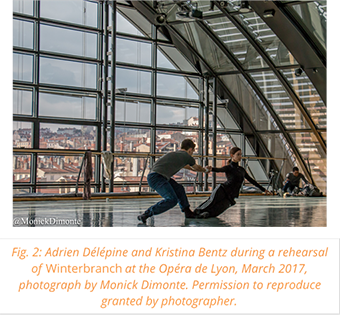 The following sections of the dance also emphasize the weight of the
body, both as a thing to be manipulated and as a force to be countered
or taken into account. Soon after the opening solo, a man and woman
enter into a duet that resembles the awkward manoeuvres of a mechanical
pulley: one serves as a counterweight to the other. The man holds the
arm of the woman, who, to begin with, is lying on her side on the floor
facing the audience. Little by little he succeeds in lifting her torso,
head, and hips off the ground by leaning his feet against hers and
pulling her toward him with all his force. As soon as the woman is
upright, she begins to descend toward the other side, supported only by
the counterweight of the man (see fig. 2). A few minutes later, the two
dancers form a figure that resembles a rotating ball inside a socket
(see fig. 3).
The following sections of the dance also emphasize the weight of the
body, both as a thing to be manipulated and as a force to be countered
or taken into account. Soon after the opening solo, a man and woman
enter into a duet that resembles the awkward manoeuvres of a mechanical
pulley: one serves as a counterweight to the other. The man holds the
arm of the woman, who, to begin with, is lying on her side on the floor
facing the audience. Little by little he succeeds in lifting her torso,
head, and hips off the ground by leaning his feet against hers and
pulling her toward him with all his force. As soon as the woman is
upright, she begins to descend toward the other side, supported only by
the counterweight of the man (see fig. 2). A few minutes later, the two
dancers form a figure that resembles a rotating ball inside a socket
(see fig. 3).
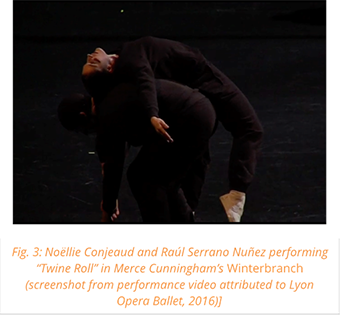 In both cases (the pulley and the ball-and-socket), the falls are
carefully controlled; we observe a calculated and steady displacement
of weight as the woman holds herself rigid, manipulated (but also
protected) by the motions of the man. In the second phrase, however,
which Cunningham referred to in his notes as the “twine
roll,” the woman makes herself completely vulnerable, rolling
over the back of the man, her back arched, exhibiting her pubis,
stomach, chest and throat to the audience. Meanwhile, the man
transforms himself into a support for her weight, bearing his burden
(the woman) as he shifts her toward the ground (see fig. 3).
In both cases (the pulley and the ball-and-socket), the falls are
carefully controlled; we observe a calculated and steady displacement
of weight as the woman holds herself rigid, manipulated (but also
protected) by the motions of the man. In the second phrase, however,
which Cunningham referred to in his notes as the “twine
roll,” the woman makes herself completely vulnerable, rolling
over the back of the man, her back arched, exhibiting her pubis,
stomach, chest and throat to the audience. Meanwhile, the man
transforms himself into a support for her weight, bearing his burden
(the woman) as he shifts her toward the ground (see fig. 3).
The duet seems to juxtapose contrasting tonalities: we witness industry
qualified by empathy, a task is executed with exquisite care. The
slowness of the first apparition of the “twine-roll” (it
will be repeated twice) invites the specator to contemplate the skill
of the dancers who are performing it. At one point during the
rehearsals I asked one of the women who performed the
“twine-roll,” Chaery Moon, what she thought the gestures
meant, what she was imagining as she executed the phrase. Her answer
was that she had no time to think about what her gestures might mean
because the balancing operation was so difficult to execute. The
challenge, she said, was to remain conscious of what her partner was
doing at every moment, to adjust her movements to the
micro-adjustments of his back muscles, to attend to the slow
but inexorable shifts of his weight beneath her prone
frame. In order to avoid falling and injuring herself, she had to
remain riveted on the incremental displacements of his weight,
displacements that were always in response to her own redistributions
of weight.
On the one hand, Moon’s account implies that the relationship
between the dancers was nothing more than a relation of weight. Of course, to some extent, this
relation characterizes all dance duets (especially ones in which there
are lifts), but this dancing “fact” is usually disguised by
mannerisms or narrative contexts. During the rehearsals for the
reconstruction, Goggans was careful to foreground this relation of
weight. Presumably channelling Cunningham, she explicitly instructed
the two dancers to avoid suggesting an amorous relation while
performing the “twine-roll.” At one point, the male and
female dancers (Mario Menendez and Chaery Moon) clasped hands as a way
of maintaining their balance. Goggans swooped down to correct them,
insisting that if they needed to hold hands to prevent themselves from
falling they could do so but only if their gesture remained invisible to the audience.
‘Do it in such a way that no one sees you’re touching each
other,’ she advised. To her mind, at least, any rapport between
dancers that might emerge over the course of the rehearsals had to be
muted; any plot that could be projected had to be suppressed.
The “twine-roll” appears twice more in the course of Winterbranch. The second time we encounter this phrase it is
executed by three couples simultaneously at a brisker pace. The third
and last time the “twine-roll” appears in the dance it is
performed at a much faster pace. As a result, the woman in each couple
is destabilized, caught off balance. Unable to calibrate her movements
to those of the man beneath her, she comes crashing down to the floor.
Each appearance of the “twine-roll” is thus distorted
either by slow motion or acceleration, indicating that Cunningham was
indeed interested in seeing how a “fact in dancing” could
appear each time in a different “shape.” Throughout the
1950s and 60s, deceleration and acceleration were among the means
Cunningham used to detach a potentially signifying gesture from a
particular context. Cunningham had other means at his disposal as well,
such as the breaking up or disaggregation of gestural continuities. We
can see how this disaggregating technique functions in another duet,
one that I will refer to, for lack of a better title, as “leaning
towards.” The “leaning towards” phrase is revelatory,
for it contains gestures that we recognize as meaningful (part of a
legible vocabulary of “intimate” human gestures) but that
suddenly become deprived of their context, shifting us into that
“abyss” toward which Cunningham directs his viewers. In
“leaning towards,” a man and a woman lean toward each other
until they balance precariously only a mere centimeter apart. Poised in
relevé, they execute a hinge in parallel, back to back. The male
dancer twists his upper body to the side, keeping his hips straight
ahead, then he extends his arms in the direction of the woman. Balanced
also in a hinge, she leans closer to him; he leans closer to her. But
they never touch. It is as though the man were reaching out to catch
the woman in her fall, a fall that never comes.
In the context of the phrase, his gesture could easily be read as a
gesture of protection. The moment is rich with longing and frustration,
proximity and distance, all the ingredients of a romantic duet. An
instant later, the woman abruptly stands up straight and the man
repeats the same protective gesture—as if to catch her—but
at a speed that the eye can barely register. This time, the gesture we
registered earlier as protective, takes on a mechanical quality; it is
detached from anything the other dancer is doing, emptied of affect and
integrated into what seems to be an arbitrary sequence of rapid,
interrupted, almost spasmodic gestures that bring the man to the floor.
We understand at this juncture that the gesture which seemed a moment
ago to be a gesture saturated with meaning, a “protective”
gesture, has been abstracted from its earlier function—as were
the accelerated gestures of the “twine roll.” Momentarily,
we glimpse something close—but not identical—to a
“fact in dancing,” an element in a taxonomy of such
“facts,” part of an alphabet or gamut of possible moves.
Isolated and abstracted, “to lean toward” seems to mean
little more than “to lean toward.”
But a question remains: Can a gesture be entirely liberated from a
context to reveal itself as “fact”? To answer that question
we need to consider the “shape” of the “fact”
and how that shape comes to appear. On one level, we might define the
shape that phenomenalizes the fact as the peculiar orientation the fall
takes when inserted into a continuity—here, when the hinge
appears first as part of a flowing protective gesture, then suddenly
abruptly as part of a chain of broken-up gestural bits. This
orientation can be considered the first order of shaping, the degree
zero of choreography as a time-based art. But this shape, inflected to
be sure by its place in a continuity, does not actually exist until it
has been executed by an individual dancer. That dancer also contributes
to “the further fact” that modifies—and in modifying
actualizes—the “fact in dancing.” The dancer,
that is, brings to the now oriented fact-shape not simply a momentum
and a rhythm but also an emotional color or mood. Finally, in addition
to the shape the “fact” takes within the continuity and the
singular dancer’s performance of it, there is the scenography,
the “presentation context” that ineluctably influences the
way the oriented, performed fact-shape will be perceived.
Given that for Winterbranch Cunningham opted for such a highly
charged presentation context, it is highly unlikely that he believed
the dance was just about “falling” or that ultimately he
wanted it to be interpreted as such. His careful directions to
Rauschenberg and his attempt to preserve the original scenographic
details of the work during Events indicate that an interpretative frame
for the movement mattered to him a good deal. The historical context of Winterbranch helps explain why this might have been so. The
period of the 1960s was one in which dance works addressed in
increasingly explicit ways contemporary political events. By 1964,
spectators would have been particularly alert to allusions in modern
dance to scenes of violence: The United States had just entered into
the war in Vietnam in 1961, and 1964 in particular was a year of
escalating violence, both in the air and on the ground. (The Gulf of
Tonkin attack was conducted on August 2, 1964.) If Cunningham wanted at
that very moment to display the simplicity of “facts in
dancing,” he made very little effort to guarantee that simplicity
in Winterbranch. Far from attempting to suppress associations
with recent and current events, he allowed them to multiply. The black
costumes, the rugs that serve as stretchers, the lighting evocative of
surveillance strobes—all these elements converge to amplify the
mood of menacing violence that the public couldn’t but apprehend.
Even at the level of the danced gestures themselves, which accelerate
over the course of the dance until they are performed at a frenetic,
break-neck speed, Cunningham seems to have been working with far more
than “the idea of bodies falling” (Vaughan 1997, 137).
 In addition, there is much evidence to suggest that
“falling” carried many personal and literary associations
that Cunningham continued to explore throughout his career. His
“Choreographic Notes” are full of allusions to H. C.
Earwicker (Here Comes Everybody), the hero of James Joyce’s Finnegans Wake who, let us recall, dies of a fall. There is no
reason to exclude the possibility that Cunningham associated the
“fact” of falling with literary figures, historical events,
religious symbols, and personal preoccupations, and that all of these
associations are present in the piece.. In any case, the cultural
associations of the act of falling are never far from the surface of Winterbranch. And how could it be otherwise? Falling is
without doubt the most symbolically weighted physical action that
exists.[26] It is by no
means clear, then, that the “fall,” as a gesture, could be
revealed, or even approached, as just a “fact.”
In addition, there is much evidence to suggest that
“falling” carried many personal and literary associations
that Cunningham continued to explore throughout his career. His
“Choreographic Notes” are full of allusions to H. C.
Earwicker (Here Comes Everybody), the hero of James Joyce’s Finnegans Wake who, let us recall, dies of a fall. There is no
reason to exclude the possibility that Cunningham associated the
“fact” of falling with literary figures, historical events,
religious symbols, and personal preoccupations, and that all of these
associations are present in the piece.. In any case, the cultural
associations of the act of falling are never far from the surface of Winterbranch. And how could it be otherwise? Falling is
without doubt the most symbolically weighted physical action that
exists.[26] It is by no
means clear, then, that the “fall,” as a gesture, could be
revealed, or even approached, as just a “fact.”
 As if to bring the point home, Cunningham produced with the
photographer Robert Propper a series of studio stills of Winterbranch in the late 1960s that underscore the mortuary,
religious, and even pornographic implications of falling. Studio shots
are in general an untapped but important source of information about
Cunningham’s dances, for they indicate how he wanted the dance to
be publicized, emblematized, and recalled. Those taken by Propper are
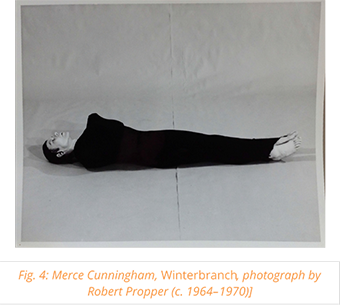
particularly eloquent. In figure 4 we see Cunningham lying prone in his
black tube, a flashlight protruding strangely from the wrap, thus
suggesting a curious displacement—yet lingering presence—of
the erotic drive.
As if to bring the point home, Cunningham produced with the
photographer Robert Propper a series of studio stills of Winterbranch in the late 1960s that underscore the mortuary,
religious, and even pornographic implications of falling. Studio shots
are in general an untapped but important source of information about
Cunningham’s dances, for they indicate how he wanted the dance to
be publicized, emblematized, and recalled. Those taken by Propper are
particularly eloquent. In figure 4 we see Cunningham lying prone in his
black tube, a flashlight protruding strangely from the wrap, thus
suggesting a curious displacement—yet lingering presence—of
the erotic drive.
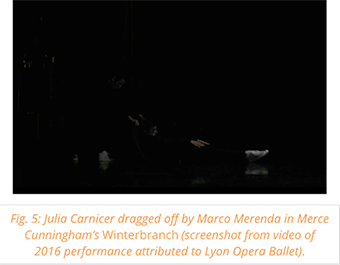
At no point in the dance does the male dancer lie in the position
Cunningham assumes for Propper’s photograph. However, near the
middle of the piece, a woman, lying still and prone on her back, is
indeed wrapped in one of the black carpets and dragged offstage by a
male partner (see fig. 5).
The studio still thus captures something central to the piece, not
“falling,” but rather the state of “having
fallen,” the weight of the stilled body as a material object
that, when presented on the stage, implies a narrative, a dramatic past
(“having fallen”). The question is, then, whether the
ethics of Cunningham’s dance should be located in what he
consistently represented as his refusal of symbolism, a resistance to
culturally over-determined meanings, or whether instead his ethics
inhere in both the movement and the presentation context, a
set of choreographic and staging decisions that at once confirm those
cultural meanings and put them to the test?
Part V. Conclusion: Winterbranch and the Ethics of Gesture
As in the example Agamben provides of the pornographic gesture suddenly
interrupted to expose its mediality, so too the gestures in Winterbranch expose their mediality, their quality as movement
support, while nonetheless retaining their connection to a frame, a
context, that suggests a way to interpret them. At times, Cunningham
seems to want to leave that frame behind, to remind us that the frame is a frame (not the “thing” itself), and even to
claim that it is ethical—or at least emancipatory—to do so.
And yet, I doubt Cunningham ultimately believed that it is either
ethical or emancipatory to seek to leave all frames behind, to suppress
all “particular forms” or “shapes,” to expose
the dancing “fact” as such. That would mean neglecting to
make a new continuity of the fragmented, disaggregated gestures with
which he worked (and he always emphasized with his dancers the need to
discover, in their own bodies, that new continuity); it would mean
suppressing the independence of the individual dancer who provides the
dynamic, the “shape,” the emotional color; it would mean
removing all scenographic choices and rejecting all studio stills in an
effort to keep the movement clean of context. If Cunningham sometimes
leaned in that direction, Winterbranch is clearly not an
example of that tendency.
Carolyn Brown hits the mark when she refers, in the passage quoted
earlier, to “the ethos of Winterbranch: darkness,
foreboding, terror, devastation, alienation, doom” (2007, 477).
Cunningham must have intuited that in 1964 it was time to produce a
more topical piece, to expose the fact that falling bodies are
eloquent, they are not just “facts” to be manipulated or
carted away. Winterbranch suggests that because we are human,
even simple shifts in weight can speak, can have something to
say—even if it is simply that the body is in danger of being
hurt. In that sense, Winterbranch is from beginning to end a
meditation on the body as a sensate, living organism subject to injury.
The pulley- and piston-like figures underscore the fragility of the
dancers as they lift and set one another down. The make-up Rauschenberg
devised for the dance points to the element of risk: the black smudges
under the eyes of the dancers at once protect them, literally, from the
blinding lights and suggest that vulnerability; the black smudges
recall to spectators the fact that the dancers, as sensate beings,
require protection. And this sense that dancers require protection
characterizes Cunningham’s approach to dance in general. He is
known to have adjusted his choreography—even if chance derived
and supposedly fixed—to prevent one dancer from colliding with
another, or to better control a lift. Choreography was always, for him,
a manifestation of care as well as an unfolding of the seemingly
impossible permutations suggested by chance. Thus it is not surprising
that elements of care are built into his technique. When I spoke to two
of the dancers cast to perform the phrase “leaning
towards,” Chiara Paperini and Tylor Galster, I learned that they
were both experiencing pain in their lower backs while performing the
hinge.[27] Trained
largely as classical ballet dancers, they were not used to executing
the kind of off-center hinges that are a primary building block of
Cunningham’s technique and choreographic vocabulary. During the
rehearsals Goggans, a seasoned Cunnngham teacher as well as dancer,
advised Paperini and Galster to make use of the muscles of the abdomen
to support the lower back in the hinge (as all Cunningham-trained
dancers learn in technique class). The care the dancers had to exercise
to protect their backs while performing the hinge must be considered a
significant part of the actualization of the dancing
“fact,” a component of its “shape” as
performed. It is precisely this aspect of the actualization that
constitutes what is gestural in the gesture: a sensitivity to the body
as a support, as a lived support. If Agamben and Cunningham
share an interest in the suspension of “communication” in
favor of “communicability,” if both view that suspension as
opening the ethical dimension, Cunningham adds a further element to
which he, as a choreographer and dancer, is acutely sensitive. That
element is the dancer’s own experience—as a medium, a
support for meaning, but also as a person living and shaping that
support-ness, that “media character,” on a stage.
The gesture in “leaning toward” that I interpreted as
protective demands focused concentration on the part of the dancer: she
must tighten the muscles of the abdomen, straighten the lower back, and
draw the sacrum in. To some extent, this skillful use of the muscles
becomes automatic over time; yet the effort involved always leaves a
trace in performance, what I have called elsewhere “the affect of
skill” (see Noland 2002, 120–35). This primary affect
already directs the gesture toward the pole of expression and meaning;
it gives the gesture its first shape, its first frame. Agamben shows
some sensitivity to this layer of lived experience when he writes in
“Le Geste et la danse” of “the dance of dancers who
dance on stage, the accomplishment of their skill as dancers and their power to dance as
power” (12; my emphasis). What Agamben refers to as the
dancers’s “skill as dancers” is not
“nakedness”; there is nothing pre-cultural or natural about
it (Cunningham in Vaughan 1997, 86). In fact, as an example of
technique it can be traced back to a very precise historical moment.
Dance technique, or skill, is a language; it is acquired, an
“accomplishment” that might, at times, afford an experience
of the “abyss.” It is the “linguistic” element
in gesture, a manifestation of our “linguistic nature,” or,
more precisely, of our natural disposition to be acculturated, to
acquire languages and skills, to become a vocal or gestural support for
signs. To stage this skill in its clearest form was always one of
Cunningham’s cherished goals—one could even say one of his
ethical goals. But skill is not the same thing as mediality “as
such,” or “expression as such,” or
“communicability” as “milieu pur.” Skill is
dirty and sweaty; it bears the marks not only of the person who attains
it but also of a specific training developed at a specific point in
time. As Winterbranch seems to insist, skill as exercised by a
dancer on stage is an invitation to a reading, an invitation to
interpretation, that, at certain historical junctures, it might be
unethical to ignore.
Winterbranch
can be said, then, to occupy one pole on a large spectrum of works in
Cunningham’s repertory, none of which—I maintain against
the grain—ever achieves, or could achieve, a display of energy in
its “naked” form. Winterbranch incessantly, even
doggedly, drags its gestures toward legibility, toward communication
and message, even as they are interrupted, suspended, exposed as the
instances of technique they also are. As in Agamben’s account,
the two orders—or extreme poles of the spectrum—co-exist:
the gesture is a sign (“communication”) and the gesture is
a support, a medium (“communicability”). The ethical
dimension is not opened, then, by seeking to suspend, to remain in an
“abyss” of endless mediality understood as a thing in
itself (“as such”). The ethical dimension is opened by
recalling that suspension is itself suspended, that we are
“condemned to meaning,” as Merleau-Ponty put it, and that
communication is a betrayal but also a chance. If at certain moments in
history it might be more ethical to press for the suspension of
semantics, even of expression, at others it might be more ethical to
emphasize the semantic and expressive weight a gesture can support.
There is ultimately no one way for art to be ethical, nor one way for
it to be political.[28]
It is impossible to ensure that a communication will be successful,
just as it is impossible to ensure that “nothing” will be
communicated at all. If the stage can display anything, it is that
fact.
Notes
[1] That Winterbranch was indeed a controversial work is
confirmed by the reviewers who saw it and the dancers who danced in
it. See, for instance, Arlene Croce (1968): audiences of Winterbranch “got restless, laughed, hissed,
yelled” (25); Don McDonagh (1970): “He shocked a dance
audience with his first solo recital in New York in 1944, then
later with ‘Sixteen Dances for Soloist and Company of
Three’ in 1951, and over a decade later in 1964 with
‘Winterbranch’” (33). See also Carolyn Brown
(2007): “Without question Merce’s work was the most
controversial of the season” (59).
[2] David Vaughan indicates that the last full performance of Winterbranch was in 1974 (see 1997, 293).
[3] Agamben (1999), thinking of Aristotle, calls this “linguistic
nature” our “factum loquendi.”
[4] As far as I know, Agamben has published only one essay (1997) on a
particular choreographer: Hervé Diasnas.
[5] See Noland (2009) for a discussion of André
Leroi-Gourhan’s Gesture and Speech and Marcel
Mauss’s “Techniques of the Body.”
[6] Gesture is thus to be understood as the alternative to an
“image,” a “reification and obliteration of a
gesture”. See Lucia Ruprecht’s brilliant consideration
of gesture as continuum versus gesture as arrest (2015), with which
the present essay is in dialogue.
[7] All translations are my own. It was thus published the same year as
the Italian version of “Notes on Gesture” as
“Note sul gesto,” in Trafic, 1992.
[8] See “Notes on Gesture” where Agamben describes how a
gesture is “stiffened and turned into a destiny” (53),
or where he speaks of the “mythical rigidity of the
image” (54).
[9] The passage reads: “It has precisely nothing to say because
what it shows is the being-in-language of human beings as pure
mediality” (Agamben 2000, 58); or elsewhere: “gesture,
having to express Being in language itself, strictly speaking has
nothing to express and nothing to say other than what is said in
language—gesture is always the gesture of being at a loss in
language” (Agamben 1999, 78).
[10] That “ethics,” “politics,” and
“gesture” all share a common semantic and philosophical
space in Agamben’s writing is verified by a quick glance at
“Notes on Politics,” which ends with an italicized
sentence we have already read in “Notes on Gesture”
(57); Agamben just replaces the word “gesture” with the
word “politics”: “Politics is the exhibition of a mediality: it is the act of
making a means visible as such” (2000, 115–116); original emphasis. Agamben is
drawing from Walter Benjamin's notion of politics, presented in
"What is Epic Theater?" (first version), as the act of making
appearance appear.
[11] Feeling and Form was translated into Italian in 1956 and 1970. Langer quotes Mary
Wigman’s “The New German Dance”: “The shape
of the individual’s inner experience [...] will also have the
unique, magnetic power of transmission which makes it possible to
draw other persons, the participating spectators, into the magic circle of creation” (1953, 23). Another
possible source is Walter Benjamin’s Notes aux Tableaux Parisiens, which Agamben cites in
“Pour une éthique du cinéma” (1992).
[12] Agamben’s understanding of the relation between gesture and
verbal language could be fruitfully compared to Maurice
Merleau-Ponty’s comments on the “geste
linguistique” (1945, 216–7).
[13] Agamben is alluding to Stéphane Mallarmé’s
“Mimique”: “un milieu, pur, de fiction” [a
milieu, pure, of fiction] (2003, 179). Citing loosely, Agamben
removes the comma between “milieu” and
“pur.”
[14] Cunningham makes some of his clearest statements about audience
reception in these interviews, which were first published in France
in 1980 and thus were probably recorded around 1979. “I
don’t think what I do is non-expressive,” he states,
“it’s just that I don’t try to inflict it on
anybody, so each person may think in whatever way his feelings and
experience take him” (Cunningham and Lesschaeve 2009, 106).
[15] Jill Johnston wrote in 1963, for instance, that
“Cunningham’s dances are still beyond the general
public because he doesn’t give the public anything literal to
hold onto. His dances are all about movement, and what you see in
them that relates to your common experience is your own business
and not his” (1963, 10). Likewise, Marcia Siegel wrote in
1971 that Cunningham “refuses to assume a metaphorical or
illusionary intent. In other words, his dancing is not about
something else” (1971, 471). Siegel’s approach changed
over time, but her early appraisals were shared by many, including
Roger Copeland who wrote 1979 that Cunningham’s work is
“virtually devoid of ‘expressive’ or symbolic
elements” (1979, 26); see also Susan Leigh Foster (1986). For
a subtle approach to expression in Cunningham, see Mark Franko
(1992).
[16] On Stéphane Mallarmé’s “milieu pur” as
a problematic notion for dance, see Frédéric Pouillaude
(2014, 118–21).
[17] Variations V (1965). For Collage (1952), working with untrained
performers, Cunningham made a gamut of simple task gestures.
[18] Cunningham began working on Winterbranch in 1963. The
dance constitutes the final chapter in a four-part series on the
seasons that he began almost a decade earlier: Springweather & People (1955); Summerspace (1958); Rune (the original title of which was Autumn Rune) (1959); and Winterbranch (1964). For
a more detailed account of how the dance was made, see Noland
(forthcoming).
[19] See also “Choreography and the Dance”: “I am more
interested in the facts of moving rather than my feelings
about them” (Cunningham 1970, 181).
[20] Other dances of the 1960s were studies in one of the eight
“facts in dancing”: Summerspace (1958), for
instance, is based on an exploration of the “Turn.”
[21] Speaking of RainForest Cunningham affirms: “Yes,
it’s a character dance and since such a dance is made
specifically on a given body, its flavor changes sharply when some
other dancer takes over the part” (Cunningham and Lesschaeve
2009, 113).
[22] A reviewer of Benjamin Millepied’s 2013 reconstruction of Winterbranch remarks on the “urban” noise and
the “headlights” that sweep the stage but does not
mention disasters or holocausts (2013). Audience members I
interviewed at the March 2016 performance in Lyon compared Winterbranch to a scene of post-nuclear disaster.
[23] Robert Rauschenberg and Jasper Johns were both present at Allan
Kaprow’s 18 Happenings in 6 Parts in 1966; even
earlier they kept abreast of works by Jean Tinguely, George
Maciunus, and others (see Lussac 2004).
[24] Winterbranch was performed in a few other Events without the original
scenography (1974; 1978); however, the fact that Cunningham later
made the choice to retain it indicates his awareness of a
possibility that extends to all his works—their integrity as
performances, as statements or mood pieces.
[25] The crawling, wriggling figure returns at the end of the dance; a
group of five dancers simultaneously fall to the ground then leave
the stage crawling on their back without the use of their hands,
their bodies covered almost entirely by one of the black rugs.
[26] The history of dance offers ample evidence that the fall has played
a primary role in the development of several modern dance
techniques: Doris Humphrey based much of her choreographic practice
on two central actions, “fall and recovery”; Laban was
fascinated by the body’s weight; and Graham explored the
effects of gravity on movement. Given the importance of the fall in
the history of dance, it is not surprising that Cunningham would
eventually take it up as a theme.
[27] A “hinge” requires a dancer to balance on the balls of
feet, heels held off the floor, while bending at the knee and
keeping the back in line with the hips and shoulders. A twisted
hinge, à la Cunningham, requires the dancer to simultaneously
twist the upper torso toward the side while maintaining the hips
straight in relation to the knees.
[28] See Rancière (2009) for a pertinent reflection on the politics
of meaning in art.
Works Cited
Agamben, Giorgio. 1992. “Pour une éthique du cinéma.”
Translated by D. Loayza. Trafic 3: 49–52.
———. 1996. Mezzi senza Fine: Note sulla Politica. Turin: Bollati Boringhiere.
———. 1997. “Le corps à venir.” Les Saisons de la Danse 292 (May): 6–8.
———. 1999a. “Aby Warburg and the Nameless
Science.” In Potentialities, translated by David
Heller-Roazen, 89–103. Palo Alto: Stanford University Press.
———. 1999b. “Kommerell, or on Gesture.” In Potentialities, translated by David Heller-Roazen, 77–85.
Palo Alto: Stanford University Press.
———. 2000. Means Without Ends. Translated by
Vincenzo Binetti and Cesare Casarino. Minneapolis: University of Minnesota
Press.
Banes, Sally. 1993. Democracy’s Body: Judson Dance Theater, 1962–1964.
Durham: Duke University Press.
Brown, Carolyn. 2007. Chance and Circumstance: Twenty Years with Cage and Cunningham.
New York: Knopf.
Cage, John. 1961. Silence. Middletown: Wesleyan University Press.
Chroniques d’un petit rat parisien
. 2013, 27 May. Accessed May 11, 2017.
http://www.leschroniquesdunpetitratparisien.com/tag/winterbranch/
Copeland, Robert. 1979. “Politics of Perception.” The New Republic, November.
Croce, Arlene. 1968. “Merce Cunningham.” Dance Perspectives 34.
Cunningham, Merce. 1968. Changes: Notes on Choreography. Edited by
Frances Starr. New York: Something Else Press.
———. 1970. “Choreography and the Dance.” In The Creative Experience, edited by Stanley Rosner and Lawrence E.
Abt. New York: Grossman.
———. n.d. “MGZMD 295.” Choreographic Records.
Jerome Robbins Collection, New York Public Library.
Cunningham, Merce, and Jacqueline Lesschaeve. 2009.
The Dancer and the Dance: Merce Cunningham in Conversation with
Jacqueline Lesschaeve. London: Marion Boyars.
Dalva, Nancy. 2005. “The Angle of Incident: The Merce Cunningham
Dance Company at the Joyce Theater.” DanceView 22 (1):
18–21.
———. ed. 2007. Green World. New York: Editions
2twice.
Duchamp, Marcel. 1975. Duchamp du signe. Edited by Michel
Sanouillet and Elmer Peterson. Paris: Flammarion.
Foster, Susan Leigh. 1986. Reading Dancing: Bodies and Dancing in Contemporary American Dance. Berkeley: University of California Press.
Franko, Mark. 1992. “Expressionism and Chance Procedure: The Future
of an Emotion.” Res: Anthropology and Aesthetics, 21
(Spring): 142–60.
https://doi.org/10.1086/RESv21n1ms20166846
Godard, Hubert. 1998. “La geste et sa perception.” In La danse au XXe siècle, edited by Isabelle Ginot and Michel
Marcel, 224–29. Paris: Bordas.
Hering, Doris. 1954. “Merce Cunningham and Dance Company.” Dance Magazine, February.
Johnston, Jill. 1963. “Cunningham, Limon.” The Village Voice, September 5.
Laban, Rudolf von. 1960. The Mastery of Movement on the Stage. 2nd
ed. London: MacDonald and Evans.
Langer, Susanne K. 1953.
Feeling and Form: A Theory of Art Developed from Philosophy in a New
Key. London: Routledge & Kegan Paul.
Levinas, Emmanuel. 1979. “Ethics of the Face.” In Totality and Infinity, edited by Alphonso Lingis, 197–200.
The Hague: Martinus Nijhoff.
https://doi.org/10.1007/978-94-009-9342-6
Lussac, Olivier. 2004. Happening & Fluxus. Paris:
L’Harmatton.
Mallarmé, Stéphane, 1842–1898. 2003. Oeuvres Complètes. Edited by Bertrand Marchal. Pléiade.
Vol. II. Paris: Gallimard.
Martin, John. 1950. “Litz, Cunningham Give Dance Solos.” New York Times, August 13.
McDonagh, Don. 1970. The Rise and Fall of Modern Dance. New York:
A Cappella Books.
———. 1976. The Complete Guide to Modern Dance.
New York: Doubleday.
Merleau-Ponty, Maurice. 1945. Phénoménologie de la perception. Paris: Gallimard.
Noland, Carrie. forthcoming. Merce Cunningham: After the Arbitrary. Chicago: Chicago University Press.
———. 2002. “Energy Geared to an Intensity High
Enough to Melt Steel: Merce Cunningham, Movement, and Motion
Capture.” Leonardo Electronic Almanac 17 (2): 120–35.
https://doi.org/10.5900/SU_9781906897161_2012.17(2)_120
———. 2009. Agency and Embodiment. Cambridge, MA:
Harvard University Press.
https://doi.org/10.4159/9780674054387
———. 2017. “Crises: Bound and Unbound.” In The Oxford Handbook of Dance and Reenactment, edited by Mark
Franko. Oxford: Oxford University Press.
Pouillaude, Frédéric. 2014.
Le désoeuvrement chorégraphique: étude sur la notion
d’oeuvre en danse. Paris: Vin.
Rancière, Jacques. 2009. The Emancipated Spectator.
Translated by Gregory Elliot. New York: Verso.
Reynolds, Dee. 2007.
Rhythmic Subjects: Uses of Energy in the Dances of Mary Wigman, Martha
Graham and Merce Cunningham. Hampshire: Dance Books.
Ruprecht, Lucia. 2015. “Gesture, Interruption, Vibration: Rethinking
Early Twentieth-Century Gestural Theory and Practice in Walter Benjamin,
Rudolf von Laban, and Mary Wigman.” Dance Research Journal
47 (2): 23–42.
https://doi.org/10.1017/S0149767715000200
Siegel, Marcia. 1971. “Dancing in the Trees and over the
Roofs.” The Hudson Review 24 (3): 466–75.
https://doi.org/10.2307/3849471
The London Times
. 1964. “American Choreographer’s Strangest Ballet,”
August 3.
Vaughan, David. 1997. Merce Cunningham: Fifty Years. Edited by
Melissa Harris. New York: Aperture.
Biography
Carrie Noland is Professor of French and Comparative Literature at the
University of California, Irvine. She is the author of Poetry at Stake: Lyric Aesthetics and the Challenge of Technology
(Princeton, 1999), Agency and Embodiment: Performing Gestures/Producing Culture
(Harvard, 2009), and Voices of Negritude in Modernist Print
(Columbia, 2015). She is also co-editor of two interdisciplinary
collections:
Diasporic Avant-Gardes: Experimental Poetics and Cultural Displacement
with Barrett Watten, and Migrations of Gesture with Sally Ann
Ness. At present, she is completing a manuscript entitled Merce Cunningham: After the Arbitrary (forthcoming from Chicago
University Press).
© 2017 Carrie Noland
Except where otherwise noted, this work is licensed under a Creative Commons Attribution-NonCommercial-ShareAlike 4.0 International License.