Introduction: Towards an Ethics of Gesture
Lucia Ruprecht, Emmanuel College, University of Cambridge
‘The gesture is the exhibition of a mediality: it is the process of
making a means visible as such. It allows the emergence of the being-in-a-medium of human beings and
thus it opens the ethical dimension for them’, Giorgio Agamben
writes in his Notes on Gesture (2000a, 58).[1]
This special section of Performance Philosophy takes
Agamben’s statement as a starting point to rethink the nexus
between gesture and ethics. While both are bound together here, their
association is not evident at first sight. What is an ethical gesture
if we assume that ethics concerns a good ‘way of being, […]
a wise course of action’, which is the Greek definition? Or, if
we go with the moderns, when we take it that ‘ethics is more or
less synonymous with morality’, with ‘how subjective action
and its representable intentions’ relate to a ‘universal
Law’, as in Immanuel Kant (Badiou 2001, 1–2)? What is such
a gesture if we understand by ethics, with Alain Badiou, a specific
relationship between subjective action and the extraordinariness of
what this philosopher calls ‘the event’—that
is, a ‘fidelity’ to particular, radical experiences of art,
science, politics, and love (67)? What might a Levinasian gestural
ethics look like, one that is grounded in the immediacy of an
‘opening to the Other’ which disarms the reflexive subject
(19)? Gesture has indeed been described as an opening of the body
beyond itself, as something that is often, or perhaps even necessarily,
relational. In her Inclinations: A Critique of Rectitude
(2016), Adriana Cavarero develops a decidedly gestural ethic which is,
as the title suggests, based on the posture of inclination: a bending
of the body towards those who are vulnerable and dependent, and whose
need of protection is as actual and given as that of a child. More
generally, it has been argued that the body in gestures is
‘attracted by the world, by an already existing object, by the
achievement of a future action that I can already perceive’, and
so is suspended vis-à-vis its opposite at a distance that allows a
specifically gestural ‘tension’ to ‘flourish’
(Blanga-Gubbay 2014, 125, 127). This implies that gesture often avoids
touch—although it may not exclude it—and thereby foregoes
the possessiveness of the haptic (Mowat 2016).
The ethical is tied to action and acting, to the ways in which one
conducts one’s life.[2]
Despite its diverse conceptualisations in the history of philosophy,
current understanding of the topic in cultural theory tends to rest on
a distinction between moral codes and ethics, which has found one of
its most acute formulations in the twentieth century in Michel
Foucault’s genealogical project.[3]
James Laidlaw describes it succinctly:
Foucault distinguishes between what he calls moral codes—rules
and regulations enforced by institutions such as schools, temples,
families and so on, and which individuals might variously obey or
resist—and ethics, which consists of the ways individuals might
take themselves as the object of reflective action, adopting voluntary
practices to shape and transform themselves in various ways […].
Ethics, including these techniques of the self and projects of
self-formation, are diagnostic of the moral domain. (2014, 29)
The gestural, by contrast, seems to come into its own where it departs
from what is usually considered manifest action, where it is taken out
of the functionality of an ‘operational chain’ (André
Leroi-Gourhan) to assume expressive or pantomimic power. Expressivity,
however, is only one element of gesturality, and functionality can be
handled creatively. As Asbjørn Grønstad, Henrik Gustafsson,
and Øyvind Vågnes outline in the introduction to their recent
collection Gestures of Seeing (2017), Vilém
Flusser’s influential theory of gestures distinguishes between
‘good and bad gestures’ in relation to how they interact
with a given apparatus, for instance the camera.[4]
Bad gestures, in this setting, follow the camera’s presumed
rules; good gestures imply ‘the active resistance of the
photographer to become a function of the apparatus she uses. The
gesture of photography, then, is an effort of resistance against the
apparatus (the program or code) by using it in ways not intended or
imagined by its inventors’ (2). Agamben’s expanded use of
the term apparatus thus seems to be in (unacknowledged) conversation
with Flusser. He writes: ‘I shall call an apparatus literally
anything that has in some way the capacity to capture, orient,
determine, intercept, model, control or secure the gestures, behaviors,
opinions or discourses of living beings’; and Flusser’s
effort of resistance returns in Agamben’s ‘hand-to-hand
combat with apparatuses’ to bring back to ‘common
use’ that which ‘remains captured and separated’ in
them (Agambem 2009, 14, 17). By differentiating ‘good’ from
‘bad’ modes of technical interaction, Flusser declares
photography to be an ethical (and indeed also philosophical) practice.[5]
He conceives of gesture as a ‘movement’ of good usage that
cannot be ‘objectively explained by [its] purpose or
function’: it ‘expresses the freedom to act and
resist’, in order to ‘truly communicate’
(Grønstad et al. 2017, 1). ‘To understand a gesture defined
in this way’, Flusser (2014) argues, ‘its
“meaning” must be discovered. […] The definition of
gesture suggested here assumes that we are dealing with a symbolic
movement’ (3).
The gestures of photography will recede, in the following, behind those
of film, dance, performance art, and philosophical discourse. But even
if photography is not one of the central media in this enquiry,
Flusser’s account of it advances our argument by thinking
together expression, communication, and action: we do things with gesture. That which has been introduced above
as gesture’s abstaining from (haptic) acting must, then, be
qualified. As the following contributions will amply demonstrate,
gesture—whether it is considered within or beyond the paradigm of
expression—does not evade the act; it possesses an agency that
might be called acting otherwise. It is in the forms, kinetic
qualities, temporal displacements, and calls for response which this
acting-otherwise entails that a gestural ethics takes shape. In other
words, gestures can act ethically as they en-act what they name, even
if their naming must always remain contested. Carrie Noland (2009)
argues that a gesture is a performative: ‘it generates an
acculturated body for others—and, at the same time, it is a
performance—it engages the moving body in a temporality that is
rememorative, present, and anticipatory all at once’ (17).[6]
As Rebecca Schneider will show, this temporality of gestural
performance is also reiterative and citational, bearing a capacity for
bringing back that which has been enacted before, but also enabling
reformulation and difference. Focusing on gesture’s
relationality, Schneider introduces a decidedly ethical slant to
political discussions of reiteration.
Despite the fact that the contributors to this special section do not
necessarily share the same definitions of gesture, a focus on the
ethical potential of gestural acts as singular instances of physical,
filmic and writerly performance unites their approaches. All of them
tease out the ethics of the works and acts that they address: dances by
Ted Shawn (Alexander Schwan) and Merce Cunningham (Carrie Noland),
films by François Campaux (Astrid Deuber-Mankowsky), John Ford,
George Stevens, and Clint Eastwood (Michael Minden), gestures of hail
and of political protest (Rebecca Schneider), and gestures of
philosophical criticism in Walter Benjamin (Mark Franko).
Indeed, all authors also trace, what Laura Cull (2012) in her Deleuzian
exploration of the immanent ethics of theatre calls, an ethical feeling
of ‘respectful attention’ or ‘attentive
respect’ in their various objects of enquiry (237).[7]
Gesture emerges more broadly as the gesturality of dance or as a
gestural mode of thinking and writing, and more narrowly, in specific
instances of expressive or functional movement, or of movement that
hovers at the cusp between the narrative and the non-narrative.
The following will both introduce the argument of each of the
contributors and continue to develop some of the overarching questions
posed by our collaborative investigation of the ethics of
gesture—what it might mean, what it might look like, and what it
might do. Along the way, I will discuss two highly gestural video
installations by Danish artist Joachim Koester,The Place of Dead Roads (2013) and Maybe this act, this work, this thing (2016), which serve as
performed commentaries on the questions at hand.
Gesture, Potentiality, and Act in Agamben
To return to Flusser for a moment: His pictures are produced by a
photographer who communicates a subjective position in the shape of a
philosophical idea by leaving a kind of ‘fingerprint’ on a
surface (2011, 286). In Flusser, it is precisely the communication of
this intention which turns the activity of taking a photograph into a
gesture. He thus subscribes to a theory of expression that Agamben in
his understanding of gesture actively negates. Rethinking entirely
‘our traditional conception of expression’ (2002, 318),
Agamben’s gestures do not have any circumscribed intention. What
they communicate is ‘communicability’ (2000a, 59), the
dwelling in language of human beings. Agamben’s turn towards
mediality in his ‘Notes on Gesture’ has been much discussed
(see Grønstad and Gustafsson 2014), and will be productively
reread and probed with regard to filmic, dancerly and critical
performances in several of the following contributions. I will not
therefore go back to the essay’s argument in any detail here, but
will highlight one of its ethical concerns: that it is the emptying-out
or, with Simone Weil, ‘decreation’ (Saxton 2014, 62) of
meaning that frees gesture to become a carrier of potentiality; which
is, in Agamben, the condition for ethical choice. ‘The point of
departure for any discourse on ethics is that there is no essence, no
historical or spiritual vocation, no biological destiny that humans
must enact or realize’, he writes in The Coming Community (1993). ‘This is the only
reason why something like an ethics can exist, because it is clear that
if humans were or had to be this or that substance, this or that
destiny, no ethical experience would be possible—there would be
only tasks to be done’ (43).[8]
Where, then, is the place of the act in Agamben’s ethics of
potentiality? In the epilogue to The Use of Bodies (2016), the
ninth and final instalment of the Homo Sacer project, entitled
‘Toward a Theory of Destituent Potential’, Agamben explains
the relation between potential and act in Aristotle:
Potential and act are only two aspects of the process of the sovereign
autoconstitution of Being, in which the act presupposes itself as
potential and the latter is maintained in relation with the former
through its own suspension, its own being able not to pass into act.
And on the other hand, act is only a conservation and a
‘salvation’ (soteria)—in other words, an Aufhebung—of potential. (267)[9]
The operationality of Aristotle’s ‘potential/act
apparatus’ (276), however, must be interrupted to reach the
destituent potentiality towards which Agamben’s epilogue is
geared. What does Agamben mean by destituent potentiality? He uses the
term ‘destituent’ for grasping the paradoxical nature of
‘a force that, in its very constitution, deactivates the
governmental machine’ (2014, 65). This force does not simply
destroy a power or a function, but liberates ‘the potentials that
have remained inactive in it in order to allow a different use of
them’ (2016, 273). He conjures up a situation where potential
becomes a ‘constitutively destituent’
‘form-of-life’ (277):[10]
a ‘properly human life’ (277) from which, quoting Spinoza,
a ‘joy’ is born, where ‘human beings contemplate
themselves and their own potential for acting’ (278). Agamben
links destituent potentiality to a process of rendering inoperative or
neutralising operations in order to expose them, which is echoed in the
emptying-out of meaning that frees gesture to appear as such, and to
become a carrier of potentiality. Such destitution attempts to think an
act that does not act, or a non-act that acts: a (de)act(ivat)ing,
perhaps; or an acting-otherwise.[11]
The destituent is connected in Agamben to the advent of various kinds
of newness. With reference to Benjamin’s ‘Critique of
Violence’, the new emerges in the shape of the ‘proletarian
general strike’ (269): ‘“on the destitution [Entsetzung] of the juridical order together with all the
powers on which it depends as they depend on it, finally therefore on
the destitution of state violence, a new historical epoch is
founded”’ (268). With reference to Christ’s
deposition from the cross, the new emerges in the shape of redemption:
‘in the iconographic theme of the deposition […] Christ has
entirely deposed the glory and regality that, in some way, still belong
to him on the cross, and yet precisely and solely in this way, when he
is still beyond passion and action, the complete destitution of his
regality inaugurates the new age of the redeemed humanity’ (277).
With reference to the imagined politics that is intimated at the end of The Use of Bodies, destitution emerges, finally, in the shape
of a ‘constituted political system’ that embraces within
itself ‘the action of a destituent potential’, for which
[i]t would be necessary to think an element that, while remaining
heterogeneous to the system, had the capacity to render decisions
destitute, suspend them, and render them inoperative. […] While
the modern State pretends through the state of exception to include
within itself the anarchic and anomic element it cannot do without, it
is rather a question of displaying its radical heterogeneity in order
to let it act as a purely destituent potential. (279)
The vocabulary of contemplation, exposure, and display that informs the
preceding discussion leads us back, then, to the realm of the ethics of
(gestural) art, which (together with politics, in Agamben) names
‘the dimension in which works—linguistic and bodily,
material and immaterial, biological and social—are deactivated
and contemplated as such in order to liberate the inoperativity that
has remained imprisoned in them’ (278). Inoperativity is
associated with the energies of ‘anomie’ and of an
‘anarchic potential’ (273), that which is without law,
command or origin; that is—to draw on Agamben’s gestural
understanding—without pre-given meaning.[12]
Gestural acting-otherwise certainly includes strategies that, by making
given gestural routines inoperative, opens up a space for experiment,
improvisation, reflection, and the new. While anarchic and anomic
elements—from the resignification to the running wild of
gestures—do appear in the following case studies,
acting-otherwise is only partly characterised by such excessive forms
of inoperability. Often, subtler ways of modifying the operative
continuum will come to the fore, such as: the detaching of gestures of
violence from their usual ends, as in Koester’s The Place of Dead Roads; the delicate filmic
defamiliarisation, through slow motion, of the process of applying a
brush stroke, as Deuber-Mankowsky shows; or the rhythmical punctuation
of the continuum of thought with caesuras in Benjamin’s
‘physiological’ style, as traced by Franko. Noland’s
suggestion to consider gestural agency as ‘differential rather
than oppositional alone’ is path-breaking here, as it allows us
to study ‘a whole range of deviations from normative
behaviour—from slight variation to outright rejection—while
simultaneously construing the normative as equally
wide-ranging in its modes of acquisition’ (2009, 3).
Gestural Acting-Otherwise
Alexander Schwan’s essay ‘Ethos Formula: Liturgy and
Rhetorics in the Work of Ted Shawn’ (2017) opens this special
section by exploring forms of gestural normativity and ‘spiritual
vocation’ that fall to the wayside in Agamben’s gestural
ethics. Addressing how such gestural normativity is not only acquired,
but passed on through ethical attitudes ‘encoded’ in
movement patterns, Schwan turns to the other side of Agamben’s
self-reflexive modernism, exemplified by Ted Shawn’s liturgical
dances. With a head-nod in the direction of Aby Warburg’s pathos
formulae, Schwan suggests using the term ‘ethos formulae’
for postures and gestural routines which are ‘motivated by
decision-making rather than emotional content’’, while
still retaining a relationship with a form-giving or task-setting law.
Shawn’s choreographic aesthetics—or in fact,
ethics—is set within the greyzone between liturgy and modernist
dance and thus proves to be a rich ground for ethos formulae.
Influenced both by François Delsarte’s nineteenth-century
system of gestural meaning-making and his own Methodist background,
Shawn’s choreographic ‘decisions’ were guided by the
gestural ‘tasks’ which they carried out, and the
codifications which they performed. If gestures, as has been argued
above, can act ethically as they en-act what they name, Shawn made sure
that this ‘naming’ remained recognisable:
Standing upright and having his hands folded in front of his solar
plexus, he opened his arms slowly and symmetrically, raising them to a
point where his fingers still pointed to the ground and his open palms
reached towards the audience in a gesture of devotion, greeting and
blessing. (Schwan 2017, 32)
Moving from the gestural rhetoric of liturgy to that of the Western,
forms of generic recognisability are at stake in Michael Minden’s
essay too. His ‘Ethics, Gesture and the Western’ (2017)
begins with a brief discussion of Koester’s The Place of Dead Roads, which I would like to address in more
detail before turning to Minden’s argument. Koester’s
installation presents a group of four androgynous dancers in
nineteenth-century cowboy gear who are engaged in an apparently
involuntary, almost feverishly obsessive pantomimic reenactment of the
stock postures, gestures and moves of the Western genre: they eye and
circle each other chins down, launch into chimeric gun battles, revolve
as if lassoing, bounce as if riding a horse, convulse as if being hit
by a bullet or even ‘step-dance as if having their feet shot at
in the saloon’ (Börcsök 2017).
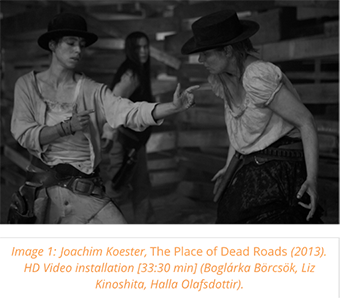 Sometimes, the recognisability of their moves is not so much a matter
of the latter’s mimetic shapes than of their ‘effort
quality’, to use Rudolf von Laban’s term: it is with
abruptness that the dancers swing around or stop and start movement
sequences, reminding us of the hypervigilance and the speedy reactions
of gunfighters. One description speaks of a deconstruction of the Wild
West’s ‘ritualised gestures’ (Camden Arts Centre
2017), pointing up the fact that the choreography (which was created by
Koester together with the striking performers Pieter Ampe,
Boglárka Börcsök, Liz Kinoshita and Halla Olafsdottir)
takes generic gestures out of their embedding in a plot structure. It
also takes them out of their usual gender assignment, as each dancer
enacts a vocabulary that would be considered largely masculine within
the genre-framework. At the same time, displacements of genre
vocabulary across body parts produce cross-over genderings: the
circling wrist movement of (a man’s) lassoing returns in the
undulations of a woman’s hips. For Noland, gesturality consists
not least in the fact that ‘movements of all kinds can be
abstracted from the projects to which they contingently belong’,
so that, ‘accordingly, they can be studied as both discrete units
of meaning and distinct instances of kinesis’ (2009, 6).
Koester’s video installation incites this kind of study. Detached
from their sites and props, from their usual operationality and from
narrative context, his gestures are performed in a space that is
similarly abstracted, segmented by loosely mounted wooden walls which
suggest make-shift cabins. The soundscape is denaturalised, amplifying
the inhales and exhales of breath, the shuffling of feet, and muffled
blows. A form of muffling also affects the field of the visual, with
the dancers moving in and out of shallow zones of focus, and even
moving in and out of camera frames, as if each medium shot defined a
new stage-like square.
Sometimes, the recognisability of their moves is not so much a matter
of the latter’s mimetic shapes than of their ‘effort
quality’, to use Rudolf von Laban’s term: it is with
abruptness that the dancers swing around or stop and start movement
sequences, reminding us of the hypervigilance and the speedy reactions
of gunfighters. One description speaks of a deconstruction of the Wild
West’s ‘ritualised gestures’ (Camden Arts Centre
2017), pointing up the fact that the choreography (which was created by
Koester together with the striking performers Pieter Ampe,
Boglárka Börcsök, Liz Kinoshita and Halla Olafsdottir)
takes generic gestures out of their embedding in a plot structure. It
also takes them out of their usual gender assignment, as each dancer
enacts a vocabulary that would be considered largely masculine within
the genre-framework. At the same time, displacements of genre
vocabulary across body parts produce cross-over genderings: the
circling wrist movement of (a man’s) lassoing returns in the
undulations of a woman’s hips. For Noland, gesturality consists
not least in the fact that ‘movements of all kinds can be
abstracted from the projects to which they contingently belong’,
so that, ‘accordingly, they can be studied as both discrete units
of meaning and distinct instances of kinesis’ (2009, 6).
Koester’s video installation incites this kind of study. Detached
from their sites and props, from their usual operationality and from
narrative context, his gestures are performed in a space that is
similarly abstracted, segmented by loosely mounted wooden walls which
suggest make-shift cabins. The soundscape is denaturalised, amplifying
the inhales and exhales of breath, the shuffling of feet, and muffled
blows. A form of muffling also affects the field of the visual, with
the dancers moving in and out of shallow zones of focus, and even
moving in and out of camera frames, as if each medium shot defined a
new stage-like square.
If the physical vocabulary of the Western is thus derealised and
exposed in its dance-like gesturality, the mechanically repetitive
performance of the dancers also exhibits the automatism with which
gestural regimes enter bodies, especially when automatic reaction is a
matter of survival in violent encounter. Koester refers to such
automatisms when speaking of a gestural move that he and the performers
called the ‘electric gun’, which they defined as an
‘electric current connected to holding a gun which would cause
the hand, the arm and sometimes the whole body to shake and
vibrate’ (Koester 2017b). Not only are bodies shown to be
radically immersed in and driven by their motor actions, we also get
the impression that many of their strategic moves are always already
infected by the tremors of combat trauma. This automatic gesturality
undergoes subtle changes in the course of the film, which is looped
indefinitely in the gallery space. Sequences where the dancers perform
the expected (if defamiliarised) score build up towards less
painstakingly executed, less obviously scripted and more anarchic
passages. Described by Koester as instances of a ‘happy
dance’ that ‘can be seen as an attempt to end the spell of
historic violence’ (2017a), these sequences constitute passages
of unleashed gestural force, moments of gestural recovery which at the
same time resemble gestural crises. Agamben’s fairly clear-cut
dialectic of gestures lost and regained (see Agamben 2000a) is
complicated here: While the bodies of the performers are bound up
within functioning representational patterns as long as they follow the
guiding rhetoric of the Western, they are performed by the
gestural vocabulary which they use; once they start performing
their own gestures, they cease to signify.
In an essay on contemporary Flemish dance, Rudi Laermans (2010)
describes such passages into non-signification with recourse to Agamben
as a foregrounding of ‘the body as a medium of non-verbal
expressivity that becomes notable as such only when the will to express
something is hampered by the very same body’ (411).[13]
This aesthetic of ‘gesturing dance’ variously discloses
‘the performing body as a failing medium of expressivity’,
one that paces out ‘the very limits of the body as a medium of
communication and representation, while still not giving up an
underlying sense of humanism’, or focuses on ‘the
borderline zone where physicality becomes expressive but does not yet
fully represent something. The very presence of the moving body then
crosses out its unavoidable “being in representation” when
performing in front of an audience’ (411–412). The Place of Dead Roads belongs on this terrain of gesturing
dance. Its choreographic oscillation between representationality and
non-representation thrives in the liminal spaces between the operative
and the inoperative, the scripted and the non-scripted. It derives its
ethics from the attentiveness and the reflectiveness with which it
crosses from one side to the other, or lingers on the various degrees
of entanglement between the two.
It is important to note that the muscular reactions, which have entered
the bodies’ neurophysiological set-up and form their motoricity,
are tied in Koester’s video installation to a history of
violence. By mimicking, rather than enacting, aggressive and defensive
moves—‘the performers never touch the revolvers they wear,
despite their obsessive miming of the gestures of aiming, shooting
etc’., writes Minden (2017, 40)—by in fact turning
functionally motivated movement into gestural movement, this history of
violence is placed at one remove, and finally interrupted when the
dancers slip into non-signification. What returns at this point is a
gestural acting-otherwise that abstains from launching into the
fully-fledged haptics of (violent) action. No longer-operational
movement is put to new use as gesture. The ethico-critical impact of
Koester’s work, then, participates in a genealogy that goes back
to Bertolt Brecht and Walter Benjamin. In her recent rereading of the
second version of Benjamin’s essay on Brecht’s epic
theatre, Judith Butler emphasises how gesturality, in this tradition,
can be defined as abstention from violent deed. Butler focuses on a
scene which Benjamin uses to explain how interruption becomes a
precondition for the production of gestus, and thereby for
discovering—in the sense of relearning to see, and possibly
change—the ‘conditions of life’ (Benjamin 1982, 152).
It is a scene from the stock elements of melodramatic middle-class
family drama in which the sudden entrance of a stranger prevents the
mother from hurling a bronze bust at her daughter, and the father from
calling a policeman from the open window. ‘Benjamin stops the
scene quite suddenly’, Butler (2015) writes,
giving us only the gesture, the frozen image, but not the act of
violence itself.
The gesture, then, functions as the partial decomposition of the
performative that arrests action before it can prove lethal. Perhaps this kind of stalling, cutting, and stopping establishes an
intervention into violence, an unexpected nonviolence through an
indefinite stall, one effected by interruption and citation alike. In
other words, the multiplication of gestures makes the violent act
citable, brings it into relief as the structure of what people
sometimes do, but does not quite do it—relinquishing the
satisfaction of the complete act for what may prove to be an ethos of restraint [my emphasis], if not a critical act of
nonviolence. (41)
Minden observes such an ethos of restraint in the John Wayne
character’s iconic lifting of his niece towards the end of John
Ford’s The Searchers, characterising it as a gestural
moment ‘in which a stronger person forbears from violence’
and ‘dominance’ (42). While literally stalling or foregoing
cruelty, moments like these also reflect back on gesturality as such,
drawing attention to its foregoing of the (possibly violent) act. But
Minden also addresses violence head-on. He joins Agamben in thinking
about gesture as a formal frame for communicability, and he relates
this to the similar function of genre. Even though few genres might be
more ‘generic’ than the Western, Minden argues, genre here
does not necessarily mean ‘destiny’ (Agamben 1993, 43).
Therefore, it does not have to be broken or ‘subverted’,
but should be considered a potentiality within which there are spaces
for ethical reflection. If genre thus provides the conditions for
communicability—for telling a story—its exposure of its own
narrative structures draws our attention to its intrinsic ethical
potential. As Minden shows, such an instance of exposure—or
‘exploitation’ (46)—of genre at the climax of Clint
Eastwood’s 1992 Unforgiven opens violence to
philosophical reflection by making ‘explicit’ and leaving
‘unresolved’ the Western’s ‘violent
payback’ formula (David Foster Wallace cited in Minden 2017, 48).
To come back to Agamben’s wording in The Use of Bodies,
the incommensurate or exceptional quality of the violent bloodbath that
takes place at the end of Unforgiven—its
‘anarchic’ and anomic nature—is removed from its
inclusion/exclusion within the establishment of justice, to be
displayed in ‘its radical heterogeneity’. Its ethical
appeal then consists in the fact that it acts indeed, despite its
manifest nature, ‘as a purely destituent potential’ (2016,
279). Fulfilling with hyperbolic excess and thereby at once remaining
within and deactivating generic demands, haptic violence itself becomes
gestural.
Astrid Deuber-Mankowsky’s essay ‘The Paradox of a Gesture,
Enlarged by the Distension of Time: Merleau-Ponty and Lacan on a
Slow-Motion Picture of Henri Matisse Painting’ (2017) leaves
Agamben behind, to address little-discussed gestural thinking in Lacan,
in juxtaposition to Merleau-Ponty and Benjamin. Deuber-Mankowsky
provides a close reading of Merleau-Ponty’s and Lacan’s
reactions to a slow-motion sequence of Matisse painting, shot in 1946
by François Campaux. Addressing how Merleau-Ponty and Lacan read
the minute hesitations of Matisse’s hand, Deuber-Mankowsky argues
for a gestural ethics that is rooted not so much in the
phenomenological body (as in Merleau-Ponty) or in the self’s
implication in its foundational relationship to a
‘gesturally’ organic unconscious (our relationship
‘to the organ’ [62], as in Lacan), but in the experimental
setting of the filmic medium: Benjamin’s technologically enhanced
‘room for play’ (Spielraum). This room for play is
characterised less by resistance against or combat with the apparatus,
as in Flusser and Agamben, but by the latter’s use as creative
and heuristic tool. Theodor W. Adorno, Deuber-Mankowsky reminds us,
took the technological dimension of this room for play seriously, and
saw its influence on literature too. He criticized Benjamin for linking
it, in his work on Kafka, to a Brechtian theatrical aesthetic rather
than a cinematic one. Adorno himself thought of Kafka’s gestures
as akin to the aesthetic of the silent movie (see Adorno 2001, 70),
situating them in the historical context of a modernist crisis of
representation that was perceived to be marked, not least, by a
‘dying away of language’. The specific animation or
life-force of Kafka’s gesturality, Deuber-Mankowsky argues, thus
appears to be infused with the technological energy of media of
reproduction, whose ‘rhythm […] reappears in gesture as a
trembling’ (63). Think, for instance, of the quivering élan
of ‘Desire to be a Red Indian’ (Wunsch, Indianer zu werden), or of the larger oscillations of
the two ‘gestural’ celluloid balls in ‘Blumfeld, an
Elderly Bachelor’ (Blumfeld, ein älterer Junggeselle), pointing up the dynamic (and
material) quality of the filmic medium.[14]
Gesture, here, becomes one of the fulcra of media change, and it is its
very embodiedness that allows it to do so. In the case of Kafka,
literary gesturality achieves a seismographic quality, one which is
reflective not only of the fact of a media revolution, but also of this
revolution’s not yet entirely firmed-up technicity; of a rhythm
that is not yet always, and in every instance, effortless. The
typically mechanical quality of the gestures that Kafka observes, that
he notes down in his diaries, and that serve as inspiration for the
bodily conduct of his protagonists often gives rise to the impression
that its functionality is in danger. In his Paris travel diary of 1911,
Kafka (1964) describes a man and two women in a hotel lobby: the
man’s ‘arm continually trembled as if at any moment he
intended to put it out and escort the ladies through the centre of the
crowd’. A few pages later we read about the less formal etiquette
of the brothel visit—where a gap-toothed ‘[girl]’ was
‘[a]nxious lest I should forget and take off my hat’ (456,
459). In his diary accounts of social gestures, Kafka notices moments
where codes of conduct draw special attention to themselves. They are
not naturally enacted—or avoided—but affected by a specific
kind of stress that bears on the potential of social automatisms to
fall out of kilter at any moment, making inoperative too, perhaps, the
conventionalised ‘busy-bodyness’ (Santner 2015, 102) which
they sustain. Butler considers this a kind of psychosocial dysfunction
with an implicit potential for transformation when she writes:
for the most part mechanical tends to be associated in popular language
with automatic, yet every mechanism has within itself the possibility
of not quite working as smoothly as it should. So though the mechanism
is governed by the reproduction of social relations through the
reproduction of the subject, there is sometimes “play” in
the mechanism, which means that it can veer in a different relation, or
it can, indeed, fall apart and fail to reproduce in the way for which
it is designed. Most of Kafka’s efforts to treat the mechanical
foreground this constitutive possibility of breakdown, or malfunction.
(Butler 2015, 23–24)
Technicity, in this context, is not just an indicator of shaky or
alienating rationality, or of hyper-intellectual
‘cybernetics’, as in Merleau-Ponty. The technical is also
defined by a ‘productivity’, as Deuber-Mankowsky writes,
which ‘revolutionizes not only perception, but the very relation
between the subject and knowledge’ (62).
Koester’s video installation Maybe this act, this work, this thing, showcases this immense
promise of a filmic room for play, but also a sense of limitation or
malfunction in the shape of a certain gestural stress. Maybe this act is set in the very same turn-of-the-century
media revolution, as the writing of Benjamin and Kafka. It features two
dancers whose costumes indicate their association with the vaudeville
tradition in a stylised way, reenacting rather than reconstructing the
slightly worn glamour of pre-twentieth-century performance
practitioners. Koester’s film, the descriptive material argues,
conveys the advent of cinema through the bodies of vaudeville
performers. Mimicking the apparatus of a new world that threatens their
livelihood as stage actors, they simulate shutters of cameras and
projectors, quivering electricity and the whirring celluloid. Their
movements are amplified by the sounds of their heels hoofing, limbs
shuffling and voices muttering with a sense of desperate urgency that
echoes the cultural revolution that dawned with the film industry.
(Camden Arts Centre 2017)
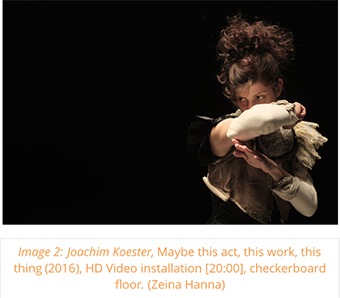 Despite this situation of endangerment, the choreography also conveys
that the unfamiliar, different and expanded gesturality of the
apparatus enters the body in creative ways; it is productive of a new
kinaesthetic. Maybe this act is performed by Boglárka
Börcsök and Zeina Hanna, and choreographed by Liz Kinoshita
(both Börcsök and Kinoshita were also involved in The Place of Dead Roads). Börcsök’s webpage
includes an early draft by Koester that suggests a séance in which
the performers become spiritualistic ‘media’ for the new
medium of film: ‘They are channeling the spirit(s) of the newly
developed cinematic apparatus, miming the machine, embodying the
machine. As the spirit(s) enter they are transformed into cogs and
wheels and moving belts. […] Their movements are accompanied by
occasional moaning; like squeaks of metal and sizzling of hard
rubber’ (Börcsök 2017). Over the course of its
creation, however, the performance began to incorporate more agency:
the performers, Koester writes, are in fact ‘working on a new act
in a dimly-lit theater’ (STUK 2017), and do not seem to be in a
permanent state of possession, but of fine-tuned perceptiveness and
concentration. We are witnessing a rehearsal situation, where the
dancers are trying out poses—maybe this one, maybe
that—whispering to themselves, ‘marking’, that is,
suggesting gestural movement sequences instead of performing them to
completion. Rehearsing and working-towards become the (ethical) act in
this video installation. More casual, explorative passages are set off
against more frantic ones; routines are occasionally
metaphorical—such as a short tap dance section, or a brief
gesture of introduction, hands on lapels, mouth whispering ‘here
we are’—but more often metonymic—in other words,
suggesting a contiguity between body and filmic
apparatus—shoulders shuddering, fingers flickering, forearms
cutting squarely through the air. If Adorno (1996) writes
pessimistically in Minima Moralia of technology’s impact
on our ‘most secret innervations’, that it is making
gestures ‘precise and brutal’, expelling from movements all
‘hesitation, deliberation, civility’ (40), Koester opens up
a counter-vision, ‘an alternative space of possibility through
technologies, bodies and minds’ (STUK 2017), which is a space of
gestural room for play.
Despite this situation of endangerment, the choreography also conveys
that the unfamiliar, different and expanded gesturality of the
apparatus enters the body in creative ways; it is productive of a new
kinaesthetic. Maybe this act is performed by Boglárka
Börcsök and Zeina Hanna, and choreographed by Liz Kinoshita
(both Börcsök and Kinoshita were also involved in The Place of Dead Roads). Börcsök’s webpage
includes an early draft by Koester that suggests a séance in which
the performers become spiritualistic ‘media’ for the new
medium of film: ‘They are channeling the spirit(s) of the newly
developed cinematic apparatus, miming the machine, embodying the
machine. As the spirit(s) enter they are transformed into cogs and
wheels and moving belts. […] Their movements are accompanied by
occasional moaning; like squeaks of metal and sizzling of hard
rubber’ (Börcsök 2017). Over the course of its
creation, however, the performance began to incorporate more agency:
the performers, Koester writes, are in fact ‘working on a new act
in a dimly-lit theater’ (STUK 2017), and do not seem to be in a
permanent state of possession, but of fine-tuned perceptiveness and
concentration. We are witnessing a rehearsal situation, where the
dancers are trying out poses—maybe this one, maybe
that—whispering to themselves, ‘marking’, that is,
suggesting gestural movement sequences instead of performing them to
completion. Rehearsing and working-towards become the (ethical) act in
this video installation. More casual, explorative passages are set off
against more frantic ones; routines are occasionally
metaphorical—such as a short tap dance section, or a brief
gesture of introduction, hands on lapels, mouth whispering ‘here
we are’—but more often metonymic—in other words,
suggesting a contiguity between body and filmic
apparatus—shoulders shuddering, fingers flickering, forearms
cutting squarely through the air. If Adorno (1996) writes
pessimistically in Minima Moralia of technology’s impact
on our ‘most secret innervations’, that it is making
gestures ‘precise and brutal’, expelling from movements all
‘hesitation, deliberation, civility’ (40), Koester opens up
a counter-vision, ‘an alternative space of possibility through
technologies, bodies and minds’ (STUK 2017), which is a space of
gestural room for play.
The movement of the camera is highly perceivable here, sometimes giving
the impression of swinging back and forth in a slightly wonky way, as
if attached to the pendulum of a huge clock which both keeps time and
is dizzied by its change. Koester explains that he and the dancers
wanted the camera to be like a ‘third performer’ so that
‘sometimes the cinematographer would move as much as the
performers themselves’, filming ‘360 degrees’.
‘This eliminated the feeling of a privileged direction and
created the impression that the performers were not only “looking
for an act”, but also “for an audience”’
(Koester 2017b). Media competition becomes a form of not-quite-settled
media cooperation, reflecting back on the historical moment at the
beginning of the twentieth century, but also pointing up the capacity
and élan of screendance in the gallery space. Dance’s
modification by filmic intervention, that is, should not be considered
under the sign of loss (of liveness, presence, and immediacy), but as
the beneficial result ‘of a particular kind of longing for
kinesthetic stimulus that emerges from the space of optical
media’, as Douglas Rosenberg puts it (2012, 14–15). Optical
media allow us, not least, to observe gesture from great proximity, and
to do so repeatedly. They enable an enhanced kind of perception and a
specific kind of attentiveness, generating an echo in the viewer of the
dedicated focus of the performers on the new kinetic world of the
apparatus.
In light of the preceding remarks, an ethics of gestural
acting-otherwise can be further specified as appearing in a situation
that is suspended between the possibility of malfunction and the
potential of room for play. We might talk of a gestural ethics where
gesturality becomes an object for dedicated analytical exploration and
reflection on sites where this gesturality is not taken for granted,
but exhibited, on stage or on screen: in its mediality, in the ways it
quotes, signifies and departs from signification, but also in the ways
in which it follows a forward-looking agenda driven by adaptability and
inventiveness. Noland’s essay ‘Ethics, Staged’ (2017)
returns to these questions when asking: ‘What do dance gestures
expose that ordinary gestures do not? Why would such an exposure be
“ethical” in Agamben’s terms? And why would (his
notion of) the ethical rely on a stage?’ (67). One answer to
these questions is Agamben’s emphasis on the value of
contemplation, on the above-cited ‘joy’ of ‘human
beings’ who ‘contemplate themselves and their own potential
for acting’ (2016, 278). This emphasis on self-reflection and
potentiality might be challenged, of course. Cavarero—without
engaging with Agamben—does so by developing her ethics of the
inclined posture from the immediate givenness of a ‘sure and
practical love, so everyday and spontaneous that it does not express
signs of suffering or self-sacrifice, and even less of excessive
self-awareness’ (2016, 174). Noland’s essay, in turn,
scrutinises Agamben, bringing to the fore how the
‘gesturality’ of gesture is exposed, on stage, and in
dance; and furthermore, how such exposure, while carrying ethical
potential, cannot ever be exclusively ‘pure’.[15]
This reading is especially provocative as it focuses on the major
proponent of twentieth-century ‘pure dance’, choreographer
and dancer Merce Cunningham, through the 2016 reconstruction of his
1964 choreography, Winterbranch. Noland critically engages
both with the tenets of Cunningham scholarship and with Agamben’s
mediality of gesture by writing ‘[a] means is never pure
[…] it can in fact never be exposed as “an end in
itself”’ […] the means is itself mediated by what it bears’ (72). Rereading
Agamben’s analysis of pornography, Noland questions the idea that
Agamben ‘opens the ethical dimension […] at the point where
communication is lost’. Instead, she argues that he does so
at the point where saying ‘something in common’ (the
clearly legible pornographic gesture) and saying ‘nothing’
(the gesture interrupted, exposed as a gesture) occur simultaneously.
[…] He points us toward that ambiguous point where a narrative
unfolds and yet that narrative is suspended, revealing a
‘stratum’ ‘not exhausted’ by a narrative
[…], a point where the communication is interrupted, yet still
‘endured’. (72)
Noland locates the ethics of Winterbranch precisely at this
point—the choreography ‘practices an ethics of gesture
insofar as it suspends movement between an “impure”
manifestation (“passion for her”, “anger against
him” [Cunningham quoted in Noland 2017, 73]) and raw human
kinesis imagined as a “pure” support’.
Noland’s essay also demonstrates that strategies for the exposure
of gesturality go beyond Brecht’s and Benjamin’s emphasis
on interruption, still very present in Butler’s engagement with a
stalling ‘ethos of restraint’ (2015, 41). Noland singles
out, for instance, the modifications of one of Winterbranch’s partnering movements, where a female
performer rolls in a deep arch across the bent back of a male
performer, while the front of her body is exposed. Depending on the
style and speed of its execution, this movement, which is based on the
relation of weight between two people, exposes its gestural potential
by creating impressions ranging from protectiveness to possible crash.
When executed carefully, however, it draws out nuances of
‘kinaesthetic awareness’ (Brandstetter 2013)—of how
it might feel to perform a movement—which might be re-imagined in
an equally kinaesthetic sense by an audience who tunes into the dancing
on stage (also see Reynolds 2007 and Foster 2010).
Mark Franko’s essay, ‘The Conduct of Contemplation and the
Gestural Ethics of Interpretation in Walter Benjamin’s
“Epistemo-Critical Prologue”’ (2017), observes an
equally kinaesthetic (and ethical) sensibility in Benjamin’s
style of thinking and writing. Franko is concerned with the gestural
quality of literary and philosophical interpretation, with the
‘rhythm’ and ‘relative velocity’ that structure
‘the operations of critical attention’ (91) which Benjamin
describes in his prologue (Vorrede) to
The Origin of German Tragic Drama (Ursprung des deutschen
Trauerspiels)
. Benjamin is addressing his own method here, and Franko shows how this
method is defined by a discontinuous temporality. Meticulous in its
detours, it is marked by the intermittency of breathing, and by the
stops and starts of turning towards and stepping back from the object
of study.[16]
Gesturality, in this case, is less a matter of content than of mode, of
the temporal and spatial choreography of what Franko calls the conduct
of contemplation.[17]
Franko argues that the ethics of such conduct lies in the
‘essential rapport’ and ‘performative relation
[…] with the interpretive content of the analysis and, hence, to
the artwork or works under scrutiny’ (91)—in our example,
German baroque drama. The sequentiality of contemplation that
‘always encounters its own death in and as expired breath’
thus adapts to the broken historicity of baroque drama as mourning
play, which is fragmented by ‘mortality and decay’ (95,
99). Franko’s ‘essential rapport’ might, in
Badiou’s words, be called a gesture of ethical
‘fidelity’ to the Trauerspiel, brought about by
Benjamin’s radical experience and ‘sustained
investigation’ of the genre (Badiou 2001, 67).
Franko’s elaboration of Benjamin’s gestural method, then,
also goes beyond Agamben’s pure mediality of gesture. And again,
a questioning of violence comes into play. Here, with Franko’s
elucidation of Agamben’s use of Benjamin’s idea of
‘violence as pure medium’, which leads Agamben to
‘the idea of gesture in his later essay as itself the
communication of communicability, or a means without end’ (93).
Arguing for a more complex understanding of gesture and the ethics of
gesture in Benjamin, Franko considers gesturality as instrumental to
the methodology of philosophical criticism. This is less a matter of a
presumed fullness or emptiness of gesture, than it is of the fact that
‘any gestural “manifestation” becomes caught up in
reflection’, as Franko suggests (102–103). This burden of
reflection affects the temporality of processes of reading and
understanding. He specifies: ‘While the communication of
communicability would presumably be instantaneous and
swift’—as swift as ‘the sovereign decision’, or
a physical act of violence—‘the ethical gesturality that
emerges as method in the Vorrede is founded on a rejection of
the “purity” of gesture because said purity must by
definition remain inaccessible to a hermeneutics’ (103).
Benjamin’s enhanced gestural awareness links a style of writing
and thinking to the bodily performances of gesture which are discussed
in the other contributions to this special section. Rather than the
differences between writerly, dancerly, and filmic gestures (see Ness
2008 and Noland 2008), our focus on ethics seems to draw out their
fault lines. A gestural ethics is also a prime site for the fault lines
between theatre, dance (or film) studies, and performance studies.
Gestural practice or action is a performance that does not require the
proscenium stage (or screen); as Noland (2009) argues: ‘the term
“gesture” […] encourages us to view all movements
executed by the human body as situated along a continuum—from the
ordinary iteration of a habit to the most spectacular and
self-conscious performance of a choreography’ (6).
Schneider’s approach exemplifies this sense of the expanded
gestural stage. Her contribution, ‘In our Hands: An Ethics of
Gestural Response-ability’ (2017), not only revisits her own
thinking and writing about gesture across her work to date, but also
indicates the directions that it might take in the future, and the kind
of ethics this might yield.
As the final piece of this special section, Schneider’s essay
opens up the field in more than one way. Taking the form of a
conversation that was triggered by a number of questions that I posed
to begin with, it might be called a ‘response’, but it also
develops an ethics of ‘response-ability’ that goes beyond
the singular writing situation, to reflect on relationality as a
fundamental ethical category of calling out, and answering calls.
Rethinking her explorations inThe Explicit Body in Performance and Performing Remains of gestural reiteration and citation, and
their potential to at once reinstate the same and bring about the
different, Schneider engages with the gesture of the hail. Both
predicated upon a fundamentally ethical relationality (see Benjamin
2015, Levinas 1969) and susceptible to ideological investment, the hail
epitomises the operations of the ‘both/and’, a logic of
conjunction that structures and punctuates Schneider’s thoughts
on gesture: from the classic Brechtian tactic in which performance both
replays and counters conditions of subjugation to Alexander
Weheliye’s reclamation of this tactic for black and critical
ethnic studies. The gesture of the hail leads us, then, to the gesture
of protest of the Black Lives Matter movement. The hands that are held
up in the air both replay (and respond to) the standard pose of
surrender in the face of police authority and call for a future that
might be different. By doing so, this gesture of protest literally
stages what has been called, at the beginning of this introduction, a
Levinasian ‘opening to the Other’, albeit in a situation of
threat and resistance to threat: a gesture of disarmament which also
disarms the onlooker.
Without going back to Agamben, Schneider’s response also
radically questions the viability of a pure mediality of gesture, as
such a proposition would need to be predicated upon the assumption that
everyone has equal opportunity to blend in with the unmarked agent of
this mediality, the ahistorical ‘liberal humanist figure’
(Weheliye 2014, 8) of white Man. What her response-ability thus equally
effectuates, is a shift away from potentiality as unmarked space.
Following Schneider’s argument, gesture’s acting-otherwise
can only ever be accomplished by the ways in which gestures act on
their own implication in the signifying structures of gender,
sexuality, race, and class, on how these structures play out
relationally across time and space, and between historically and
locally situated human beings.
To conclude: A note of thanks. A series of serendipitous moments made
this project possible. It began in summer 2015, when I was encouraged
to apply for conference support by a newly-established network—an
application that was, in the end, unsuccessful. But instead, the
Schröder Fund and the German Endowment Fund of the Department of
German and Dutch at the University of Cambridge stepped in, and my
thanks goes to the boards of these two funds, especially to Sarah
Colvin. In his editorial note to that summer’s issue of Dance Research Journal, Mark Franko (2015) suggested that the
assembled contributions, which included an article of mine, together
worked ‘toward an ethics of gesture’ (1)—a
formulation which I found so pertinent that it stuck in my mind, so
much so that I turned it into the title of the symposium that I
organised at Emmanuel College, Cambridge in April 2016. Thanks are due
to Alyce Mahon and Andrew Webber, who chaired sessions during the day
and enriched the discussion with their interventions. I also thank
Emmanuel College for the provision of conference facilities and for a
memorable dinner. All but one of the contributions to the symposium are
documented in this special section. Jonas Tinius, for whose input I
remain grateful, decided to publish his contribution elsewhere; Rebecca
Schneider agreed to embark on a question-based revisiting of her work
on gesture instead of contributing her conference paper, leading to a
shared intellectual journey that proved as exciting as it was
enlightening—my heartfelt thanks are due to her. A brilliant
gesture workshop at the Warburg Institute London, which took place in
December 2016, confirmed my sense that a renewed engagement with
gesture in and beyond Agamben was warranted, and I thank Andrew
Benjamin and Christopher Johnson for their hospitality and for
facilitating such stimulating discussions during that event. I had the
good fortune of being able to attend a seminar by Mark Franko at
Gabriele Brandstetter’s series of research colloquia at Free
University Berlin in January 2017, where he developed the elegant
gestural reading of Benjamin’s epistemo-critical prologue which
is testified to in his present contribution to this special section. I
would also like to extend my thanks to Joachim Koester, whose art
instigated much of the thinking in this introduction, and who so
generously shared his works and insights.
I am thrilled that Performance Philosophy agreed to publish
the following array of articles, and my thanks goes to the editors,
especially to Theron Schmidt, for their support throughout the
publication process; to the anonymous reviewers, for their careful
reading and expert advice; to Rosa van Hensbergen, for her brilliant
editorial and administrative assistance and wonderful dance
conversation; and, last but not least, to all of the contributors, for
their stellar work, and for the enthusiasm with which they entered into
this collaborative exploration of how gesture acts otherwise.
Notes
[1] Giorgio Agamben first published this text in 1991 under the title
‘Notes sur le geste’ in the cinema journal Revue Trafic, founded in the same year by French film
critic Serge Daney.
[2] Note here the topic of this year’s Performance Philosophy conference (Prague 2017),
‘How does Performance Philosophy Act? Ethos, Ethics,
Ethnography’.
[3] For current research in the anthropology of theatre and performance
that engages with the ethics of theatre and rehearsal practice as a
form of Foucauldian self-cultivation, see, for example, Tinius
(2015).
[4] Flusser’s theory was published in German in 1991, the same
year as ‘Notes sur le geste’. In 2014, an English
translation appeared under the title Gestures.
[5] ‘The gesture of photographing is a philosophical gesture, or
to put it differently: since photography was invented, it is
possible to philosophize not only in the medium of words, but also
in that of photographs. The reason is that the gesture of
photographing is a gesture of seeing, and so engages in what the
antique thinkers called “theoria,” producing a picture
that these thinkers called “idea”’ (Flusser 2011,
286).
[6] Even though Carrie Noland’s seminal Agency and Embodiment (2009) does not explicitly focus on
the ethics of gesture, its engagement with the agency of
kinaesthetic experience, and with the subtleties and varieties of
gestural deviations as well as norms, provides cornerstones for the
present enquiry.
[7] See also André Lepecki’s notes on Gilles Deleuze and an
ethics of dance, as ‘a project of affirming life as a desire
to activate powers (pouissance) and affects that are not
bound to organizational tyrannies or majoritarian imperatives on
how to live one’s life’ (2007, 119).
[8] For a discussion of this passage, see also Minden and Schwan in
this special section.
[9] Aufhebung is used here in the Hegelian sense of both
‘abolishment’ and ‘preservation’.
[10] For Agamben’s use of ‘form-of-life’, see the
following: ‘By the term form-of-life, […] I
mean a life that can never be separated from its form, a life in
which it is never possible to isolate something such as naked life.
[…] It defines a life—human life—in which the
single ways, acts, and processes of living are never simply facts
but always and above all possibilities of life, always and above
all power (Agamben 2000b, 3–4).
[11] In contrast to Agamben’s ‘action of a destituent
potential’, my use of ‘acting-otherwise’ shifts
the emphasis from philosophical reflection to corporeal practice,
while retaining Agamben’s differentiation between action that
constitutes something and action that is potential and destituent.
I suggest ‘acting-otherwise’ as a general formula that
needs to be fleshed out and made specific by addressing the
particularities of singular gestural practice, which take
precedence over and might challenge philosophical consistency. It
would be fruitful, but goes beyond the scope of this introduction,
to include a third term here, Deleuze and Guattari’s ‘ agencement’, as used recently by Erin Manning
(2016). As opposed to agency’s focus on an individual or a
group’s volition, agencement values ‘modes of
experience backgrounded in the account of agency’, especially
those that deviate from neurotypicality; agencement also
‘carries within itself a sense of movement and
connectibility’ (123), questioning any clear-cut dialectic of
willed/unwilled action.
[12] Agamben’s use of ‘gag’ in Notes on Gesture as ‘something that could be put in
your mouth to hinder speech’, but also ‘in the sense
‘of the actor’s improvisation meant to compensate a
loss of memory or an inability to speak’ (2000a, 59) is
another way of naming that which he, in The Use of Bodies,
calls the ‘constitutively destituent’ (2016, 277).
[13] It should be noted here that the dancers who perform in The Place of Dead Roads are all linked to the Flemish
dance scene which Laermans addresses.
[14] Andrew Webber writes: ‘The balls are, suitably enough, made
of celluloid: fabricated, that is, as objects of projections for a
theatrical home-movie’ (Webber 1996, 327).
[15] For a helpful philosophical discussion of ‘purity’, see
Cull (2012, 229–234).
[16] Compare Koester’s amplification of the sounds of
breath-taking in The Place of Dead Roads, and
Minden’s remarks on gestures of breath in his contribution to
the special section.
[17] Franko’s gestural ethics of interpretation should therefore
not be confused with Agamben’s ‘gestic
criticism’, which is concerned with the
‘intention’ of the work or works that are being studied
(1999, 77).
Works Cited
Adorno, Theodor W. 1996. Minima Moralia. Translated by E. F.
N. Jephcott. New York: Verso.
———. 2001. ‘Letter of 17. 12. 1934’. In
Theodor W. Adorno, Walter Benjamin, The Complete Correspondence 1928–1940, edited by Henri
Lonitz, translated by Nicholas Walker, 66–72. Harvard: Harvard
University Press.
Agamben, Giorgio. 1991. ‘Notes sur le geste’. Translated by
Daniel Loayza. Revue Trafic 1, 31–36.
———. 1993. ‘Ethics’. In The Coming Community, translated by Michael Hardt, 43–44.
Minneapolis: University of Minnesota Press.
———. 1999. ‘Kommerell, or On Gesture’ in Potentialities: Collected Essays in Philosophy, edited and
translated by Daniel Heller-Roazen, 77–85. Stanford: Stanford
University Press.
———. 2000a. ‘Notes on Gesture’. In Means Without End: Notes on Politics, translated by Vincenzo
Binetti and Cesare Casarino, 49–60. Minneapolis: University of
Minnesota Press.
———. 2000b. ‘Form-of-Life’. In Means Without End: Notes on Politics, translated by Vincenzo
Binetti and Cesare Casarino, 3–12. Minneapolis: University of
Minnesota Press.
———. 2002. ‘Difference and Repetition: On Guy
Debord’s Films’. In Guy Debord and the Situationist International: Texts and Documents, edited by Thomas McDonough, translated by Brian Holmes, 313–319.
Cambridge, MA: MIT Press.
———. 2009. ‘What is an Apparatus?’ In What is an Apparatus and Other Essays, translated by David Kishik
and Stefan Pedatella, 1–24. Stanford: Stanford University Press.
———. 2014. ‘What is a Destituent Power?’
Translated by Stephanie Wakefield. Environment and Planning D: Society and Space 32, 65–74. https://doi.org/10.1068/d3201tra
———. 2016. The Use of Bodies. Translated by Adam
Kotsko. Stanford: Stanford University Press.
Badiou, Alain. 2001. Ethics: An Essay on the Understanding of Evil. Translated by Peter Hallward. London: Verso.
Benjamin, Andrew. 2015.
Towards a Relational Ontology: Philosophy’s Other Possibility.
New York: Suny.
Benjamin, Walter. 1982. ‘What is Epic Theatre?’. In Illuminations, translated by Harry Zohn,149–156. New York:
Harcourt.
Blanga-Gubbay, Daniel. 2014. ‘Life on the Threshold of the
Body’. Paragrana 23 (1):122–131.
https://doi.org/10.1515/para-2014-0012
Börcsök, Boglárka. 2017a. ‘Maybe This Act, This Work,
This Thing by Joachim Koester (2016)’. Boglárka Börcsök. Accessed October 5.
https://boglarkaborcsok.wordpress.com/dancer-performer-collaborator/the-place-of-dead-roads/
———. 2017b. ‘The Place of Dead Roads by Joachim
Koester (2013)’. Boglárka Börcsök. Accessed
October 5.
https://boglarkaborcsok.wordpress.com/dancer-performer-collaborator/the-place-of-dead-roads/
Brandstetter, Gabriele. 2013. ‘Listening: Kinesthetic Awareness in
Contemporary Dance’. In
Touching and Being Touched: Kinesthesia and Empathy in Dance and
Movemen
, edited by Gabriele Brandstetter, Gerko Egert, and Sabine Zubarik,
163–179. Berlin: De Gruyter.
https://doi.org/10.1515/9783110292046.163
Butler, Judith. 2015. ‘Theatrical Machines’. Differences: A Journal of Feminist Cultural Studies 26 (3):
24–42.
https://doi.org/10.1215/10407391-3340336
Camden Arts Centre. 2017. ‘What’s on: Joachim Koester. In the
Face of Overwhelming Forces’. Camden Arts Centre. Accessed
October 5.
https://www.camdenartscentre.org/whats-on/view/koester
Cavarero, Adriana. 2016. Inclinations: A Critique of Rectitude.
Translated by Amanda Minervini and Adam Sitze. Stanford: Stanford
University Press.
Cull Ó Maoilearca, Laura. 2012. Theatres of Immanence: Deleuze and the Ethics of Performance.
Basingstoke: Palgrave Macmillan.
Deuber-Mankowsky, Astrid. 2017. ‘The Paradox of a Gesture, Enlarged
by the Distension of Time: Merleau-Ponty and Lacan on a Slow-Motion Picture
of Henri Matisse Painting’. Performance Philosophy 3 (1):
53–65.
https://doi.org/10.21476/PP.2017.31164
Flusser, Vilém. 2011. ‘The Gesture of Photographing’. Journal of Visual Culture 10 (3): 279–293.
https://doi.org/10.1177/1470412911419742
———. 2014. Gestures. Minneapolis: University of
Minnesota Press. https://doi.org/10.5749/minnesota/9780816691272.001.0001
Foster, Susan Leigh. 2010. Choreographing Empathy: Kinesthesia in Performance. New York:
Routledge.
Franko, Mark. 2015. ‘Editor’s Note: Toward an Ethics of
Gesture’. Dance Research Journal 47 (2): 1–2.
https://doi.org/10.1017/S0149767715000248
———. 2017. ‘The Conduct of Contemplation and the
Gestural Ethics of Interpretation in Walter Benjamin’s
“Epistemo-Critical Prologue”’. Performance Philosophy 3 (1): 91–106. https://doi.org/10.21476/PP.2017.31166
Grønstad, Asbjørn, and Henrik Gustafsson, eds. 2014. Cinema and Agamben: Ethics, Biopolitics and the Moving Image. New
York: Bloomsbury.
Grønstad, Asbjørn, Gustafsson, Henrik, and Øyvind
Vågnes, eds. 2017. Gestures of Seeing in Film, Video and Drawing. New York:
Routledge.
Kafka, Franz. 1964. Diaries 1910–1923. Edited by
Max Brod, translated by Joseph Kresh, Martin Greenberg and Hannah Arendt.
New York: Schocken.
Koester, Joachim. 2017a. ‘The Place of Dead Roads’.
Wall-mounted description at Camden Arts Centre, London, where the video
installation was exhibited from 28 January to 26 March 2017.
———. 2017b. Email conversation with Lucia Ruprecht. April
29.
Laermans, Rudi. 2010. ‘Impure Gestures Towards ‘Choreography in
General’: Re/Presenting Flemish Contemporary Dance,
1982–2010’. Contemporary Theatre Review 20 (4):
405–415.
https://doi.org/10.1080/10486801.2010.50576
Laidlaw, James. 2014. ‘The Undefined Work of Freedom:
Foucault’s Genealogy and the Anthropology of Ethics’. In Foucault Now: Current Perspectives in Foucault Studies, edited by
James Faubion, 23–37. Cambridge: Polity.
Lepecki, André. 2007. ‘Machines, Faces, Neurons: Towards an
Ethics of Dance’. TDR 51 (3): 118–123.
https://doi.org/10.1162/dram.2007.51.3.118
Levinas, Emmanuel. 1969. Totality and Infinity: An Essay on Exteriority. Translated by
Alphonso Lingis. Pittsburgh: Duquesne University Press.
Manning, Erin. 2016. The Minor Gesture. Durham: Duke University
Press.
Minden, Michael. 2017. ‘Ethics, Gesture and the Western’. Performance Philosophy 3 (1): 39–52.
https://doi.org/10.21476/PP.2017.31160
Mowat, H. B. 2016. Gesture and the cinéaste: Akerman/Agamben, Varda/Warburg
(doctoral thesis).
https://doi.org/10.17863/CAM.6333
Ness, Sally Ann. 2008. ‘Conclusion’. In Migrations of Gesture, edited by Sally Ann Ness and Carrie Noland,
259–279. Minneapolis: University of Minnesota Press.
Noland, Carrie. 2008. ‘Introduction’. In Migrations of Gesture, edited by Sally Ann Ness and Carrie Noland,
ix–xxviii. Minneapolis: University of Minnesota Press.
———. 2009. Agency and Embodiment: Performing Gestures/Producing Culture.
Cambridge, MA: Harvard University Press.
https://doi.org/10.4159/9780674054387
———. 2017. ‘Ethics, Staged’. Performance Philosophy 3 (1): 66–90.
https://doi.org/10.21476/PP.2017.31165
Reynolds, Dee. 2007.
Rhythmic Subjects: Uses of Energy in the Dances of Mary Wigman, Martha
Graham, and Merce Cunningham
. Hampshire: Dance Books.
Rosenberg, Douglas. 2012. Screendance: Inscribing the Ephemeral Image. Oxford: Oxford
University Press.
Santner, Eric. 2015.
The Weight of All Flesh: On the Subject-Matter of Political Economy, edited by Kevis Goodman. New York: Oxford University Press.
Saxton, Libby. 2014. ‘Passion, Agamben and the Gestures of
Work’. In Cinema and Agamben: Ethics, Biopolitics and the Moving Image, edited by Asbjørn
Grønstad and Henrik Gustafsson, 55–70. New York: Bloomsbury.
Schneider, Rebecca, and Lucia Ruprecht. 2017. ‘In Our Hands: An
Ethics of Gestural Response-Ability. Rebecca Schneider in Conversation with
Lucia Ruprecht’. Performance Philosophy 3 (1): 107–24. https://doi.org/10.21476/PP.2017.31161
Schwan, Alexander. 2017. ‘Ethos Formula: Liturgy and Rhetorics in the Work of Ted Shawn’. Performance Philosophy 3 (1): 22–38. https://doi.org/10.21476/PP.2017.31168
STUK. 2017. ‘Programme: Maybe This Act, This Work, This Thing
(Joachim Koester)’. STUK. Accessed May 5.
http://www.stuk.be/en/program/maybe-act-work-thing
Tinius, Jonas. 2015. ‘Aesthetics, Ethics, and Engagement:
Self-Cultivation as the Politics of Engaged Theatre’. In
Anthropology, Theatre, and Development: The Transformative Potential of
Performance
, edited by Alex Flynn and Jonas Tinius, 171–202. Basingstoke:
Palgrave Macmillan.
https://doi.org/10.1057/9781137350602.0017
Webber, Andrew J. 1996. The Doppelgänger: Double Visions in German Literature.
Oxford: Clarendon.
https://doi.org/10.1093/acprof:oso/9780198159049.001.0001
Biography
Lucia Ruprecht is an affiliated Lecturer at the Department of German and
Dutch, University of Cambridge, and a Fellow of Emmanuel College. Her
Dances of the Self in Heinrich von Kleist, E.T.A. Hoffmann and Heinrich
Heine
(2006) was awarded Special Citation of the de la Torre Bueno Prize. She has
co-edited Performance and Performativity in German Cultural Studies (with
Carolin Duttlinger and Andrew Webber, 2003), Cultural Pleasure
(with Michael Minden, 2009) and New German Dance Studies (with
Susan Manning, 2012). From 2013 to 2015, she was an Alexander von Humboldt
Fellow at the Institute of Theatre Studies, Free University Berlin. She is
currently completing the manuscript of a book entitled
Gestural Imaginaries: Dance and the Culture of Gestures at the
Beginning of the Twentieth Century
, under contract with Oxford University Press.
© 2017 Lucia Ruprecht
Except where otherwise noted, this work is licensed under a Creative Commons Attribution-NonCommercial-ShareAlike 4.0 International License.