Self or Group Technology? Ambiguities of the Workhop Format
Stefan Hölscher, Ruhr University Bochum
Introduction
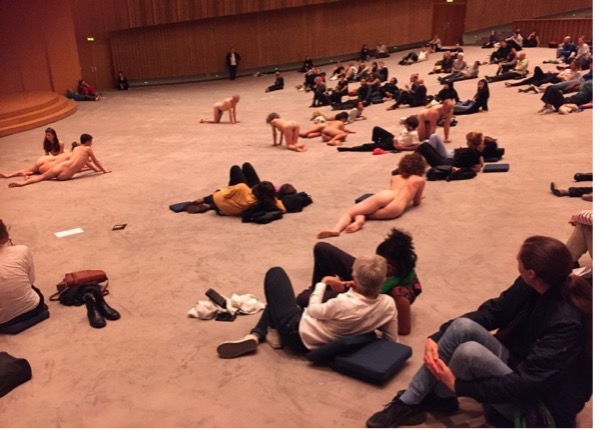
The durational and workshop-like format Life Forms, which was presented at Haus der Kulturen der Welt (HKW) in Berlin from April 25 th to 27th, 2019, accepted and exposed what I call the paradox of the workshop.[1] Unlike many workshops following in the tradition of the 1960s neo-avant-gardes, Life Forms did not invoke a single event that united all its participants under the umbrella of one shared identity, but quite on the contrary, it allowed for all the involved subjects to relate both to themselves and to each other differently. In a Foucauldian sense it combined subjectivities and the relations between them to facilitate another subjectivity both on the level of the individual and the collective.
Inspired by my experience of attending Life Forms,I will investigate how the recent interest in the workshop format in continental European dance differs from the historical emergence of the workshop in the 1960s United States; I will consider this difference particularly with respect to the area of conflict that revolves around group technologies and technologies of the self. For this purpose, I will consult Michel Foucault's late investigation of ascesis and different kinds of subjectivity, Richard Schechner's approach to the workshop, as well as Ana Vujanović, Bojana Cvejić, and Marta Popivoda’s research on Performing the Self.[2] In the final section of this essay, I will return to Life Forms and the question in how it reflects the paradox of the workshop.[3]
Life Forms (HKW, 2019), visitor photo by Stefan Hölscher
The problem of subjectivity in late Foucault
I want to start by outlining Foucault's later thought on ascesis as a government of self in contrast to a government of others. I will demonstrate that ascesis concerns neither an aesthetics of existence, nor the idea of ‘freedom’ as replacing Foucault's previous concern with historical a priori forms as conditions of possibility for experience (cf. Sarasin 2010), but, rather, subjects radically changing their relation to themselves and each other; it concerns a ‘spiritual’ relation which empowers them not to be governed in a certain way and has an impact on the webs of knowledge and power surrounding them.
After having conducted research on biopolitics and the history of governmentality in the late 1970s, in the early 1980s Foucault commits himself to ascesis, the history of various kinds of subjectivity, and practices of subjectivation. In a text entitled “The Subject and Power” (originally published as an afterword to the anthology Beyond Structuralism and Hermeneutics edited by Hubert L. Dreyfus and Paul Rabinow in 1982), Foucault considers power relations with regard to biopolitics, defining them as “a way in which certain actions modify others” (Foucault 1982, 219) and highlighting that “something called Power, with or without a capital letter, which is assumed to exist universally in a concentrated or diffused form, does not exist. Power exists only when it is put into action, even if, of course, it is integrated into a disparate field of possibilities brought to bear upon permanent structures” (219). For the late Foucault, powers are reversible relations depending on actions acting upon other actions which need to be carried out in order to be effective. In the context of biopolitics in the era of governmentality, power relations involve diverse pastoral technologies and fields of knowledge which establish and uphold a structure encompassing those governing and those being governed; in Nietzschean terms, they establish and uphold relations between shepherds and their sheep.
Surprisingly, in the same essay from 1982, Foucault emphasises that the goal of his work “during the last twenty years” (208) had never been “to analyze the phenomena of power, nor to elaborate the foundations of such an analysis” (208), but instead “to create a history of the different modes by which, in our culture, human beings are made subjects” (208). Referring to the modern episteme from The Order of Things (1966), he distinguishes between different “modes of objectification” which, from the late 18th century onwards, participate in the production of subjects, namely (1) linguistics for the speaking subject, (2) economics for the laboring subject, and (3) biology as “the objectivizing of the sheer fact of being alive” (208). According to Foucault, during the time of the late-18th century, the modern state arises out of the three domains of labour, life, and language, which transform human beings into biopolitical objects of knowledge and power. The modern state relies both on its totality and on the individuality of its citizens: On the one hand it brings forth the idea of individuality, on the other hand individuals can only be considered as such in their relation to the state, that is, in relation to the complex network of its institutions, and the divisions and segmentations amongst its members. Foucault draws a remarkable conclusion from this constellation:
the political, ethical, social, philosophical problem of our days is not to try to liberate the individual from the state, and from the state´s institutions, but to liberate us both from the state and from the type of individualization which is linked to the state. We have to promote new forms of subjectivity through the refusal of this kind of individuality which has been imposed on us for several centuries. (216)
Foucault performs the same juxtaposition of a government of others and a government of self in his analysis of ascesis in Greek and Roman antiquity. Not unlike his homage to Immanuel Kant in the essay What is Enlightenment? (1984), what is at stake in ascesis is a radically changed relation to the self that the subject has to confront as a means of overcoming the “immaturity” imposed on them by the pastoral regime of shepherds and sheep. Foucault writes on Kant and enlightenment: “[W]e are in a state of ‘immaturity’ when a book takes the place of our understanding, when a spiritual director takes the place of our conscience, when a doctor decides for us what our diet is to be” (Foucault 1997, 305). It is not my intention to qualify or not the ascetic relation to the self as a power relation—the actions of a single subject acting upon other actions of the same subject—but as a self-relation which implies a relation to others. This cannot be reduced to the pastoral networks of knowledge and power that constitute the modern subject before it is capable of changing the relations of these networks.
The workshop format between self and group technologies
My proposition is that workshops take place in a tension between the form of collectivity they involve and the individual positions they put their participants in. Historically they fostered group rather than individual settings, but in the present their means and ends have changed. Whereas the neo-avant-gardes workshops predominantly addressed the production of other subjectivities, today workshops are rather about the reproduction of one and the same subjectivity: That of the individual. This fundamental change corresponds to what Foucault describes as the logic of the state, manifesting for instance in the contemporary professional development workshop culture. Seen from this angle, workshops establish both relations of individuals to themselves and relations in-between individuals that exceed their self-relations; they include not only a collective situation but also the formatting and formation of subjectivity in relation to that situation.
In the Greenwich Village Art Scene in New York during the 1960s, various makers in the field of performing and visual arts questioned the traditional hierarchy between training, rehearsal, and showing, respectively, between their practice as a process and the products of their practice. For many in experimental artistic milieus during the 1960s it was more important to develop collective forms and modes of dwelling in time and space than to commit themselves to rehearsing and training for a performance production that exceeded their togetherness in the workshop. In various artistic contexts around 1968—Andy Warhol's Factory, Judson Church Theatre, or Grand Union (cf. Hupp Ramsey 1991), but also Open Theatre, Living Theatre, or The Performance Group—a mode of subjectivity which does not derive from individuality but from togetherness emerged. As a group technology it had an impact on what Foucault describes as technologies of the self. From the 1970s onwards, this mode of subjectivity migrated from groups to the individual and expanded into other societal domains—from business workshops and life coaching to more or less esoteric frameworks such as tarot or yoga, all of which we are we are confronted with these days.
My argument is that whilst in artistic environments of the 1960s the workshop was primarily associated with the desire for a collective “truth” in terms of the relations between people, these days’ workshop culture is about the “truth” of single individuals. What experience do I make? Where does it guide me? How will I benefit from it? The concern for altered relations to others from around 1968 has been transformed into a common concern with the preservation and enhancement of the individual in and for late capitalist society. In the artistic milieus of the 1960s—I am only speaking of the U.S. here—Open Theatre's The Serpent from 1967, Living Theatre’s Paradise Now from 1968, or The Performance Group’s Dionysos in 69 from 1969, proliferated alongside Anna Halprin´s workshops on her dance deck in California, which was established already in the 1950s, the composition workshops conducted by Robert Dunn in Cunningham´s Studio in the early 1960s, or the many films being shot in the ambit of Warhol´s Factory.
Life Forms (HKW, 2019), visitor photo by Stefan Hölscher
Among Warhol’s films is the 16mm film Jill and Freddie Dancing from 1963, in which two members of Judson Church Theatre, the dancer Fred Herko and the dance critic Jill Johnston (who wrote for The Village Voice), are shown on the rooftop of a building in New York as they are casually smoking, talking, drinking beer, and dancing. Giulia Palladini’s polemical re-coining of the term “foreplay” can help understand how artists of the time questioned the separation of preparation and presentation in the doing and making of art: for them, infinitely extended and sustained foreplays in the sense of informally being and spending time together were more urgent then “coming” together in the framework of shows or showings (Palladini 2017).
The post-1968 expansion of the workshop format from art to other fields of society, as well as the new importance of the individual at the expense of the group, correspond with the historical shift in political economy from material products to immaterial processes which marks the new spirit of capitalism in postindustrial societies after they have been outsourcing their industries to the so-called Global South in recent decades (Chiapello and Boltanski 2007). It is precisely during this time that Foucault shifts his focus to subjectivity and the ways it is interwoven with power and knowledge.
Foucault´s ascesis in the age of biopolitical governmentality
Although the government of self and the government of others are not identical, they are interwoven with each other. In his lectures on The History of Governmentality from 1977/78, Foucault analyses biopolitics as a power formation superimposing both sovereign power and disciplinary power by the end of the 18th century. Five years later, in his lectures on The Hermeneutics of the Subject from 1982, he reconsiders his previous project and aligns it with his recent research on technologies of the self:
Although the theory of political power as an institution usually refers to a juridical conception of the subject of right, it seems to me that the analysis of governmentality – that is to say, of power as a set of reversible relationships – must refer to an ethics of the subject defined by the relationship of self to self. Quite simply, this means that in the type of analysis I have been trying to advance for some time you can see that power relations, governmentality, the government of the self and of others, and the relationship of self to self constitute a chain, a thread, and I think it is around these notions that we should be able to connect together the question of politics and the question of ethics. (Foucault 2005, 252)
Foucault´s extraordinary understanding of “truth” is central for my empowering reading of ascetic relations to self and others. In his later lectures, “truth” is not something given that is achieved by gaining knowledge and ascending from the realm of sheer appearances to the high skies of true ideas, as in the Platonic model. On the contrary, Foucault describes “truth” as a commitment, a passion, and specific exercises which involve a radical change of the relation between subjectivity and its practical means and ends. Ascetic exercises are carried out by subjects distancing themselves from their objectification in structures of knowledge and power, and aim instead towards new group formations of a different self and different relation to others. Foucault locates his concept of ascesis in a historical period both after Plato's idea of a perfect state in which an eternal order of things has to be remembered (termed recollection) and after the Christian understanding of ascesis as self-renunciation (termed exegesis). What Foucault finds in Greek and Roman antiquity differs from the understanding of ascesis as confession as it is still dominant nowadays, especially in business workshops and life coaching. The form of ascesis which interweaves group with self technologies in artistic workshops from the 1960s neo-avant-gardes, in Foucault’s words, “involves coming together with oneself, the essential moment of which is not the objectification of the self in a true discourse, but the subjectivation of a true discourse in a practice and exercise of oneself on oneself” (333).
In the year of the original publication of “The Subject and Power,” Foucault sketches out new forms of subjectivity and processes of subjectivation (as governments of self), opposing them to modes of subjection (as governments of others). Returning to ancient Greek and Roman texts, he indicates a lost “spirituality”:
We will call “spirituality” [...] the set of [...] researches, practices, and experiences, which may be purifications, ascetic exercises, renunciations, conversions of looking, modifications of existence, etc., which are, not for knowledge but for the subject, for the subject´s very being, the price to be paid for access to the truth. (15)
he remarks in his first lecture on The Hermeneutics of the Subject. Furthermore, he accentuates the fundamental difference between the objectification of the subject and the subjectivation of a truth discourse which, according to him, is called into play in the period between Plato and the rise and spread of Christianity:
Let's say, schematically, that where we moderns hear the question “is the objectification of the subject in a field of knowledge (connaissances) possible or impossible?” the Ancients of the Greek, Hellenistic, and Roman period heard, “constitution of a knowledge (savoir) of the world as spiritual experience of the subject.” And where we moderns hear “subjection of the subject to the order of the law,” the Greeks and Romans heard “constitution of the subject as final end for [themselves] through and by the exercise of the truth.” (319)
The precondition for what is described as truth is a “pact between the subject of enunciation and the subject of conduct” (406), meaning that “the presence of the person speaking must be really perceptible in what [they] actually say[...]” (405), which “must be sealed by the way [they] conduct [themselves] and the way in which [they] actually live[s]” (405 f.). Thereby, ascesis “is not a way of subjecting the subject to the law; it is a way of binding [them] to the truth” (317),and it “involve[s] arriving at the formation of a full, perfect, complete, and self-sufficient relationship with oneself, capable of producing the self-transfiguration that is the happiness one takes in oneself” (319 f.). The problem of ascesis can be summarised in the following question: “How can the subject act as [they] ought, how can [they] be as [they] ought to be, not only inasmuch as [they] know[…] the truth, but inasmuch as [they] say it, practice it, and exercise it?” (319 f.).
In a later lecture from The Hermeneutics of the Subject, Foucault tells his audience:
The form of this schema is neither recollection nor exegesis. Unlike the Platonic model, it neither identifies care of the self and knowledge of the self, nor absorbs care of the self within knowledge of the self. Rather, it tends to accentuate and privilege care of the self, to maintain its autonomy at least with regard to knowledge of the self whose place is, as I think you will see, limited and restricted even so. Second, the Hellenistic model unlike the Christian model, far from moving in the direction of self-exegesis or self-renunciation, tends, rather, to make the self the objective to be attained. (257)
The self as the objective to be attained and subjective truth as something according to which one has to conduct one´s life together with others are far away from a self being objectified in structures of knowledge and power. In his essay What is Enlightenment? from 1984, Foucault will appreciate a short text by Kant with the same title that was originally published in 1784 and contains similar constellations to the ones he had been dealing with in The Hermeneutics of the Subject. Following Kant, Foucault defines enlightenment as “a modification of the preexisting relation linking will, authority, and the use of reason” (Foucault 1997, 305). For Kant and Foucault, one can only exit from one´s state of immaturity “by a change that one will bring about in [oneself]” (306), which implies a task and an obligation. According to Foucault, enlightenment is less a historical moment towards the end of the 18th century or a specific relation to the present—which at the end of the 18th century was the present of the French revolution toward which Kant felt ‘enthusiastic’, as Jean-François Lyotard shows in a brilliant essay (2009)—but a relation to oneself that implies “to take oneself as object of a complex and difficult elaboration” (Foucault 1997, 311) that ties oneself “to an indispensable asceticism” (311). Associating Kant´s elaborations on enlightenment with the observations Baudelaire made in the 19th century, Foucault, in the year of his sudden death, carves out another understanding of modernity: “Modern man, for Baudelaire, is not the man who goes off to discover [themselves], [their] secrets and [their] hidden truth; [they are] the man who tries to invent [themselves]. This modernity does not ‘liberate man in [their] own being’; it compels [them] to face the task of producing [themselves]” (312). The production of precisely this other subjectivity was at stake in many artists turning to the workshop in the 1960s.
The workshop past and present
From this perspective, the supposed “truth” of a collective realisation, which was at stake in the artistic formatting and formation of other kinds of subjectivity during the 1960s, forecasts our present, in which the authenticity that the workshop promised in the 1960s is revealed as an illusion, i.e., the assumption that there could be a space and a time independent from individualism, the market, and capital. Nowadays, it is our togetherness and the subjective relations we establish between us as individuals that are considered processes and products. They become our “artificial hells” in which we are forced to participate actively and not only passively (Bishop 2012).
Therefore, when some pioneers of the neo-avant-garde privileged the subjectivity of being in groups over being individuals, nowadays this same tendency is used to enhance individuals for a global market which demands flexibility and the ability to continuously adjust within projects. All too often, we participate in workshops in order to advance our skills or to network rather than make an experience that changes us as individuals or makes us relate differently to others. Not only in business workshops or life coaching events, but in a multitude of dance workshops people primarily relate to each other as individuals. In contrast, when Richard Schechner, notably the founding figure of Performance Studies as a field of research whose emergence was closely linked to the cultural revolution of 1968, addresses the workshop in “Drama, Script, Theater and Performance” (1973), he puts a lot of hope in this kind of association amongst people:
The world, which used to be made up of thousands of distinct cultures, is fast becoming global. The consequences of this emerging global megaculture are barely known. In industrial societies – east and west – “workshop” has developed as one way of recreating, at least temporarily, some of the security and intimacy of small, autonomous cultural groups. The workshop is a way of playing around with reality, a means of examining behavior by recording, exaggerating, fragmenting, recombining, and adumbrating it. The workshop is a protected time/space where intra-group relationships may thrive without being threatened by intergroup aggression. In the workshop special gestures arise, definite sub-cultures emerge. The workshop is not restricted to theater, it is ubiquitous. In science, it is the “experimental method,” the laboratory team, the research center, the fieldwork outpost. In psychotherapy it is the “group,” the rehabilitation center, the “therapeutic community.” In living styles, it is the neighborhood, the commune, the collective. (When the workshop is repressive rather than facilitating, as in many “total institutions” such as asylums, prisons, hospitals, and schools, it is a most violently abusive way of treating human beings.) The aim of the workshop is to construct an environment where rational, arational, and irrational behavior exist in balance. Or, to put it biologically, where cortical, brain-stem, motor, and instinctive operations exist in balance, leading to expressive, symbolic, playful, ritualized, “scripted” behavior. It is my opinion that workshops are more important than most people dream of. And if I may end on a somewhat fanciful note: I associate the workshop environment with those ancient, decorated caves that give evidence of singing and dancing, people celebrating fertility in risky, sexy, violent, collective, playful ways. (Schechner 1988, 110)
Unfortunately, I cannot be as optimistic as Schechner; half a century later, the workshop’s differences to training, rehearsal, and showing in the artistic field, and its differences to the assembly line in the factory and political economy have become much more ambiguous than it may have seemed at the time of the workshop’s emergence around 1968. Whilst Schechner makes a clear distinction between facilitating workshops and repressive ones—the latter ones he locates in “asylums, prisons, hospitals, and schools” (110) alone—this borderline has become blurry over the last few decades. What was originally conceived as a group technology empowering and facilitating “small, autonomous cultural groups” (110)—in the best case replacing the individuality of entertainment- and drama-based theatre with the collectivity Schechner culturally appropriated from the rituals of so-called “tribal” culture—nowadays has been turned into various technologies of the self. These technologies of the self, however, have little to do with what Foucault described in terms of ascesis; late capitalist society promotes individuals over groups whenever people gather in what would probably better be discussed separately as “works” on the one hand and "shops” on the other hand.
At the beginning of the 1970s, inspired by the rituals of “tribal societies,” Schechner contrasted the workshop format with work, e.g., wage labour or instrumentally driven activity in general. In From ritual to theater and back: The efficacy–entertainment braid (1974), he states: “Industrial cultures separate and standardize functions and expressions; communal societies combine many functions and expressions in extended, complicated events. Industrial cultures specialize in sequencing univocal actions while communal cultures generalize by means of events that are multivocal” (Schechner 1988, 155). Schechner hoped to overcome individualism by contrasting industrial with communal societies, and theatre as an individualist means of entertainment and representation with ritual as a way of actualising collective relations in-between their participants by means of their efficacy—which for him implied the transformation of subjectivity away from the individual toward the group. In that, Schechner was driven by a deep trust in performance as a process that is opposed to showings and their separation from preceding trainings and rehearsals, as well as their internal separation of performers and audience. What he rejects is the causality and chronology of trainings (the transmission of technique from one individual to others through exercises), rehearsals (the structuring of a scripted process by repetition), and showings (the entertainment of individuals).
Life Forms (HKW, 2019), visitor photo by Stefan Hölscher
In the same text from 1974, Schechner states:
[S]ince around 1965 what has been shown to the spectators is the very process of developing and staging the performance—the workshops that led up to the performance, the various means of theatrical production, the ways the audience is brought into and led from the space, and many other previously conventional and/or hidden procedures. (131)
However, what Schechner did not take into consideration when he proclaimed the protection of the workshops’ “time/space where intra-group relationships may thrive” (110) is that this frame as the formatting and formation of subjectivity was, from its very beginning, not only linked to groups, but also to the individual positions that it put their participants in. Already around 1968, the workshop as an environment for the production of subjectivity was not only about collective experience and the relations one bears to others, but it was equally linked to individual experience. From the start, the workshop was in danger of reproducing the bourgeoise figure of the individual rather than producing forms of subjectivity of the kind that Foucault envisioned when he talked about ascesis.
Nowadays, workshop organisers and attendees in the artistic and in other social fields, while claiming to privilege processes over products, might just in fact be witnessing the rendering of processes into products. They forget that the formatting and formation of collectivity goes hand in hand with a formatting and formation of subjectivity as Foucault analyses it in The Hermeneutics of the Subject. In this context, Jon McKenzie describes our current state of affairs as a society of performance (McKenzie 2001), and Bojana Cvejić recently emphasised, along the same lines, that we do not observe a spectacle from a distance anymore, but are embedded in processes unfolding alongside the very relations between us, and hence we have been turned from public citizens into private users (Cvejić 2016). My suggestion is to understand the paradox of the workshop as a collective practice that is neither a training or rehearsal, nor a showing, but the very process that promises to be its own product, producing both a collectivity and individual positions, similar to what is Foucault’s stance on ascesis.
For Schechner, the workshop is closely linked to what he calls “actuals.” In his essay Actuals (1970), he develops an understanding of “actualizing” which is closely linked to the workshop format and denominates a “special way of handling experience and jumping the gaps between past and present, individual and group, inner and outer [...]” (Schechner 1988, 32). An actual has to do with (1) process, (2) situations, (3) contest, (4) initiation, or “change in status for the participants” (46), and (5) a concrete usage of space (46). According to Schechner, actuals are as much contrasted to dramatic theatre (as an individualist and just entertaining entity) as the workshop is to the idea of showings in front of a supposedly passive audience. In contrast—and long before Jacques Rancière presented his influential lecture The Emancipated Spectator (2004)—workshops for Schechner are supposed to activate collectives, not produce passive individuals. As actualisations of a togetherness, they are the empowering of people and the transformation of situations; they initiate change. They ought to be collective realisations of a supposed communal experience which would be different from individualist experience and the daily life reality in industrial societies at an earlier point in the unfolding of globalisation.
What, then, is the difference between our present and the alternative modes of association that the generation of 1968 was searching for? Why the paradox of the workshop? And what does all of that have to do with Foucault´s ascesis? Around 1968, artists were not simply looking for alternative ways of working together and collaborating on common goals and agendas within a given market—this is the situation of today´s freelance artists, who attend workshops in order to gain skills and engage in networking—but, instead, and much like Foucault at the beginning of the 1980s, they tried to change subjectivity as such, and the order of experience that it is based upon (e.g., Janevski and Lax 2018; Martin 2006). In Schechner´s day and age, workshops perhaps could still be considered “caves that give evidence of singing and dancing, people celebrating fertility in risky, sexy, violent, collective, playful ways” (110), but today it is difficult to separate the cave from its outside, from post-industrial societies and the real subsumption of life, from the rendering of the processes and events of life into products.
Life Forms at Haus der Kulturen der Welt
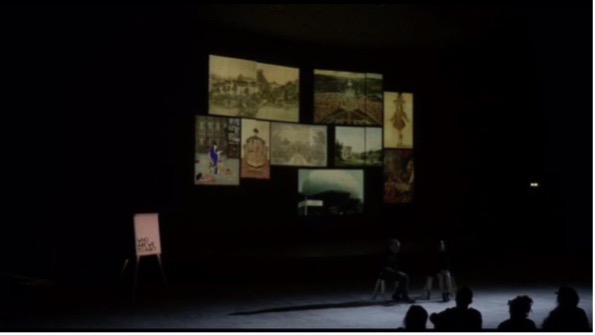
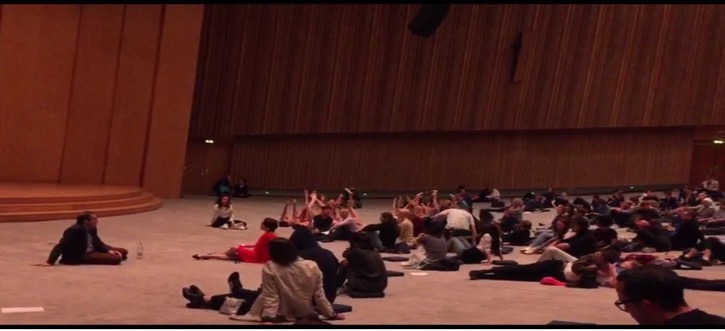
In Life Forms, over the course of three days, we were welcome to come and go as we pleased. Scholars and artists from different backgrounds appeared in the middle of the crowd, starting conversations in varying tones, modalities, and numbers: Among them were Lisa Baraitser, Luis Campos, Maria Chehonadskih, Louis Chude-Sokei, continent., Hu Fang, Maya Indira Ganesh, Wesley Goatley, Melody Jue, Noël Yeh Martin, Luciana Parisi, Sascha Pohflepp, Elizabeth A. Povinelli, Marina Rosenfeld, Kaushik Sunder Rajan, Jenna Sutela, Bronislaw Szerszynski, Gary Tomlinson, and John Tresch. They reappeared several times, but always in different constellations. The conversations were framed by Xavier Le Roy and Scarlet Yu's choreography of fragments from animal motives that Le Roy had developed ever since the creation of his group show Low Pieces (2009–2011). As time passed, we experienced how we became-other depending on how we related to others. We recognised this in the way that the scholars changed their way of talking or how they stood or sit in space in relation to the ensemble of people around them. As an audience member, one did neither merge with the event, nor did one become part of a uniform collective. One related both to oneself and to the group, continuously balancing between these two different levels.
What does this imply for today´s workshops? Can there be a workshop without a commitment and passion for truth in the above mentioned Platonian and Christian sense? My proposition is to think of workshops as ascetic sets of exercises, practices, and technologies of the self and the group, which enable subjects and groups of subjects to exit structures of objectivation so as to subjectivize themselves, and by doing so bring forth new forms of subjectivity. Workshops as ascetic practices would signify an emancipation from the individuality that subjects are ascribed to by the pastoral logic of shepherds and sheep. In ascetic workshops, modes of subjectivation would be at play, which may help to find ways out of our ‘self-incurred immaturity’ and current powerlessness. Ascesis would involve the task and obligation to invent exercises that empower the construction of new relations between the subject and their means and ends. Under the condition that one binds oneself to a subjective truth and follows a commitment and a passion for that truth, new forms of subjectivity may emerge, which is perhaps even more urgent these days than by the end of the 1990s, when there was no pandemic and dance moved on to pastures new the last time, at a time when the general political situation was a bit more tranquil than in 2021.