
Figure 1: Révolte. Natural pigment over trunks. Frans Krajcberg: Un artiste en résistance, 2017.
In a documentary about his work, Polish born, Brazilian naturalized artist Frans Krajcberg (1921–2017) says that, over the course of his creative development, he “discovered matter” and found that he “can work with it, with nature, not be afraid of it, participate with it” (Salles 1986).[1] The movie Krajcberg: The Poet of Traces [2] by Walter Salles, a renowned Brazilian filmmaker, accompanies the artist as he travels to the Amazon River Basin and other wooded areas to document the rampant deforestation taking place in Brazil and to gather local materials that would become the building-blocs of his art. Moving beyond artworks about the natural world, Krajcberg created together with natural elements. His goal was not to represent nature as an object to be contemplated by the human sensorial apparatus, mediated by artistic skill. He wished to “feel matter”; to use it not simply as raw material, but to collaborate with it, or, as the voice over in Salles’s film puts it, “for the first time, an artist was working in co-authorship with nature.” He “introduced […] the idea of the creativity of nature itself” (Walters 1999, 244) and, together with the natural world, shaped pieces that both pay homage to it and denounce environmental destruction.
Plants are central to Krajcberg’s artistic praxis. Considered to be one of the founding figures of Earth Art in Brazil and internationally (McNee 2014, 100), Krajcberg used materials borrowed from nature for most of his career. He received artist training in Germany and Paris in the aftermath of the Second World War, adopting an expressionist painting style. After moving to Brazil in 1947, he started to experiment with found materials and natural forms, including natural pigments, minerals and plants.[3] In this article, I will focus on Krajcberg’s work from the 1980s onwards, when he began to employ charred tree trunks he collected in the aftermath of the devastating forest fires that destroy Brazil’s old-growth tropical forests to make his sculptures (see Fig. 1).[4] Most of these fires are human-induced and are used as a means to clear land for agricultural purposes, a process that has been going on since the beginning of the colonizing period, but which has greatly intensified from the middle of past century onwards. Krajcberg mourned the loss of the Atlantic rainforest he witnessed first-hand. His house and studio were located in the southern part of the Brazilian state of Bahia, in what used to be a densely forested area that has been all but decimated through fire. Scientists had predicted it would take 80 years for the rainforest to disappear, but it was gone during the artist’s lifetime, in just 40 years. Based upon this grim precedent, “you can imagine,” Krajcberg tells viewers in Salles’s documentary, “how our Amazon will be destroyed.” “It became unbearable here, […] there is nothing here anymore,” he reflets sadly as he faces his interlocutor (Salles 1986). “What can I do about this?” is the implicit question he leaves open in the documentary and that he tries to answer through his art.
In the face of the massive devastation of rainforests, Krajcberg sought to express his indignation for the plants’ pervasive mistreatment at the hands of humans, who adapted exploitative colonial practices to our neo-colonial, neo-liberal age. “The ferocity of the colonizer in Brazil is exactly the same after 500 years—cutting down the forests—[…] though today they [those who act in ways similar to the former colonizers] call themselves technicians” (quoted in McNee 2014, 108), the artist told the Brazilian Chamber of Deputies in 1976, in a clear indictment of the then-governing military dictatorship’s lax environmental protection policies. Krajcberg wondered “how to make a sculpture scream as if it had a voice” (quoted in Walters 1999, 208), “how to make a piece of charcoal scream” (quoted in Collontonio and Cravo 2005, 44) and articulate their condemnation of a Western-style economy predicated on the depletion of natural resources in one area after the other. His solution was to bring together sculpture and charcoal, art and its material substratum, which he unites in an inextricable network of meaning that goes beyond mere artistic display.
In his artworks, Krajcberg links art and environmental activism. “I want to show the destruction, my revulsion [at the destruction of the natural world],” he says, “and at the same time to make my art” (Krajcberg, quoted in Walters 1999, 119). His charred wood sculptures occupy a zone of indistinction between aesthetics and political denunciation, and he openly acknowledges that “my goal is not to make sculptures, my goal is to lend a shape to my scream” (Russo 2009, 21). To underline his environmental activism, Krajcberg frequently said that he was unconcerned about whether or not his pieces were deemed to be artworks (Walters 1999, 209), often going as far as stating that he no longer considered his sculptures to be art (McNee 2016, 101). Parallel to his obvious dedication to the environmental cause, I would argue that there is another underlying reason for Krajcberg’s reluctance, in the final decades of his life, to define himself as an artist in the traditional sense of the word. His incinerated wood pieces blur the boundaries not only between art and activism, but also between the artist and his object, between human and non-human works. As he mentions in Salles’s documentary, “I like to touch a flower, or to almost talk to a tree” (1986). His art is the result of this ongoing sensorial but also intellectual exchange with plants.
Figure 1: Révolte. Natural pigment over trunks. Frans Krajcberg: Un artiste en résistance, 2017.
For Krajcberg, “art is life” and he wishes to “give continuity to life, the life of the forest” through his artworks (Walters 1999, 119). Yet, he picked the dead bodies of trees to create his sculptures. Does this choice not betray an inherent contradiction in his artworks? The artist’s work with calcinated wood might, at first blush, point to a somewhat naïve belief in the redemptive power of art that would offer incinerated plants a resurrection, a second, superior life in the realm of human culture. After all, German philosopher Friedrich Hegel defended in his influential Phenomenology of Spirit (1807) that a tree or any other natural element achieves a higher existence once it has been touched by human spirit,[5] which means, in the case of a tree, once it has been cut down and turned into a table, a chair or, better still, into pieces of paper onto which humans can write philosophical treatises or into artworks that tingle the human senses and mind.
Krajcberg’s incinerated wood sculptures cannot, I would contend, be reduced to a human hubristic attempt to instill life into dead plants through the power of art. Nor can they simply be interpreted as means to counterbalance the rampant destruction of forests by preserving at least some of the remnants of the incinerated trees as artworks. When Krajcberg mentions his aspiration that the life of the forest continues in his pieces, he must be understood quite literally as referring to the forms in which charred wood carries life. The artist states that “it [wood] conveys warmth. It seems like it is conveying the warmth that existed when it was alive. That is extremely important to me. I like to feel that […] the warmth of matter” (Salles 1986). Significantly, in ancient Greek, the words for forest or “wooded area” and matter were the same, namely “hyle.” For Krajcberg, wood is capable of expression, in the same way as plants articulate themselves and establish meaningful relations with their surroundings.
Krajcberg is certainly not making a case for regarding plants living in healthy forest, such as old-growth trees from the Amazon, as strictly equal to the incinerated pieces of wood he salvages in the aftermath of forest fires. Such a line of thought would mean, in a reductio ad absurdum line of argumentation, that humans have a free ticket to, in good conscience, burn down all remaining forests, given that incinerated wood has a life akin to that of trees. The value Krajcberg places on his work with wood does mean, however, that he calls into question not only the separation between human and non-human art and activism, but also the strict divide between living and non-living matter. Though different from a plant, wood has a life of its own. It can convey meaning and, similar to a tree in a forest, be part of a complex web of signification.
To be clear, Krajcberg’s sculptures stand for a strong indictment of the burning of rainforests and of the destruction of animals and plants for the sake of short-sighted economic gain.[6] They are a visually impactful condemnation of the loss of the myriad forms of life that this devastation represents. But they also acknowledge that, even after their death, the bodies of plants have agency. The pieces of charred wood used in his sculptures enact a performance, advocating through the exhibition of their injured bodies for the lives of the trees they used to be. It is as if there is a memory to matter and the corporeality of the incinerated wood brings back the image of the living plant and speaks for the trees’ right to remain alive. Krajcberg’s artworks, therefore, strive to give each being their due and to do justice to the different forms of existence of plants, including in their afterlife as wood.
Krajcberg often states that, with such richness in nature, he, as an artist, can only hope to approximate it (Salles 1986). Following this train of thought, the ideal artwork would be one that exists in symbiosis with the natural world, to a point where art and nature become indistinguishable. This was perhaps what Krajcberg strove to accomplish when he drew extensively on natural elements—natural pigments, parts of mangroves, vines and trees, etc.—to emulate their elegance and bring the equilibrium of natural life into his art. But in the context of widespread destruction of the natural world, it would have been shortsighted to continue producing artworks based on the assumption of a pristine nature. The artist therefore started to bring the damaged life he found in the natural environment into his art. With his charred wood sculptures, he persists in his efforts to come close to nature. But his pieces now speak of the ravaged natural world of the Anthropocene, where rainforests have been burnt to the ground and centuries-old trees have been turned into calcinated wood. From a celebration of forests, Krajcberg’s art becomes a cry of revolt against the destruction of plant life. His burnt wood sculptures, lying at the intersection of life and death, allow matter to speak out for the preservation of life.
In what follows, I examine the notions of language, signification and volition that allow us to reflect upon Krajcberg’s sculptures and their denunciation of the destruction of Brazilian rainforests. My analysis goes back to recent studies in the field of plant signaling and behavior that show the ability of plants to perform activities we previously ascribed only to animals. The fact that plants can feel, communicate, think, have memory, and so on, has been shown in a variety of scientific studies (see, for instance, Calvo 2016) and popularized in books including Daniel Chamovitz’s What a Plant Knows (2012), Anthony Trewavas’s Plant Behavior and Intelligence (2014), Peter Wohlleben’s The Hidden Life of Trees (2015), Stephano Mancuso’s The Revolutionary Genius of Plants (2017), among many others.
Taking this growing body of literature on plant articulation as a point of departure, several questions about the possibility of plant performance and expression in collaboration with humans remain. Can plants communicate with Homo sapiens? If so, what is it that they want to say? What about matter, such as wood? Is its able to express itself? What is the difference between the language of a living plant and that of a piece of wood? In order to address these issues, I will turn to three theoretical frameworks for understanding the articulation of flora and, more broadly, of living and non-living matter: semiotics, so-called “New Materialism,” and Indigenous thought from the Amazon. Semiotics, closely linked to linguistics and to the philosophy of language, dates back to the nineteenth century. The existence of non-human forms of language was already contemplated in the work of its founder, Charles Peirce and, especially from the second half of the twentieth century onwards, several semiotic studies argue for the possibility of signification in non-humans and even in non-living beings.
There is a conceptual continuity between semiotics and the work of some authors affiliated with New Materialism, an umbrella term encompassing the writings of a variety of thinkers who, starting in the last decade of the past century, have sought to foreground the agentic capacity of matter to determine both life processes and the becoming of inert substances, as well as to question the divide between the two. Despite variations across communities, Indigenous, peasant and riverine thought from the different Amazon regions also shares a belief in the meaning-making ability of non-human living and non-living entities that shape human life and behavior. Anthropologists agree that, for Amazonian peoples, there is but a tenuous, porous demarcation separating humans and non-humans, and the move between the two realms results in a process of learning for both sides. In the following sections of this article, then, I will assess what the insights from these three loosely related frameworks can contribute to the understanding of vegetal forms of expression in Krajcberg’s artworks.
In the final section of the essay, and in light of recent semiotics and new materialist theory, as well as of insights from Amazon Indigenous thought, I examine the parameters for collaboration between human and non-human beings in Krajcberg’s sculptures. I begin by considering the relevance of the Amazon River Basin for the artist’s reflections on the role of art in contemporary society. Subsequently, I examine one of his Amazonian charred wood sculptures more in-depth, namely, “Homage to Chico Mendes,” shown in the 1992 Rio de Janeiro Museum of Modern Art exhibition titled Frans Krajcberg: Images of Fire as part of the cultural program accompanying the UN Conference on Environment and Development, also known as Earth Summit, that happened in the city on the same year.
American philosopher Charles Sanders Pierce famously wrote that “this universe is perfused with signs, if it is not composed exclusively of signs” (quoted in Deely 1990, 84). He realized that organisms navigate their environment by interpreting it, which led him “to the view that ‘mind’ and ‘ideas’ are not properties of humans alone, but are immanent in all living things” (Wheeler 2011, 272). Pierce’s insights into a generalized theory of meaning that would encompass all living beings were deepened in the second half of the past century. The research undertaken by Thomas A. Sebeok into animal forms of communication widened the purview of semiotics beyond humanity and prompted him to coin the term “zoosemiotics” in 1963 (Favareau 2010, 258).
Less than two decades later, Martin Krampen wrote his essay “Phytosemiotics” (1981), where he postulated that plants, too, are able to produce and interpret signs. Heavily influenced by the work of biologist Jacob von Uexküll, Krampen argues that, even though plants have no central nervous system, they can process so-called “meaning factors,” or stimuli, which they decipher and respond to (Krampen 2010, 269). Biologically very different from humans and other animals, plants use the means at their disposal to make sense of their surroundings—or, in von Uexküll’s words, their Umwelt, which is literally translated into English as “world around”—and to shape their lives based upon their interpretation of outward signs. Krampen’s work suggests that environments such as the ones Krajcberg struggles to defend through his activism form vast semiotic networks involving, beyond their human and other animal inhabitants, the plants that make up the complexity of rainforest life.
In his essay, Krampen emphasizes the foundational importance of plants for human life and culture, given that they produce all the oxygen non-human and human animals breathe (271). A corollary of Krampen’s argumentation, highlighted in Krajcberg’s artworks, is that, by burning oxygen-producing rainforests such as the Amazon, humans are undermining their own possibilities of meaning-making. “Despite the impression of progress,” Krampen writes, “the human organism […] remains locked together with plants by a mutual rule of correspondence: If men cease to care for plants […] they will asphyxiate themselves” (276). Krajcberg’s artistic collaboration with plants reveals not only that vegetal life is able to produce meaning, but also draws our attention to the symbiotic relationship between humans and flora that cuts across all levels of human existence, a balance that is being thrown off-kilter by the relentless exploitation of plants. Through Krajcberg’s artworks, viewers become aware of the role plants play as, in Krampen’s words, “teachers” and as “living examples” of “passive resistance” (275). The display of charred wood in the artist’s sculptures bespeaks the silent, non-violent resistance of flora against the fires decimating rainforests.
Sebeok’s and, later, Krampen’s work on non-human semiotics is the foundation for the discipline of biosemiotics,[7] “an interdisciplinary scientific project that is based on the recognition that life is fundamentally grounded in semiotic processes” (Hoffmeyer, quoted in Kull et al. 2011, 15).[8] Biosemiotics sees a continuity between meaning-making in humans and in non-human beings.[9] Its implication for the study of human cultural productions is, as Timo Maran points out, a widening of “the sphere of semiotic processes to embrace all living organisms on Earth” (2014, 262). For Maran, “human culture should be considered as being surrounded by a multitude of other semiotic systems, some partly accessible, some rather different from ours” (262). Biosemiotics, therefore, clears the path for examining sign relations between humans and non-human semiotic subjects (ibid.). We can understand Krajcberg’s incinerated wood sculptures through a biosemiotics lens as an inter-species collaboration that cuts across the signifying potential of both humans and plants.
While the project of biosemiotics offers a possible theoretical framework for understanding Krajcberg’s works as human/plant creations, it has, in my view, two significant shortcomings. First, and in spite of its proponents’ claims that it is an all-encompassing theory of meaning embracing the totality of living beings, biosemiotics often involves a hierarchical view of organisms, an understanding of nature as a ladder—the Medieval scala naturae, or Great Chain of Being—that descends from God, through humans, to animals, then plants and so on. This pyramidal take on the world, according to which “higher” forms of existence are above and “lower” ones further down the ladder, was the cause for regarding plants and/or animals as incapable of producing and interpreting meaning in the first place.
Biosemiotics’ hierarchy of meaning-making beings goes back to Pierce’s distinction between symbols that depend on convention and are characteristic of human linguistic communication, icons, which function based upon a resemblance between two terms, and indexes that hinge upon a physical or spatial relation (265–66). In his essay on “Phytosemiosis,” Krampen implies that plants are only capable of the “lowest” meaning-making, while humans alone have access to higher forms of signification.[10] This structured vision of life precludes a true collaborative endeavor between humans and plants, such as we find in Krajcberg’s sculptures.
Another limitation of biosemiotics is that it establishes a stark differentiation between living and non-living beings. As Maran succinctly puts it, “instead of talking about the opposition between the humans and the environment, the environment itself can be seen as twofold, including the physical environment as well as semiotically competent animals [and plants] who are much more similar to humans than we are to rocks or rivers” (264). “Semiosis,” then “is what distinguishes all that is animate from lifeless” (Sebeok, quoted in Kull et al. 2011, 2), a statement so often repeated by Sebeok that some semioticians know it as “Sebeok’s thesis.” If non-living matter is completely devoid of meaning, though, how can we interpret the signifying possibilities of incinerated wood in Krajcberg’s sculptures?
Some semioticians have found in the project of biosemiotics a cue to question the strict divide between biological life and non-living matter. Donald Favareau points out that, for biosemiotician John Deely, “all the phenomena that are criterial of biological life […] must themselves be congruent with, emerge from, and build upon the possibilities, constraints and regularities of the existing physical substratum” (2010, 260). Therefore, he continues, “the search for the non-biological regularities of the universe that alone make semiosis veridical becomes a field of (at least theoretical) investigation in its own right” (ibid.). Deely designates the discipline that examines the “regularities of the non-living surround that can potentially function as signs” as physiosemiotics (260–61). According to Deely, such a broad conception of semiotics would include “the two levels of cognitive semiosis (anthroposemiosis and zoösemiosis), and two lower levels of semiosis not dependent on cognition as such (phytosemiosis and physiosemiosis)” (1990, 83). While Deely still relies on a hierarchical view of semiotic processes, the ones he designates as cognitive deemed higher than those he regards as non-cognitive, his concept of “physiosemiotics” paves the way for considering the signification of matter. The meaning-making potential of wood in Krajcberg’s sculptures could thus be interpreted from both a phytosemiotic and a physiosemiotic perspective.
The main premises of bio- and physiosemiotics find an echo in recent theorizations of so-called New Materialism. This term encompasses a group of heterogenous theoretical approaches including, among others, ecological postmodernism, post-humanism, material feminism, “thing theory” and object-oriented ontology (Iovino and Oppermann 2014, 10). What unites the otherwise disparate new materialist body of writings is, as Jane Bennett succinctly puts it, the aim “to detach materiality from the figures of passive, mechanistic, or divinely infused substance” (2010, xiii).[11] New materialist thinkers share an awareness of “[t]he power of matter to build dynamics of meaning in and across bodies” (Iovino and Oppermann 2014, 4).[12] For this group of thinkers, matter is capable of semiosis and the whole world is a “material-semiotic reality” (Haraway, quoted in Iovino and Oppermann 2014, 2). As a consequence, matter has a mind of its own, or, in other words, it has agency, which “therefore, is not to be necessarily and exclusively associated with human beings and with human intentionality, but […] is a pervasive and inbuilt property of matter, as part and parcel of its generative dynamism” (Iovino and Oppermann 2014, 3). In a nutshell: matter matters and means quite a lot more than we used to give it credit for.
New materialist thinkers highlight the co-imbrication of matter and meaning, at the same time as they espouse a non-hierarchical view of the multiple forms of existence. They recognize that different entities have diverse ways of expressing themselves, but shun the anthropocentric bias of considering human modes of articulation to be inherently superior to those of other beings. “If matter itself is lively,” Bennett argues, “not only is the difference between subjects and objects minimized, but the status of the shared materiality of all things [human and non-human, living and non-living] is elevated” (2010, 13). As she points out: “Materiality is a rubric that tends to horizontalize the relations between humans, biota, and abiota. It draws human attention sideways, away from an ontologically ranked Great Chain of Being and toward a greater appreciation of the complex entanglements of humans and nonhumans” (112). For new materialist thought, human volition and action are not considered to be exceptional phenomena; they are a knot within “a vast network of agencies” (Iovino and Oppermann 2014, 3). As Serenella Iovino and Serpil Oppermann point out, “the human agency meets the narrative agency of matter halfway, generating material-discursive phenomena in the forms of literature and other cultural creations” (9). Krajcberg’s sculptures are an example of cultural productions that result from an encounter between human and non-human material agency, such as the one mentioned in the quote above.
Karen Barad’s notion of agential realism exemplifies the pertinence of new materialist reflections for the discussion of Krajcberg’s sculptures. Barad’s project draws on quantum theory to contests both what she considers to be “the excessive power granted to [human] language to determine what is real” (2007, 133)[13] and “[t]he postulation of individually determinate entities with inherent properties,” or “things,” which, in her view, are the hallmark of an outdated, atomistic metaphysics (137). Instead, she turns to matter, which she understands as “productive, generated and generative” (136). According to Barad, matter is not a substance; it is a becoming: “not a thing but a doing, a congealing of agency” (151). The world—or matter—is therefore not molded by human discourse, nor is it composed of discreet beings that interact with one another. “The primary semantic units are not ‘words’ but material-discursive practices,” writes Barad (141), and the primary ontological units are phenomena that emerge through intra-actions and constitute entangled agencies.[14] As she puts it: “in contrast to the usual ‘interaction,’ which assumes that there are separate individual agencies that precede their interaction, the notion of intra-action recognizes that distinct agencies do not precede, but rather emerge through, their intra-action. […] agencies […] don’t exist as individual elements” (33).[15] For Barad, meaning results from agential intra-actions, that is to say, it inheres in phenomena that arise out of material encounters.
Barad’s agential realism regards meaning as the outcome of “an ongoing performance of the world” in its materiality (149). Intelligibility is “not a human-dependent characteristic but a feature of the world in its differential becoming” (ibid.). Similarly, “knowing does not require intellection in the humanist sense, either. Rather, knowing is a matter of differential responsiveness (as performatively articulated and accountable) to what matters” (ibid.). Signification and interpretation, then, depend upon “matter(ing),” upon the “dynamic articulation/configuration of the world,” which means that materiality is itself discursive (151).
For Barad, not only is matter agentic, but we also cannot think of human agency apart from the agency of matter. Human (or non-human) agency, as displayed, for instance, in a work of art, emerges as the outcome of intra-actions and is coextensive with the becoming of matter. Artworks can thus be regarded as the outcome of intra-actions, or as phenomena, the meaning of which is tied to material processes. Krajcberg’s incinerated wood sculptures embody Barad’s assertion that meaning-making is always the performative coalescing of matter. They make apparent that all artworks are necessarily a coming together of material forces, a collaborative agential materialist performance.
A counterpoint to New Materialism’s views on the vitality of matter can be found in Indigenous, peasant and riverine Amazonian thought that foregrounds the agency of non-human beings and their impact on human lives. Native Amazonian communities consider not only fauna and flora but also, for instance, rivers or mountains, as subjects capable of intentionality and social agency. Such entities are akin to what anthropologist Marisol de la Cadena has designated, in the context of Andean culture, as earth-beings (2015), salient forms of existence from the landscape or, in the case of Amazonia, also animals and plants, with whom humans negotiate key aspects of their ongoing commerce with their surroundings.
Anthropological studies show that Amazonian communities make no rigid distinctions between humans and non-humans, and cross-species metamorphoses are a frequent trope of Amazonian culture. Indigenous worldviews presuppose that non-human beings have an outlook of their own, which they relinquish to adopt other non-human or human standpoints, or, conversely, that humans can learn to see the world through a non-human perspective. Rivers, for instance, are frequently considered to be snakes that, once angered, need to be appeased, lest humans want to suffer their wrath (see Galeano 2017). Interspecies relations are common, an example being the widespread belief throughout the region that river dolphins seduce young women, often by assuming the shape of men (see Slater 1994). Eduardo Kohn shows that, for some Amazonian communities, forests have their modes of thought and enter into dialogic exchanges with humans (2013). Speaking trees who ponder human-plant relations and bemoan the exploitation of flora are a feature of several classical Latin American novels about the Amazon, including José Eustasio Rivera’s The Vortex (La vorágine, 1924) and Rómulo Gallegos’s Canaima (1935).
The constant exchanges between different entities and the metamorphoses of various forms of being into one another in Amazonian thought echo Barad’s new materialist argument about the flux of matter, which congeals into specific, meaningful configurations—or phenomena—only momentarily as part of the ongoing performance of the world. The wood in Krajcberg’s sculptures exemplifies this recurrent metamorphosis of matter. Plants, who are capable of turning inorganic substances into organic life through photosynthesis, are transformed into charred wood through forest fires. That incinerated wood, in turn, enters into a collaborative exchange with the sculptor to become a work of art that, subsequently, is interpreted by viewers and readers of texts such as the present one, in an infinite chain of transmutations and (re)significations.
Anthropologist Eduardo Viveiros de Castro has theorized the recurrent metamorphoses in Amazonian cultures as part of a worldview he calls “perspectivism.” He defines this term as a “conception [...] according to which the world is inhabited by different sorts of subjects or persons, human and non-human, which apprehend reality from distinct points of view” (1998, 469). Castro argues that Amazonian Indigenous groups presuppose a spiritual unity of all living beings, who share the same cultural background, the difference between humans and non-humans lying solely in their bodies. For these communities, “animals [and, I would add, plants] are people or see themselves as persons,” a notion associated with the idea that “the manifest form of each species is a mere envelope (a ‘clothing’) which conceals an internal human form [...]” (470–71). Non-human beings have “an intentionality or subjectivity formally identical to human consciousness, materializable, let us say, in a human bodily schema concealed behind an animal mask,” the distinction being “between an anthropomorphic essence of a spiritual type [...] and a variable bodily appearance, characteristic of each individual species but which rather than being a fixed attribute is instead a changeable and removable clothing” (471). The collaboration between wood, plants and people, such as the one seen in Krajcberg’s sculptures, is made possible by this common spirituality and culture shared by humans and non-humans.
According to Castro, Amazonian thought is unabashedly anthropomorphic. Amazonian anthropomorphism is grounded on the notion that humans and non-humans are equally able to create meaning and culture. Rather than erasing non-human life by willfully superimposing human features upon it, Amazonian communities believe non-human and human beings possess similar spiritual attributes. The anthropomorphism of Amazonian peoples chimes in with recent debates in the environmental humanities on anthropomorphism as a way to underline the connections between humans and other forms of existence. As Bennett points out, “in revealing similarities across categorical divides and lighting up structural parallels between material forms in ‘nature’ and those in ‘culture,’ anthropomorphism can reveal isomorphisms” (2010, 99). In the same vein, Frederik Karlsson argues for “critical anthropomorphism” as a means to move away from a mechanistic view of non-humans and to highlight the very real analogies between humans and other beings (2012). In the context of plant writing, John Ryan has similarly advocated for anthropomorphism “to prompt readers to care more about vegetal others” (2020, 103). Krajcberg’s sculptures can be regarded as a form of critical anthropomorphism in that the artist and the plants contribute to the creation of a cultural artefact.
Castro considers that the anthropomorphizing of non-human entities in Amazonian Amerindian communities belongs to a mode of thought that is not multicultural but, rather, multinatural. Western multiculturalism entails the unity of human and non-human physical bodies—the Cartesian res extensa—governed by the same natural laws; spirit and mind—or res cogitans—is what generates distinctions between different human communities and between humans and non-humans. Unlike multiculturalist societies, Amazonian peoples believe in a shared spiritual unity of all entities, separated only by their corporeal diversity (Castro 1998, 470). Castro points out that “if there is a virtually universal Amerindian notion, it is that of an original state of undifferentiation between humans and animals, described in mythology. Myths are filled with beings whose form, name and behavior inextricably mix human and animal [and, I would add, plant] attributes in a common context of intercommunicability, identical to that which defines the present-day intra-human world” (471). For Amerindian communities, then, the “common condition of both humans and animals is not animality but rather humanity. The great mythical separation reveals not so much culture distinguishing itself from nature but rather nature distancing itself from culture [...]. Humans are those who continue as they have always been: animals are ex-humans, not humans ex-animals” (472). Like humans, plants and animals are seen as beings who respond intelligently to their surroundings and who have their own knowledge and sociality, which, through close contact, becomes entangled in human social life.
The cultural common ground of both humans and non-humans allows the transformation of ones into the others and the concomitant adoption of each other’s points of view. The world is shaped by the conjunction of perspectives originating in different beings who are engaged in constant connections and dialogue. For Amazonian peoples, shamanism designates the ability of some humans to adopt the perspective and ways of thinking of non-humans and perform the others’ acts and modes of being. Sculptures such as Krajcberg’s can be regarded as a form of shamanism, in that they inscribe non-human existence in human cultural life. But we might also envision plants and animals as shamans who metamorphose into humans, embrace their ways of cultural expression and—for instance in the case of Amazonian mind-altering plants like ayahuasca or yopo—determine human thoughts and actions. Krajcberg’s sculptures would thus result from a human/plant/wood shamanic ritual that hovers between art and activism.
Krajcberg collected charred vines, mangrove roots and tree trunks he used to create his sculptures in various regions of Brazil affected by forest fires, from the Atlantic rainforest that used to surround his home in Nova Viçosa to the Amazon River Basin. The piece I examine more in-depth in this section, “Homage to Chico Mendes,” is made of a burnt tree trunk gathered by the artist in the aftermath of a forest fires in Amazonia. The fires seasonally plaguing the Amazon are symbolic of the rapid disappearance of old-growth rainforests throughout the planet. The area’s biodiverse flora is a paradigmatic example of the intricacy of plant existence and of its variegated forms of articulation. I regard Krajcberg’s charred Amazonian wood sculptures as a form of material performance and signification within the vast array of Amazonia’s vegetal expression.
My focus on an artwork made with Amazonian wood stems from the relevance of this region for Krajcberg’s own theorization of his artistic praxis that culminated in the publication of the Rio Negro Manifesto of Integral Naturalism he penned together with Pierre Restany and Sepp Baendereck during a trip to the area in 1978.[16] Even though the manifesto has a clear universal aim, as McNee points out (2014, 110–11), the Amazon is central to its arguments. Framing the more abstract reflections in the body of the text, Amazonian nature and its vitality are referenced in the introductory and concluding paragraphs as the trigger for a reconceptualization of the arts (ibid.). As we read in the beginning of the document, “a context as exceptional as that of the Amazon raises the idea of a return to originary nature,” which “should be praised as a hygiene for perception and mental oxygen” (76).
The authors of the manifesto claim that the Amazon is “the last reservoir and refuge of integral nature” (2017, 74) and ask themselves: “What kind of art, what system of language, can such an environment trigger, an environment that is exceptional from every point of view, and exorbitant when compared to our common sense?” (ibid.). Their answer was that only an artistic praxis in tune with nature can do justice to Amazonia. They decry the “tyranny of the object” in art that commodifies the natural environment and goes in tandem with a hyper-materialistic consumer society. The critical impulse behind the dematerialization of art that seeks to overcome consumerism is, in their view, only a partial solution to this problem (75). They believe that a “final anthropological mutation” is needed that would trigger and a “Second Renaissance” (75, 76) of humans.
Epic as the formulations of manifesto certainly are, betraying a somewhat Romanticized view of artists and the power of their craft, the text is prescient in its demand of an overhaul of the human, Western, business-as-usual ways of inhabiting our planet that has led to the current environmental catastrophe. The repeated calls for a “restructuring” of “perceptive consciousness” that would allow for its “planetarization” or “universalization” beyond the narrow confines of humanity (75–6) can be read as an invitation to consider the key role of non-humans in human life and cultural productions. And the plea to “return to the hidden sense of things and their symbolism” (75) echoes new materialist theorizations on the vitality of matter. Krajcberg’s creation together with plants/wood mirrors the spirit of the manifesto that challenges the “I to embrace the world and become one with it” as the “ultimate reality of human language” (76). Such language would no longer be just human but, rather, unite human and non-human forms of performance and signification, a development apparent in Krajcberg’s incinerated wood sculptures.[17]
The 1978 manifesto did not directly reference the Amazon’s Indigenous population, pitting only a vaguely described “ancestral” sense of nature against an industrial, urban one (76). In the New Manifesto of Natural Integralism, written by Krajcberg and Claude Mollard in 2013, the authors underscore their view, already present in the earlier document, that art should be committed to a “life in harmony with nature” (2017, 81). Unlike the first text, however, the latter manifesto directly ties the devastation of the Amazon rainforest to the destruction of the traditional ways of life of local Indigenous populations. Krajcberg and Mollard call on art to link “the most contemporary cultures to the more ancestral ones,” in a bid to establish a balanced connection to the environment (80). The authors make a case for bringing together cutting-edge artistic work, Western environmental reflections and Indigenous beliefs. Such bridging of cultures was also the thrust of the previous sections of this essay that linked views on human/non-human relations in recent trends in the environmental humanities to native Amazonian cosmologies. A combination of Western art with Amazonian flora, Krajcberg’s pieces can best be understood by resorting to traditions of thought originating in both of these contexts.
The sculpture “Homage to Chico Mendes” (Fig. 2) powerfully embodies the back and forth movement between Western and Amazonian cultures that became a hallmark of Krajcberg’s artworks about the region. The title of the piece refers to rubber-tapper Chico Mendes (1944–1988), an Amazonian trade union leader and environmental activist. Mendes was assassinated by the son of a landowner in the Brazilian state of Acre because of his efforts to protect local land from deforestation through the creation of a so-called “extractivist reserve” in the area, where only traditional and sustainable extractivist activities are allowed, such as fishing, hunting or rubber tapping. Standing alone on the ground floor of Rio de Janeiro’s Museum of Modern Art (Walter 1999, 137), the sculpture set the tone for the artist’s exhibition as both an artistic tribute to Amazonian flora and to the activists who struggle to defend it, and as an indictment of agribusiness-led rainforest destruction.
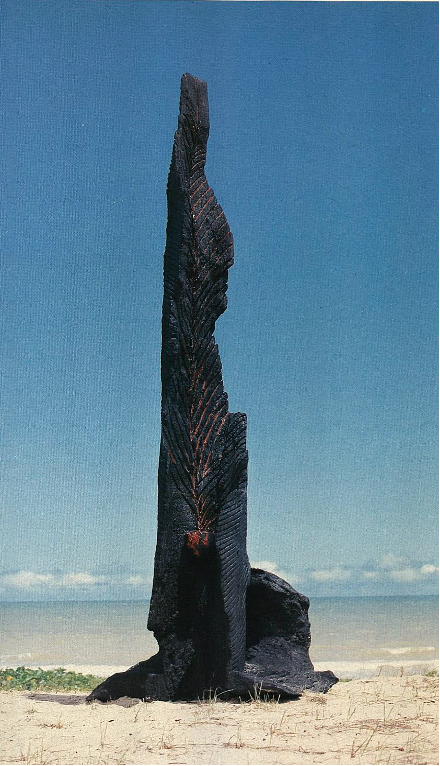
Figure 2: Homage do Chico Mendes. Natural pigment over over trunk. Frans Krajcberg: Imagens do Fogo, 1992.
Made with the incinerated trunk of an Amazonian tree recovered after a forest fire, the sculpture embodies, shaman-like, a series of metamorphoses, as well as transmutations of meaning that reveal the instability of human/non-human and organismic/material dualisms. The wood of a dead tree, that is to say, plant life turned into matter, refers to another death—that of rubber-tapper Chico Mendes. The sculpture points to the intricate ties binding plant and human bodies, both in life and in death. Such a connection between the devastation of rainforests and the tragedies of human history were often underscored by the artist himself. He mentions that, when he beheld his first large-scale forest fire in the Brazilian state of Paraná, he realized that “the trees were like men calcinated by the war. I could not take it” (quoted in Isaac 2013, 133).
A Polish Jew who survived the Holocaust, where he lost his entire family, Krajcberg regarded the devastation of nature as a repetition of the horrors he witnessed during the Second World War. “The first time I wept after the war was in [the Brazilian Amazon state of] Acre, when I saw all that destruction,” he states, “I could no longer tolerate man’s barbarity once I found nature” (quoted in Collontonio and Cravo 2005, 42). For Krajcberg, the assassination of Mendes goes hand in hand with the murder of the trees themselves who are relentlessly killed because of human greed. The striations carved into the wood of the sculpture stand for the activity of rubber-tappers who make small incisions in the bark of rubber trees to collect their sap. But the red pigmentation embedded in those striations is a clear reference to blood: the blood of all war victims the artist saw in his youth; the blood of murdered activist Chico Mendes; the symbolic blood of the charred tree whose death made that particular artwork possible; and the metaphorical blood of all other Amazonian plants destroyed in forest fires.
Still, the incinerated tree trunk in “Homage to Chico Mendes” cannot be reduced to a symbol of passive victimhood. The strong, dignified posture of the burnt trunk belies its interpretation as an inert, unresponsive entity, enlivened solely through Krajcberg’s artist touch. The powerful impression the artwork leaves upon viewers results precisely from the encounter between Krajcberg’s artistic skill and the signification of the former-plant-turned-matter that performatively articulates flora’s suffering through the display of its mutilated body. Human, plant and wood as matter join efforts that coalesce in an artistic and activist statement against the gratuitous annihilation of rainforests in the Amazon and throughout the world.
The research for this article was funded by a Grant from the Portuguese Foundation for Science and Technology (FCT), Project IF/00606/2015
[1] This and all other quotes from an original in a language other than English are rendered in my translation. Page numbers refer to the original.
[2] The title of the movie could also be translated as Krajcberg: The Poet of Vestiges/Remains.
[3] As Isaac points out, Krajcberg had been using nature “as his main raw material” at least since the 1960s (2013, 134). He used fern relief, “rock” and “earth” paintings and employed found mineral tints in his artistic creations.
[4] For a detailed description of Krajcberg’s artistis development, see McNee 2014, 101–107.
[5] Hegel makes this claim throughout his phenomenology, but see, for instance, paragraph 753 of the text.
[6] It is a well-known fact that rainforest soils such as those of the Amazon, are nutrient-poor. They need to be constantly replenished through the decomposition of organic matter. Once forests are burnt or cut down to give way to monocultures or cattle raising, soils quickly become depleted. This creates the need for clearing more and more areas of rainforest for agribusiness, creating a spiral of deforestation, soil depletion and renewed deforestation.
[7] Another definition of biosemiotics is: “a discipline that examines sign processes, meanings, and communication in and between living organisms” (Maran 2014, 260). For Wheeler, “the biosemiotic ‘project’ […] consists in an elaboration […] of the observation that all life—from the cell all the way up to us—is characterized by communication, or semiosis. This insight […] places humans back in nature as part of a richly communicative global web teeming with meanings and purposes […]” (2011, 270). As Kull, Emmeche and Hoffmeyer point out, already for Ferdinand de Saussure, the founder of modern linguistics, “semiology (the science of signs as he called it) was a field that would cover a much wider range of sign systems than human language” (2011, 3). Sebeok, the founder of biosemiotics, believed that “the process of message exchanges, or semiosis, is an indispensable characteristic of all terrestrial life forms,” adding that “semiosis, independent of form or substance, is thus seen as a universal, criterial property of animate existence” (quoted in Maran 2014, 261).
[8] Kull, Emmeche and Hoffmeyer list several disciplines that have contributed to biosemiotics: biohermeneutics, as developed by Sergey Chebanov and Anton Markoš; biosemantics, put forth by Ruth Millikan, Walter Fontana, and Marcello Barbieri; Stephen Pain’s biorhetorics; logic, especially studies of animal and vegetal logic; and biolinguistics, or studies on the biological basis of human language (2011, 12–13). Maran distinguished between semiology, which is mostly associated to European thought, and the semiotic tradition that can be traced back to American philosopher Pierce: “For most people in the humanities, at least in Europe, the word semiotics is associated, first of all, with the structuralist tradition, the semiology of Ferdinand de Saussure, the Prague linguistic circle, Louis Hjemslev, Claude Lévi-Strauss, Roland Barthes, and other representatives of the same tradition of thought. On the other hand, biosemiotics relates to another tradition of thought that, inside of semiotics, has become more and more eminent in the recent decades. This tradition proceeds from the semiotics of the American philosopher Charles Sanders Peirce and has been elaborated by his students or followers Charles W. Morris, Thomas A. Sebeok, Jesper Hoffmeyer, John Deely, and many others” (Maran 2014, 260) For Maran, the latter tradition is more open to considering the possibility of signification outside the realm of human discourse: “Unlike European semiology, which focuses on sign structures or systems, Peircean semiotics is also capable of dealing with various local sign relations in nature” (261).
[9] The point of departure of biosemiotics is “the realization that the sign-processing abilities in humans did not emerge de novo, but […] evolved from and are built upon the more primitive sign-processing abilities of our animal ancestors” (Favareau 2010, 260).
[10] Krampen writes that “[t]here are three levels of meaningful cycles corresponding to predominance of indexicality, iconicity, and symbolicity, each higher process including also the lower. Indexicality, on the vegetative level […] [i]conicity, on the animal level […] [s]ymbolicity, on the human level” (2010, 270).
[11] Bennett argues for the vitality of matter: “I will try to give voice to a vitality intrinsic to materiality, in the process absolving matter from its long history of attachment to automatism or mechanism” (2010, 3). “The project, then,” writes Bennett, “is to theorize a kind of geoaffect or material vitality, a theory born of a methodological commitment to avoid anthropocentrism and biocentrism—or perhaps it is more accurate to say that it is born of an irrational love of matter” (61).
[12] As Iovino and Oppermann put it: “All these ideas—a distributive vision of agency, the emergent nature of the world’s phenomena, the awareness that we inhabit a dimension crisscrossed by vibrant forces that hybridize human and nonhuman matters, and finally the persuasion that matter and meaning constitute the fabric of our storied world—are the basic premises of material ecocriticism” (2014, 5).
[13] Barad decries the linguistic turn in the humanities: “Language has been granted too much power. The linguistic turn, the semiotic turn, the interpretative turn, the cultural turn: it seems that at every turn lately every ‘thing’—even materiality—is turned into a matter of language or some other form of cultural representation. […] matters of ‘fact’ (so to speak) have been replaced with matters of signification (no scare quotes here)” (2007, 132).
[14] Bennett also mentions that agency lies in assemblages, not in discreet entities in chapter 2 of her book, titled “The Agency of Assemblages.” She writes: “If human culture is inextricably enmeshed with vibrant, nonhuman agencies, and if human intentionality can be agentic only if accompanied by a vast entourage of nonhumans, then it seems that the appropriate unit of analysis for democratic theory is neither the individual human nor an exclusively human collective but the (ontologically heterogeneous) ‘public’ coalescing around a problem” (2010, 108).
[15] “As Barad points out, “the primary ontological unit is not independent objects with inherent boundaries and properties but rather phenomena. […] The notion of intra-action (in contrast to the usual ‘interaction,’ which presumes the prior existence of independent entities or relata) represents a profound conceptual shift” (2007, 138).
[16] Negro River, or Black River, is one of the main waterways of the Amazon River Basin and one of the largest tributaries of the Amazon River.
[17] For a history of the reception of the Rio Negro Manifesto in Brazil and in Europe, see Walters 1998, 106–108.
Barad, Karen. 2007. Meeting the Universe Half Way: Quantum Physics and the Entanglement of Matter and Meaning. Durham, NC: Duke University Press. https://doi.org/10.2307/j.ctv12101zq
Bennett, Jane. 2010. Vibrant Matter: A Political Ecology of Things. Durham, NC: Duke University Press. https://doi.org/10.1215/9780822391623
Cadena, Marisol de la. 2015. Earth Beings: Ecologies of Practice Across Andean Worlds. Durham, NC: Duke University Press.
Castro, Eduardo Viveiros de. 1998. “Cosmological Deixis and Amerindian Perspectivism.” Royal Anthropological Institute of Great Britain and Ireland 4 (3): 469–88. https://doi.org/10.2307/3034157
Collontonio, Alex, and Christian Cravo. 2005. “Screams from the Forest: Frans Krajcberg Uses His Art to Protest Man’s Destruction of the Planet.” Americas 57 (4): 41–45.
Deely, John. Basics of Semiotics. 1990. Bloomington and Indianapolis: Indiana University Press.
Depondt, Sylvie, and Claude Mollard. eds. 2017. Frans Krajcberg: un artiste en resistance. Plaissan: Museo Éditions.
Favareau, Donald. 2010. “Introduction: An Evolutionary History of Biosemiotics.” In Essential Readings in Biosemiotics: Anthology and Commentary, edited by Donald Favareau, 1–77. Heidelberg: Springer. https://doi.org/10.1007/978-1-4020-9650-1_1
Frans Krajcberg: Imagens do Fogo. 1992. Rio de Janeiro: Museu de Arte Moderna do Rio de Janeiro.
Galeano, Juan Carlos, dir. 2017. El Río.
Hegel, G. F. W. 1977. Phenomenology of Spirit. Translated by A. V. Miller. Oxford: Oxford University Press.
Iovino, Serenella. and Serpil Oppermann. 2014. “Introduction: Stories Come to Matter.” In Material Ecocriticism, edited by Serenella Iovino and Serpil Oppermann, 1–17. Bloomington and Indianapolis: Indiana University Press.
Isaac, Cristiana Bernardi. 2013. “Krajcberg e Oiticica: Precursores da Arte na Paisagem no Brasil.” Paisagem e Ambiente: Ensaios 31: 125–46. https://doi.org/10.11606/issn.2359-5361.v0i31p125-146
Kull, Kalevi, Claus Emmeche and Jesper Hoffmeyer. 2011. “Why Biosemiotics? An Introduction to Our View on the Biology of Life Itself.” In Towards a Semiotic Biology: Life is the Action if Signs, edited by Claus Emmeche and Kalevi Kull, 1–21. London: Imperial College Press. https://doi.org/10.1142/9781848166882_0001
Karlsson, Fredrik. 2012. “Critical Anthropomorphism and Animal Ethics.” Journal of Agricultural and Environmental Ethics 25: 707–720. https://doi.org/10.1007/s10806-011-9349-8
Kohn, Eduardo. 2013. How Forests Think: Toward an Anthropology beyond the Human. Berkeley: University of California Press. https://doi.org/10.1525/california/9780520276109.001.0001
Krajcberg, Frans, and Claude Mollard. 2017. “Nouveau Manifeste du Naturalisme Intégrale.” In Frans Krajcberg: un artiste en resistance, edited by Sylvie Depondt and Claude Mollard, 78–81. Plaissan: Museo Éditions.
Krampen, Martin. 2010. “Phytosemiotics.” In Essential Readings in Biosemiotics: Anthology and Commentary, edited by Donald Favareau, 262–277. Heidelberg: Springer.
McNee, Malcolm K. 2014. The Environmental Imaginary in Brazilian Poetry and Art. New York: Palgrave MacMillan. https://doi.org/10.1057/9781137386151
Maran, Timo. 2014. “Biosemiotic Criticism.” In The Oxford Handbook of Ecocriticism, edited by Greg Garrad, 260–275. Oxford: Oxford University Press. https://doi.org/10.1093/oxfordhb/9780199742929.013.008
Restany, Pierre, Sepp Baendereck and Frans Krajcberg. 2017. “Manifeste du Rio Negro du Naturalisme Intégrale.” In Frans Krajcberg: un artiste en resistance, edited by Sylvie Depondt and Claude Mollard, 74–76. Plaissan: Museo Éditions.
Russo, Sylvia. 2009. “La révolte du Phénix.” Vie des Arts 53 (216): 20–21.
Ryan, John Charles. 2020. “Writing the Lives of Plants: Phytography and the Botanical Imagination.” a/b: Auto/Biography Studies 35 (1): 97–122. https://doi.org/10.1080/08989575.2020.1720181
Salles, Walter, dir. 1986. Krajcberg: O Poeta dos Vestígios.
Slater, Candace. 1994. Dance of the Dolphin: Transformation and Disenchantment in the Amazonian Imagination. Chicago: The University of Chicago Press. https://doi.org/10.7208/chicago/9780226924892.001.0001
Walters, Roberta Lanese. 1999. “Frans Krajcberg: Art in Defense of the Forest.” PhD Thesis. Texas Tech University.
Wheeler, Wendy. 2011. “The Biosemiotic Turn: Adbuction, or, the Nature of Creative Reason in Nature and Culture.” In Ecocritical Theory: New European Approaches, edited by Axel Goodbody and Kate Rigby, 270–282. Charlottesville: University of Virginia Press.
Patrícia Vieira is Senior Researcher at the Centre for Social Studies (CES) of the University of Coimbra and Professor of Spanish and Portuguese at Georgetown University. Her most recent monograph is States of Grace: Utopia in Brazilian Culture (SUNY UP, 20018) and her most recent co-edited book is The Mind of Plants: Narratives of Vegetal Intelligence (Synergetic, 2021). She is the recipient of a European Research Council grant to analyze literature, cinema and art about the Amazon River basin. For more information visit: www.patriciavieira.net
© 2021 Patrícia Vieira
Except where otherwise noted, this work is licensed under a Creative Commons Attribution-NonCommercial-ShareAlike 4.0 International License.