Being in Touch: A metamorphosis of Jan Fabre’s The Castles in the Hour Blue into bodies of longing
Sylvia Solakidi, Center for Performance Philosophy, Surrey UK
for Λ
“Time is the substance I am made of.
Time is a river which sweeps me along, but I am
the river;
it is a tiger which destroys me, but I am the
tiger; it is a fire which consumes me, but I am the fire.”
Jorge Luis Borges, “A New Refutation of Time”
A green light has sprouted in a small circle at the lower right
quadrant of her photograph. She is “active now.”
The pattern of dark photographs and those with bright green
circles changes continuously on the rectangular window of the
messenger application that is open while I write on my laptop.
Each light bears potential for a contact.
When did all these lights emerge?
As I am sitting at my writing table and I move my eyes from the
rectangular laptop screen to my rectangular window, I see the
rectangular sky segment cloudy and the lights on in several
rectangular windows of the rooms at the opposite side of the inner
yard; each light indicates human activity. The pattern of dark and
bright rectangular elements changes continuously, following the
weather and the hours of the day. The time that passes becomes a
kaleidoscopic installation of flashing lights that I cannot
affect; I cannot affect time, as I cannot contact people and
participate in their activities. An Empire of Light in
the inner yard.
In the old times, we touched each other and it was only Mr Monk
who needed antiseptic wipes after human contact. In the old times,
we were active with others outside our homes and it was only Mr
Monk who believed that “it’s a jungle out there.” This is the
title of Randy Newman’s song for the titles of the TV series about
the brilliant detective who suffered from phobias that worsened
after the loss of his beloved wife. Since March 2020, it’s a
jungle out there for everyone; the COVID-19 pandemic jungle. In
order to protect each other we must practise social distancing.
Our homes are shields from the virus and isolation is the price we
pay for safety; we trade human contact for safety. Touch is
related etymologically to both contact and contagion (Partridge
1991, 692); touch, though, has become dangerous, as if it was
related only to contagion and not to contact.
Despite a distance of no more than a few metres, people and
their activity around the inner yard are beyond my reach. My need
not to lose touch becomes more pressing with time; I am near but
not close enough. I am like Tantalus, who saw trees and rivers
withdraw, as he stretched his arms to grab fruits and drink water;
he could see what he could not have. As I am sitting at my writing
table and I am looking out of the window, the unbridgeable
distance of safety brings despair; I acquire the desperate body of
Tantalus. I can only be in touch with people online. Distance
depriving me from human contact in the physical space and
transforming contact in the digital space becomes a limitation in
my life.
The old times of touch as contact rather than contagion were
only over a year ago.[1]
Experts talk about the post-pandemic era, a new era of human
relationships. Old times bring nostalgia and post-pandemic brings
uncertainty. The distance in space that isolates one from others
is transformed into a distance from time, as I am isolated from
both past and future; I close down into a parenthesis of time. The
notion of post-pandemic implies a future as succession and
completion, a future of evolution, which closes the door behind it
and sets an unbridgeable distance from the past, the old times
when touch as contact was possible. If I lose touch with contact
and I offer touch to contagion, this parenthesis will never open
again and contact will be confined to an unreachable past.
Certainly, quarantine and physical distance are needed during the
pandemic. But why should physical distance become social and
temporal as well?
As I am sitting at my writing table, I try to make sense of my
unprecedented isolation. I read Marc Augé’s 2014 book The
Future and I realize that the future of post-pandemic is
not the only option. The future, he claims, is “a time of
conjunction,” which “always has a social dimension” and “depends
on others,” so that we may not lose touch (Chapter 1). The
parenthesis of time will make the past of touch as contact
“disappear and collapse” and will bring more “solitude in the
blank image of a terrifying future” (Chapter 2). Augé’s notion of
the future as “inauguration,” a “beginning” and a “birth” (Chapter
3), suggests that the transformation of touch from contagion into
contact can only happen during the pandemic, otherwise loss will
be irrevocable.
As I am sitting at my writing table and I am looking at the
succession of day and night in the changing pattern of lights in
the rectangular elements on my screen and outside my window, I
re-view an image of day and night, light and darkness, from the
old times. On a gallery wall, two rectangular drawings are hung
side by side; the day and the night, the sun and the moon, a cross
for the sun and a sword for the moon, among blue lines that cover
the surface of the drawings. Let’s follow the blue lines; where
did they stem from?
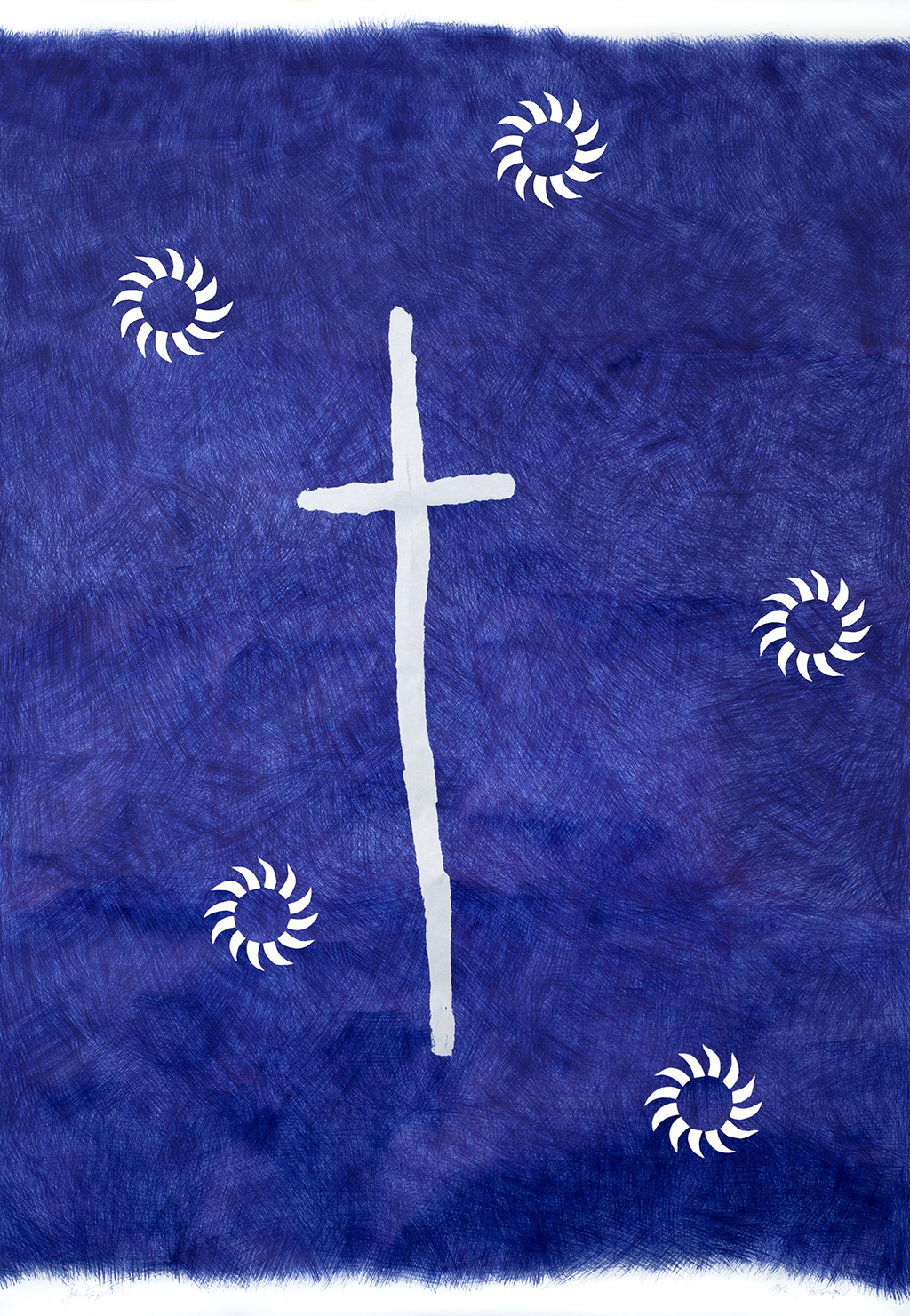
Figure 1a: Jan Fabre Cross with suns
(1987). Bic ballpoint pen on paper 238 x 165 cm. Photo: Pat
Verbruggen. Copyright: Angelos bv.
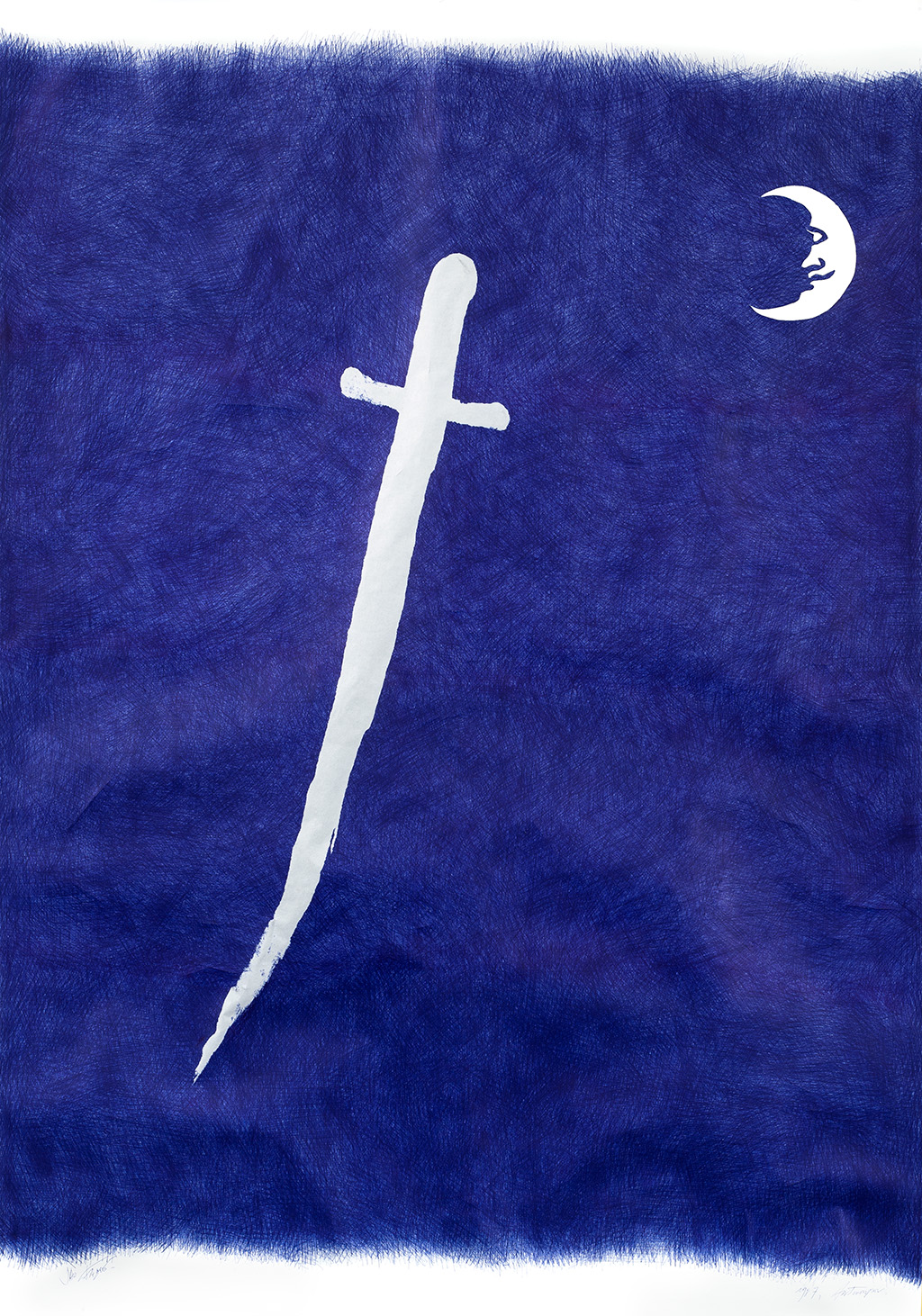
Figure 1b: Jan Fabre Sword in
the night (1987). Bic ballpoint pen on paper 238 x 165 cm.
Photo: Pat Verbruggen. Copyright: Angelos bv.
***
In the beginning was an insect. In the late 1970s, in Antwerp,
Belgium. On a white paper sheet on the top of the work table of a
young artist. What time is it? It is the Hour Blue, the time of
stillness and silence, when nocturnal animals have gone to bed and
diurnal animals are not yet awake (Bernadac 2008, 104). The Hour
Blue is a hybrid of night and day. It is not “night” since
nocturnal animals are not active; it is not “day” either, since
diurnal animals are not active. It is like an Empire of Light,
René Magritte’s series of paintings with a paradoxical combination
of a day sky with a night earth. It is the time of sleep and
transformation from night to day; it is “the hour of imagination”
(van den Dries 2001, 61).
The artist is the great nephew of the entomologist Jean-Henri
Fabre who defined the Hour Blue. And the insect was with the
artist, with Jan Fabre, who is awake and works at his table. He
was intrigued by the insect’s movement on paper and he traced it
with a blue BIC ballpoint pen (Fabre and Bekkers 2006, 23–24); he
wrote movement down. More BIC blue lines followed; the white paper
became blue with white gaps since the pen can never cover the
surface smoothly. “There is a land where drawing is writing and
vice versa […] This land lives in me and I have discovered it
through Vincent van Gogh,” Fabre writes in his diary (Fabre 2011,
15). The BIC blue lines are vibrating like those in van Gogh’s
paintings. As the Hour Blue, the hybrid of night and day, is drawn
in BIC blue pen, which is a writing instrument, each work becomes
a hybrid of drawing and Fabre’s handwriting. Out of the repetitive
BIC blue lines emerge letters, words and forms, either in blue or
in white—cuts on paper or spaces untouched by BIC, like the sun,
the moon, the stars, the sword and the cross in the works Cross
with Suns and Sword in the Night [Figures 1a and
1b]. Drawing and night are not closed down into themselves, but
open up towards writing and day, their supposed opposites.
The process of transformation from egg to adult during the life
cycle of an insect is called metamorphosis. And since an insect
triggers the drawing of the first line of Fabre’s Hour Blue, it
transforms it into an hour of metamorphosis. For Fabre, who stages
repetition in his visual and performing art, the biological
process of metamorphosis has become “an attitude in life” (van den
Dries 2001, 60). Repetition that allows the body of the artist “to
master the action” (59) is his condition for endless
experimentation (Fabre 2011, 134) and is derived from what he
considers to be the main principle of theatre that repeats itself
differently in each rehearsal and performance of a piece (Fabre
2011, 132). In Flemish, his language, the word “repetitie” stands for both repetition and rehearsal (van Dale 2008).
Metamorphosis for Fabre becomes the opening up towards new
experiences; it is a birth. Each repetition is different than the
previous one, like the forms of the body of an insect during its
life cycle. Each repetition is metamorphosis in-the-making, a
process towards a future (Fabre 2011, 139), which can be
inauguration and new beginning, according to Augé.
As I am sitting at my writing table, I try to make sense of my
unprecedented isolation from people and time by approaching the
future through Fabre’s staging of the biological notion of
metamorphosis. He is not alone in this process. In his 2021 book Metamorphoses,
philosopher Emanuele Coccia also reflects on metamorphosis as a
concept not confined to insects and their biology but as a
principle of “shared life” (174). He approaches metamorphosis as
an alternative to “evolution and progress” (9), since the
different forms of an organism do not replace one another but are
“simultaneously present and successive” (9), comprising “a
continuity of life” (3). He claims that metamorphosis is rather a
life of forms than a form of life” (54). “A single self expresses
itself” across forms (57) and none of them corresponds to a final
stage of an evolutionary process; metamorphosis is always
in-the-making. “Every living being is a chimera” of more forms,
states Coccia (55). Accordingly, Fabre privileges metamorphosis
because he “refuses to accept the body as a closed identity” (van
den Dries 2001, 66). Bodies on his stage are “hybrid,” hence
“liquid” and “rebellious,” and cannot be easily kept under
control, as they change form continuously. The Hour Blue that is
initiated by insects as a hybrid of night and day, as well as
writing and drawing, is for Fabre the hour of metamorphosis,
because the body can open up from its presumed “unique” identity
(61).
How about the body of Tantalus and its closed identity of
desperate isolation? Could it open up through a metamorphosis? As
I am sitting at my writing table, I re-view my experience of
Fabre’s Hour Blue drawings.
It is December 2018 in Milan and I visit Fabre’s exhibition The
Castles in the Hour Blue (22.09–22.12.2018) curated by
Melania Rossi in Building Gallery and Basilica of Sant’ Eustorgio.
The choice of the church does not come as a surprise. Fabre has
been influenced by the spirituality of the works of Great Masters
in Antwerp, his home city. He has even created works that are
permanently housed in Churches, such as his sculpture The man
who bears the Cross in the Cathedral of Our Lady in Antwerp
and his installations with hearts made of red coral in the Chapel
of Pio Monte della Misericordia in Naples. As I look at the works
and I am taking down notes in BIC ballpoint pen, I keep my hands
busy, with a pen and a notepad, while my hands are eager to touch
the works. These drawings with the blue lines that scratch the
paper deep and create a relief surface are like “parchment or
prepared skin,” as Fabre states (2014, 158). Their protective
glass makes the distance from the skin of my hands to their “skin”
feel bigger; I am near but not close enough. I am desperate to
touch the works, I long for this touch. The inviting, tactile
characteristics of these drawings, though, can be perceived with
my eyes; my eyes touch them. It is not the torture of Tantalus. It
is a game of the senses. The distance between our skins is part of
this game, it makes the experience of drawings more intense, as I
am on the verge of touching the works and my imagination is
triggered by involving two senses, vision and tactility, instead
of tactility alone. The viewing experience of the drawings of the
hybrid Hour Blue becomes a hybrid of two senses, a sense
in-the-making, a metamorphosis of my senses and my viewing
experience that allows me to be in touch with the drawing without
touching it.
In a series of 1989–1990 drawings, castles made of plant leaves
are placed on the BIC blue lines (Figure 2). No, these are not
leaves, they have antennae… and six legs. They are insects! The
castles are made of bodies of Phyllium giganteum, an
insect species that has a hybrid phenotype and resembles a plant
leaf. These insects undergo metamorphosis to leaves and castles by
crossing over the limits of species and living organisms; they are
hybrid creatures of the Hour Blue. They tend towards the BIC blue
lines, they long for them, but are never fused with them. They are
added on the relief as distinct bodies that interact with the
“prepared skin,” they organize and orient the vibrating BIC blue
lines around them, and they shape their Hour Blue
through their BIC blue shadow. The intensity of the interaction
between castles and BIC blue lines adds to the intensity of my
viewing experience of the drawing’s tactile features.
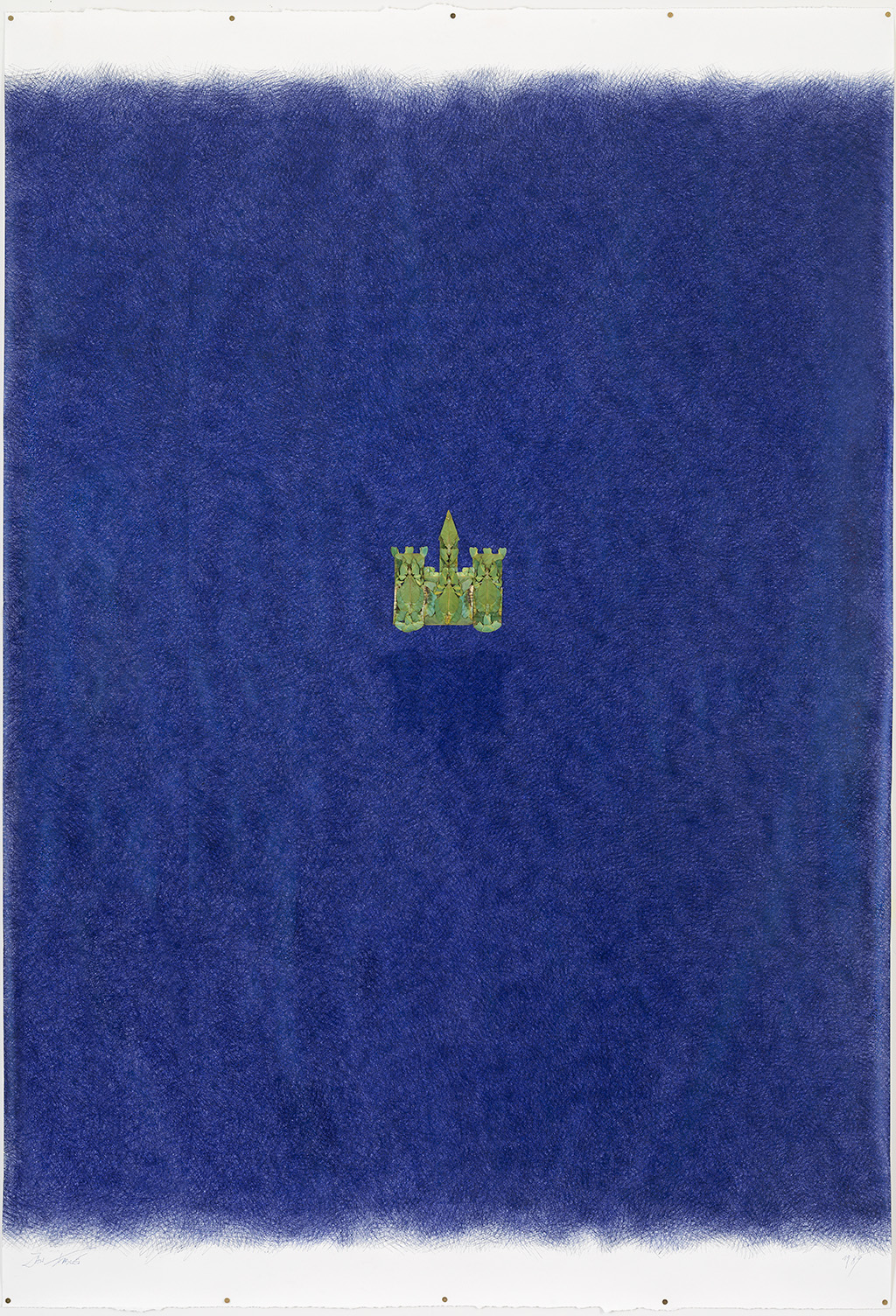
Figure 2: Jan Fabre Dream castle in the hour
blue (1989). Bic ballpoint pen on paper with pieces of Phyllium
giganteum 168,2 x 164,5 x 6 cm (incl. frame). Photo: Pat
Verbruggen. Copyright: Angelos bv
These castles are not made of stone but of bodies of insects;
life is their building stone. More precisely, “shared life”
(Coccia 2021, 174), since insects offer them their process of
metamorphosis. For Fabre, insects are “comparable to medieval
knights,” since their exoskeletons are like armour. He believes
that an armour protects the vulnerability of existence and he
embraces metamorphosis as a way to expose and protect this
vulnerability (Bernadac 2008, 105). “The medieval universe” is a
place “where the opposites coexist,” he states. His example is the
brave Lancelot, who has an imperfection since he commits adultery.
Like a medieval knight, the insect is “hard and vulnerable” (32).
The castles in the Hour Blue are such hybrids; they are vulnerable
shields. The Hour Blue, the hybrid that is fluid and cannot be
controlled, can protect as well.
In Basilica of Sant’ Eustorgio, Fabre’s 1987 piece on artificial
silk A Castle in the Sky for René (Figure 3) was hung
like a soft wall, along the left aisle of the main body of the
church, where the Mass takes place. There are no insects in this
piece. Out of the BIC blue lines emerge various forms. As I was
about to light a candle at the chapel opposite this work, I saw a
heart; it was the main form at the upper right part of the piece.
No, it is not a heart; it is a rock, the building stone of the
castle. The piece is dedicated to René Magritte, the Belgian
painter who used to paint rocks, as well as skies, like the day
sky over the night earth in his series Empire of Lights,
and Fabre considers him to be one of his Masters. The information
next to the piece pointed to my mistake; still, I looked at the
piece and its heart was beating. A metamorphosis of the rock into
a heart took place in my viewing experience. The castle founded by
this rock is a vulnerable shield, a castle in the Hour Blue,
because its beating heart is an invitation for a contact with
those who are outside. This castle offers security not because its
rocks are as strong, but because it longs for contact. A castle
can be seen from everywhere, but life inside is inaccessible; it
is closing down and it is always ready for defence. This castle,
though, shows its beating heart and opens up, it refuses isolation
and suggests that protection is connected to interaction. In the
Hour Blue of metamorphosis, safety undergoes a metamorphosis and
the knight of the castle made of stone/heart is desperate for
others; he longs for contact.
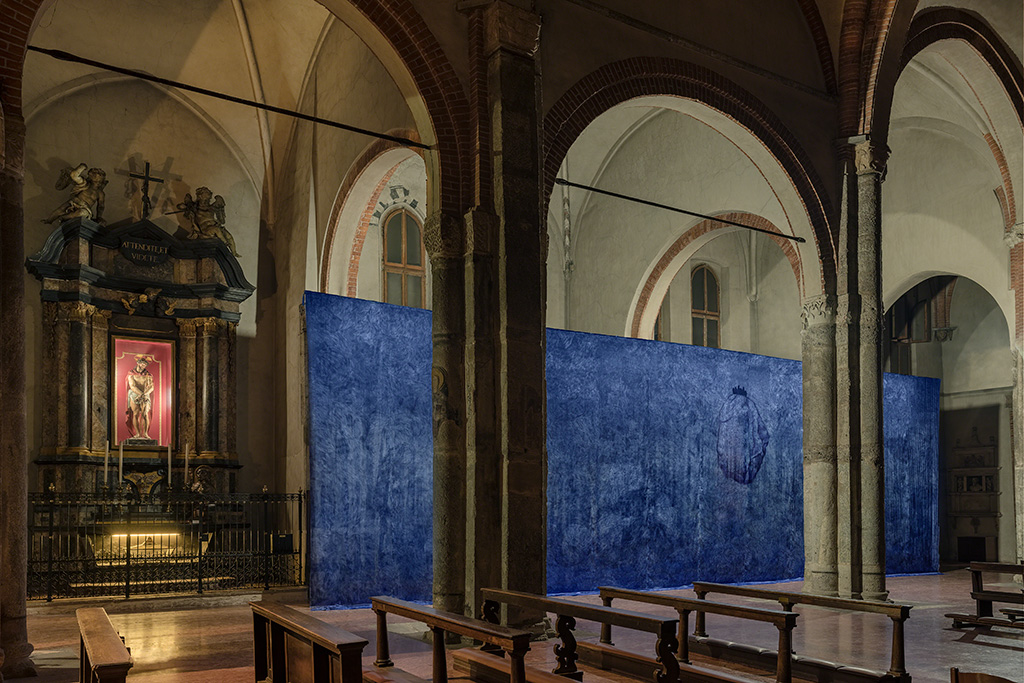
Figure 3: Jan Fabre A castle in the sky for René
(1987). Bic ballpoint pen on artificial silk 689 x 1684 cm. Photo:
Installation during the exhibition ‘Jan Fabre. The Castles in the
Hour Blue’, Milan, 2018. Location: Basilica of Sant’Eustorgio,
Portinari Chapel. Photo: Atiilio Maranzano. Copyright: Angelos bv
And there was evening, and night is not the end of the day for
Fabre, but the beginning. The Hour Blue is his time of creativity,
when he makes his drawings and writes in his diary; he uses BIC
pen for both, as “despite the computerized world, he writes
everything by hand” (Lórán 2012, 140). “Whom can I count on?” he
asks in his Night Diary (Fabre 2011, 129). His diary is
intimate, a way to close down into his thoughts, but he longs for
interaction with others, he is desperate to open up during the
day; he has also published his intimate diaries.
He works in his home that is lit not only by electricity, but by
his creativity as well; it becomes a House of Flames, of
BIC blue vibrant flames, like the houses of his 1989–1991
installation—three rectangular boxes painted in BIC blue and a
bigger one, a “Tower,” at the end. The first box has its door
closed, the other two have their doors open at different degrees,
while the Tower’s door is wide open (Figure 4). This installation
is a hybrid of different stages of closing down and opening up; it
demonstrates metamorphosis in-the-making. I did not see this
installation in Milan. The Castles in the Hour Blue is a
touring exhibition but undergoes metamorphosis, as the curator
adapts it to each exhibition site. I saw this piece in Arras,
France, in Musée des beaux Arts, the old Benedictine Abbey of
Saint Vaast, where it was scheduled to run from 02.03.2020 to
04.05.2020, but closed early because of the COVID-19 restrictions;
I visited it on its second day, to re-view the works that I had
already enjoyed in Milan.
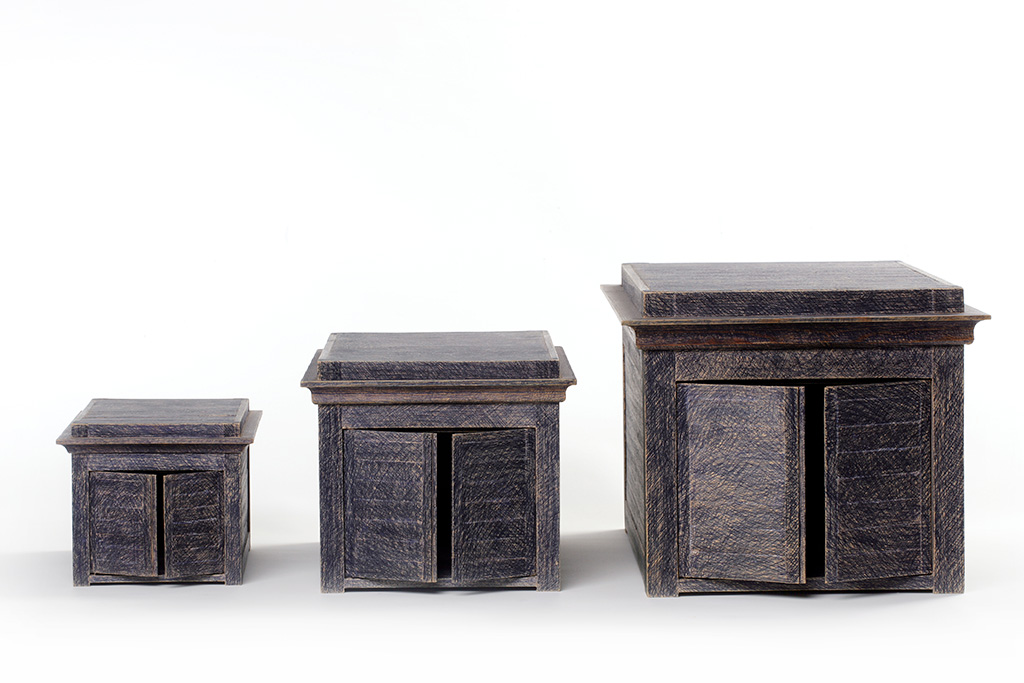
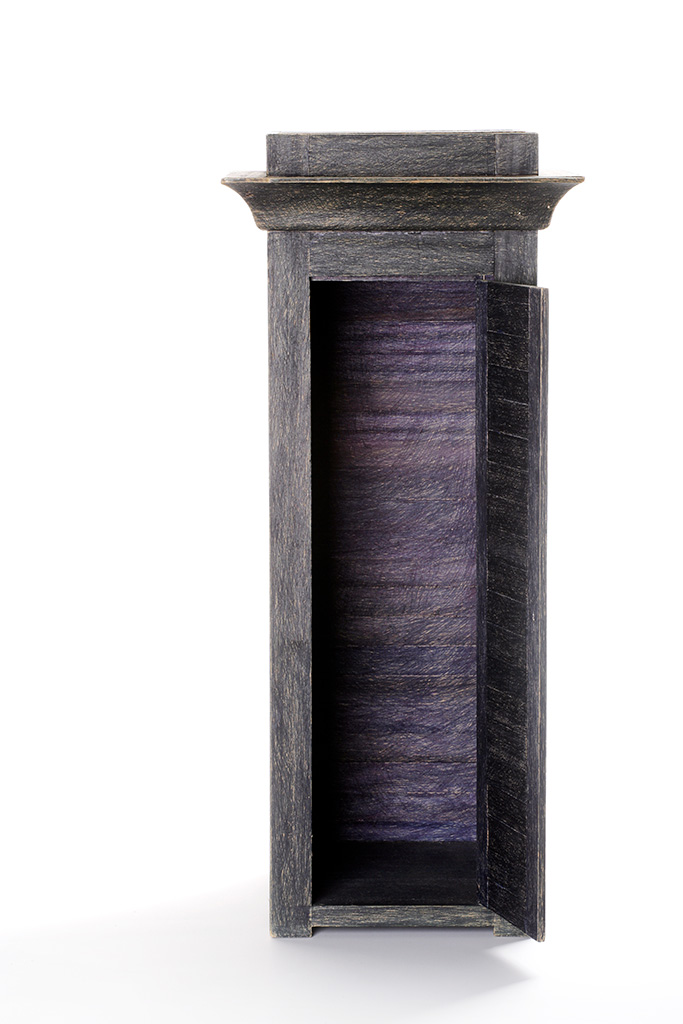
Figure 4: Jan Fabre Houses of flames (shrines)
(1988). Bic ballpoint blue on wood (three parts) 17 x 20 x 29 cm;
25 x 28,5 x 39 cm; 32 x 37 x 51,5 cm. Photo: Pat Verbruggen.
Copyright: Angelos bv. Jan Fabre Houses of flames (tower) (1991).
Bic ballpoint blue on wood 76 x 24 x 32 cm. Photo: Pat Verbruggen.
Copyright: Angelos bv
And there was morning and Fabre met people he could count on.
And with them he made the work Tivoli (1990), and
covered the walls of this castle with Hour Blue BIC drawings that
he prepared with friends and colleagues. The paper sheet of his
Hour Blue drawings has opened up and has become immense; he is
sharing the life of his Hour Blue with others. And others
re-create the Hour Blue with him. And others look at the works;
like me, who looked at photographs and film of the Tivoli castle
in his exhibition in Milan and Arras. His creativity of the night
undergoes metamorphosis and becomes a hybrid with the creativity
of others during the day.
And there was morning and Fabre met people he could count on.
And with them he makes theatre. During the night he prepares
himself for the rehearsals of the day by writing and making
drawings (Fabre 2011, 140); he prepares himself for the
metamorphosis of his creative rituals of the night into the
rituals in his rehearsal space, Troubleyn Laboratorium, in
Antwerp. “Ritual is essentially a birth,” as Augé insists, and
theatrical rituals are only possible with others. The
collaboration in Fabre’s theatre Laboratorium is also based on
metamorphosis, as Fabre believes that there is “one long chain
that keeps us all together” (van den Dries 2001, 61). The
biological fact that “our life […] was transmitted to us by
others” and that it is “a continuation and a metamorphosis of a
life that came before it” (Coccia 2021, 3–4), is transformed into
theatre. The paper sheet of his Hour Blue drawings has opened up
and has covered the stage of his first opera, The Minds of
Helena Troubleyn and his theatre piece Prometheus
Landscape I, after Aeschylus’s Prometheus Bound
in the 1980s. The knight has admitted his vulnerability by showing
the beating heart of his castle, his own beating heart, and he
longs for sharing his activities with others. He opens the door
gradually, with caution, Safety is not achieved in total
isolation, but in cautious interaction with others. Fabre closes
down for preparation in order to open up for collaboration,
towards a future as birth and “conjunction,” as Augé states, which
materializes in his theatre pieces. A castle in the Hour Blue can
be a shield for the preservation of contact; the invitation to
shield together and protect each other.
***
In the beginning was an insect and the insect is Fabre. He is
the dung beetle, “the happy Sisyphus” of repetition. He identifies
himself with the beetle that rolls a huge ball to the peak of a
hill and lets it roll back in order to collect materials and do
the itinerary again, differently (Fabre 2002). And as an insect he
can undergo metamorphosis into a castle; he becomes a
castle in the Hour Blue.
And there was evening. In his House of Flames, Fabre cannot
sleep. He is an insomniac, “he lives the night in a continuous
manner” (Fabre and Bekkers 2006, 21). As a result, he is awake
when both nocturnal and diurnal animals sleep and he experiences
the Hour Blue. He does not only observe the Hour Blue, but he
shapes it, he makes it his own, as the BIC blue lines are directed
towards the lower right corner of the paper and give rise to his
signature; his name becomes another bunch of vibrant BIC blue
lines. As he undergoes the metamorphosis of Hour Blue every night,
he becomes the Hour Blue.
According to Coccia, “being alive does not just mean perceiving
the world […] but also constructing it, shaping it in a different
way” (155). Fabre reflects on his insomnia and explains it
creatively: “Why don’t I sleep? Because only during the night I
have the time to be who I am” (2011, 20). He approaches sleep
deprivation as a creative limitation and as he is both a Castle and
the Hour Blue, he copes creatively with time, in a way that
differs from those who can sleep. The Hour Blue, his time of
“imagination,” becomes his time of creativity because he dares to
cope creatively with its temporality.
Since his childhood, he has been building castles and listening
to chivalry stories from his father (Fabre 2011, 99). Fabre has
been dreaming to restore chivalry as a fight for a good cause
(2014, 37). The knight of despair is the main character in his
2005 theatre piece History of Tears. The knight achieves
a metamorphosis of his desperate situation, from loss of hope to
longing for something, as despair makes him believe “in an absurd
hope” (Fabre 2005, 31). This knight has a special relationship
with temporality, as he says “I sense the future” (11). The good
cause that he fights for is the search for a future through
relating to people, those who are on the same stage, where he
performs his monologues at a distance. As time goes by, he
switches from “I” to “we,” when he speaks. He longs for people, as
he longs for the future that he can already sense. His sword in
this fight is “the force of vulnerability” (11). The knight is
immortal, a hybrid of living and dead bodies, since when one dies,
another takes its place (12). His body undergoes metamorphosis of
life and death and constantly changes form. It does not have “a
closed identity” (van den Dries 2001, 66), but it is “longing for
completeness” (61). For Fabre, this completeness is “the sublime
moment when scene and audience merge into a seamless whole” (61),
the moment when the insomniac artist who works alone in his room
when everyone sleeps, undergoes a metamorphosis through the
interaction with collaborators and audience.
The future that the knight senses cannot be a time that closes
down, a future of succession, but a future of a new birth. For
Coccia, metamorphosis is “a future, an omnipresent possibility.
[…] And everything leads back to it—especially death” (83), which
is “a metamorphic threshold” (90). For Fabre, “death is the father
of metamorphosis” (2007, 135). The knight of despair is a hybrid
creature of life and death on Fabre’s stage, where death longs for
life and vice versa; in his case, “two incompatible bodies belong
to the same individual” (Coccia 2021, 174). Death, the
vulnerability of existence, is not the end but the longing for a
future of a new birth.
Fabre who experiences the night “in a continuous manner,” like
the immortal knight experiences life and death “in a continuous
manner,” explores his insomniac body as a body that undergoes
metamorphosis, as a Castle in the Hour Blue. The vulnerability of
his insomniac body becomes his strength, like the exposed
vulnerability of the beating heart of the Castle of the Hour Blue.
Alone in the night, he creates rituals to cope with his insomnia.
These rituals undergo metamorphosis in his theatre space,
Troubleyn Laboratorium, his other “castle,” with his performers in
the morning. This Laboratorium is a shield for an artistic
community, “a sheltered building” (Bousset et al. 2016, 79). The
hybrid body of metamorphosis re-creates the Hour Blue by coping
creatively with its temporality through despair that longs for a
future of “an absurd hope;” a future through longing.
I went to Arras in March 2020 to watch Fabre’s solo theatre
piece Resurrexit Cassandra (2019), and his exhibition The
Castles in the Hour Blue was opening on that day. His
Cassandra is a hybrid creature of life and death, the prophetess
who comes back to life in order to warn humans about climate
change; she is a hybrid creature of the Hour Blue, although no BIC
blue lines cover the stage like in Fabre’s theatre works of the
1980s. On my last time in the theatre and in a museum before the
pandemic, I heard a plea for metamorphosis as a future through
longing. As I am sitting at my writing table, I re-view the
exhibition that I visited twice, through this plea. Since
metamorphosis is a process of repeating differently through
hybrids, I take up Fabre’s gesture and I explore it through the
dynamics of closing down and opening up. It is not a narrative of
evolution, my writing does not progress, but unfolds in rounds of
closing down and opening up that repeat this movement differently
in the art of Fabre and my experience of isolation; it creates
hybrids of these two states instead of opposing them to each
other. The beating heart and the open door of Fabre’s castles are
an invitation to share his creativity, an attempt to cope
creatively with time that will lead to a future through longing.
It is a narrative of a future as birth, a narrative of genesis of
a temporality that takes up the genesis of Fabre’s universe of the
Hour Blue. It is told with the help of the Book of Genesis and the
beginning of the Gospel of St John, an attempt of a secular
metamorphosis of a sacred narrative, like the one performed by
Fabre in his works that are in Churches.
I re-view Fabre’s exhibition in order to hybridize my experience
from the two visits with the experience of the pandemic. Art can
become a paradigm for shaping a future, since, as Augé claims,
“art offers to one and all the opportunity to live through a
commencement.” This experience does not end when I leave the
exhibition space, I can adapt it in order to live. Whom can I
count on? If touch is not closed down in a parenthesis of time
during the pandemic but becomes a hybrid of contagion and contact
by taking its vulnerability into account, this sense can undergo
metamorphosis and lead to a future through the hybrid temporality
of longing, since when I long for something, I experience in my
present a future birth.
As I am sitting at my writing table, I watch a recording of
Penny Arcade’s performance Longing lasts Longer
(Zehentner 2021), a performance that I experienced in London in
2016. “Longing is a persistent sense of loss that attaches to
ourselves,” states Arcade. Longing is not nostalgia, since
“nostalgia is done from a safe distance,” according to Arcade, but
touch is not trapped in the old times that can only be missed, but
is opening up towards the future of a new birth. As a hybrid
temporality, “longing lasts longer, longer than anything else,” as
Arcade keeps repeating, since it does not close down into one
point in time. It is immortal like the knight of despair, and
takes different forms; longing is constantly born anew. Longing
can make metamorphosis happen because it prepares for it. As I am
sitting at my writing table, I read the novella Mokusei!
by the Dutch writer Cees Nooteboom: “When does such a thing as a
great love begin? [...] probably started with the longing for one
[…] That had been the preparation for the moment” (50). For the
moment that Fabre’s theatre company meet their audience in theatre
venues; for the moment that quarantine will end.
Longing is related to length, to distance in space and time of
waiting. When Fabre closes down in his home during the night, when
BIC blue lines cannot cover the paper smoothly and when I cannot
touch the drawings, distance does not lead to disruption of
experience but to its metamorphosis into creativity. Distance from
others, which is essential to keep us safe from the pandemic, can
be approached as a creative limitation, the way Fabre is coping
with his insomnia. As I am sitting at my writing table, I re-view
the exhibition in order to explore the possibility of a
metamorphosis of my body of the desperate Tantalus into a body of
longing. Fabre achieves metamorphosis, can I do the same?
Although the distance of a few metres among windows in the inner
yard seems unbridgeable, we can be in touch online by seeing each
other. We can change our point of view on time and refuse to
experience the pandemic as a temporal parenthesis in our lives.
Instead of leaving contact in the past, we may take advantage of
the fact that we can be on the verge of touch thanks to technology
and approach it as an opportunity which makes things more intense
and urgent. Longing becomes a pressing need for action when there
is a limitation. When touch was possible and I could not imagine
that I could be deprived of it, the viewing of Fabre’s exhibition
where touch was not allowed prepared me for it as I coped
creatively by experiencing the tactile features of drawings
through a hybrid sense of vision and touch. I was “long-prepared”
for the loss. This long preparation is called longing, a longing
for loss, by Leonard Cohen in his Book of Longing
(60–61) where he made his own metamorphosis of the poem “God
abandons Anthony” by Constantine Cavafy. The hybrid temporality of
longing extends to a past that is not nostalgia. When longing for
something, we are in touch with the whole temporality instead of
suffering inside a parenthesis of time; being in touch with time
prepares for being in touch with people.
The distance mediated by screens during a video call may
activate the game of the senses, since my gaze has been prepared
to long for tactile characteristics and the touch of skin, like
the “prepared skin” of Fabre’s drawings. In the same exhibition
space, my gaze was also prepared to touch the skin of the castle
of Tivoli, through photographs and a film. The prepared gaze does
not only perceive tactile characteristics but also creates and
changes its environment, an act that also “changes the environment
of others,” as Coccia suggests (156). Thus, the intensity of being
on the verge of touching people, leads to a metamorphosis of the
sense of touch, so that people who are in touch through screens
may participate in each other’s activities through the mutual
creation of an environment of shared life defined by longing to
touch and be touched.
French phenomenologist Maurice Merleau-Ponty proposes “the flesh
of the world” as the ontological element that guarantees the
intertwining between our bodies and the world thanks to
reversibility (1968, 147), the intertwining between the body and
the world as well as between senses. Since our bodies are nodes in
the fabric of this flesh of the world, they are open to the world
and our gazes “envelop” things and bodies (131). This
reversibility makes possible the game of the senses that leads to
the hybrid sense of vision and touch. Merleau-Ponty grounds
intersubjectivity on reversibility. He describes the relationship
that we have with our own bodies not as a relationship with an
object but as a reversibility of touching and being touched: when
my two hands touch each other, each of them is both touching and
being touched from the other (1964, 166). Intersubjective
relationships happen as intercorporeal relationships when the two
hands do not belong to one body, but two: “The handshake too is
reversible” (1968, 142). Through longing I can have something
without possessing it, unlike Tantalus, who sees what he cannot
have. Others are not near but are close enough. The challenge for
which longing prepares us during the video calls is to move from
gazes that touch to touching each other; to move from having
without possessing to grasping each other’s hands.
When the digital distance is approached as a creative limitation
that may change the environment of experience, it can transform
the restrictive function of distance in the physical space as
well. The lights from the rectangular windows in my inner yard can
create the longing that has been practised online, so that I may
not be shut outside the lives of others but participate in their
activities through having without possessing them. Such
participation is possible not by visiting them, which is not safe
during the pandemic, but by realizing that by turning on and off
the light in my room I change my environment as well as theirs, as
Coccia claims (156). The light of my rectangular window is not
outside but a part of the changing pattern of lights that I
observe and corresponds to time that passes. Indeed, I can only
see one of the four sides of the rectangular inner yard and the
kaleidoscopic installation of flashing lights includes all four
sides; someone on the opposite side perceives my window as part of
the kaleidoscopic installation. Therefore, time is not outside my
room, it does not pass without me being able to have an effect on
it.
Creative coping with distance, closing down in order to open up,
leads to creative coping with time. My body is not the body of
Tantalus anymore, since by opening up towards the activities of
others it becomes a body in the course of metamorphosis, a hybrid
of temporalities of contact; the present of longing for the future
of a new contact. Longing defines my present experience and makes
it more intense, as I am not dreaming of the moment of contact
with people, but I am already in touch with them and their
activities. This also means, though, that my existence is
overwhelmed by longing; the same as metamorphosis as co-existence
of opposites and new birth is not smooth, longing involves risk.
Being desperate is not only related to loss of hope but to
willingness for great risk as well (Partridge 1991, 168). Longing
prepares for a future birth through a hybrid of vision and touch;
it does not guarantee its advent. Being on the verge, the
experience of urgency allows me to prepare to move “from longing
to skin” (Cohen 2006, 68) by opening up towards a possibility.
“Longing lasts longer than anything else,” as Arcade keeps
repeating, because opening up lasts longer. Or in Merleau-Ponty’s
words: “so long as we are alive, our situation is open” (2012,
467).
What time is it? I do not need to look at my laptop’s clock; it
is the hour of metamorphosis, the hour of longing, the Hour Blue
of the future of birth. By changing point of view upon distance,
protection not only from the pandemic but also from isolation from
past and future are achieved; only together may we protect each
other, only together may we have a future. Thanks to distance I
can become a hybrid body of longing, a body that risks the hope of
the knight of despair. I can become a Castle in the Hour Blue and
shape my Hour Blue, this essay that proposes the
temporality of longing.
***
Her green light has sprouted.
“Why are you active so late at night? Are you all right? How
about a brief chat? ... I am still sitting at my writing table,”
is my message to her.
And when my friend and I make a video call, we always touch each
other’s hands by touching our screens before we say good bye. The
idea was mine. It is the gesture that Mr Monk made when he watched
a video message that his beloved wife had recorded shortly before
her death. Our new ritual of longing until we meet again. As we
are longing for each other in order not to lose touch, we are
already in touch with each other.
Acknowledgements
The author receives funding from the TECHNE/AHRC Doctoral
Partnership
The author would like to thank Angelos/Jan Fabre for granting
permission for the publication of images of Jan Fabre’s works.
Notes
[1]
The first draft of the essay was written in London, UK during the
winter 2021 lockdown and the final version was revised in the same
London room in December 2021, when work-from-home and “be
cautious” guidance returned as a result of a surge of cases
because of a variant of COVID-19.
Works Cited
Translations from French and Dutch sources were made by
the author.
Augé Marc. 2014. The Future. London: Verso.
Kindle.
Bernadac, Marie-Laure, ed. 2008. Jan Fabre Au Louvre:
L'ange De La métamorphose. Paris: Gallimard.
Bousset, Sigrid, Katrien Bruyneel, and Mark Geurden, eds.
2016. Troubleyn Laboratorium. Brussels:
Mercatorfonds.
Coccia, Emanuele. 2021. Metamorphoses. Cambridge:
Polity Press.
Cohen, Leonard. 2006. The Book of Longing. London:
Penguin Books.
Fabre, Jan, and Ludo Bekkers. 2006. Conversation avec
Ludo Bekkers. Gerpinnes: Éditions Tandem.
Fabre, Jan. 2002. Je Marche Pendant 7 Jours Et 7 Nuits.
Paris: Ed. Jannink.
———. 2005. L'histoire Des Larmes; L'empereur De La
Perte; Le Roi Du Plagiat; Une Tribu, voilà Ce Que Je Suis;
Je Suis Une Erreur: Cinq pièces. Paris: L'arche.
———. 2007. Requiem fü r Eine
Metamorphose - Requiem for a Metamorphosis. Salzburg:
Kulturverl. Polzer.
———. 2011. Nachtboek 1978–1984. Antwerpen: De
Bezige Bij.
———. 2014. Nachtboek 1985–1991. Antwerpen: De
Bezige Bij.
Hegyi, Lórán, ed. 2012. Les années de l'Heure Bleue:
Dessins Et Sculptures, 1977–1992. Cinisello Balsamo:
Silvana Editoriale.
Merleau-Ponty, Maurice. 1964. Signs. Trans.
Richard C. McCleary. Evanston: Northwestern University Press.
———. 1968. The Visible and the Invisible. Trans.
Alphonso Lingis. Evanston: Northwestern University Press.
———. 2012. Phenomenology of Perception. Trans.
Donald Landes. New York: Routledge.
https://doi.org/10.4324/9780203720714
Nooteboom, Cees. 2017. Mokusei! a Love Story.
Trans. Adrienne Dixon. London: Seagull Books.
Partridge, Eric. 1991. Origins: an Etymological
Dictionary of Modern English. London: Routledge.
Van Dale Groot Woordenboek Nederlands-Engels.
2008. Utrecht: Van Dale. Kindle
van den Dries, Luk. 2001. “Jan Fabre: Metamorphology.” Interakta
4: 59–66.
Zehentner, Steve. 2021. “Penny Arcade's Longing Lasts
Longer.” Vimeo. April 19.
https://vimeo.com/groups/pennyarcade/videos/469743764
Biography
Sylvia Solakidi is at the final year of a PhD at the Centre
for Performance Philosophy, University of Surrey, which
explores contemporaneity, presence and duration in
postdramatic theatre. She has published research papers in:
Platform Postgraduate Journal, Antennae Journal,
Kronoscope Journal, Performance Research Journal,
Global Performance Studies Journal, Streetnotes
Journal, Critical Stages/Scènes Critiques.
© 2022 Sylvia Solakidi
Except where otherwise noted, this work is licensed under a Creative Commons Attribution-NonCommercial-ShareAlike 4.0 International License.