Idea + will + sentences + time = Sarah’s draft
Sarah Fine, University of Cambridge
This piece is written to be performed in front of an audience. It can also be read as a paper, in the way that a play is written to be performed but can also be read as a script. Like a play, it includes stage directions. Square brackets signal a stage direction. All stage directions appear on slides on the screen behind the speaker throughout the performance. The slides feature as ‘boxes’ in the written text you are reading.
The setting is a university lecture hall or seminar room, with stage space at the front for the speaker, and lecture style seating for the audience. The audience faces the speaker.
The audience is expecting to see an academic philosophy research presentation (‘paper’) from an academic researcher specialising in philosophy (‘the speaker’).
Here is the first slide:
Hello.
How are you feeling?
Really. How are you feeling right now? I’m interested.
Excited? Tense? Stressed? Apprehensive? Tired? Hungry?
Please make a mental note of it.
Would you mind turning to the person next to you and asking them how they’re feeling? Go ahead.
First, we will dim the lights.
The noise, the pressures, the deadlines, the responsibilities, all the things weighing you down, the stuff you’re doing after this—let’s see if we can leave the distractions of the rest of the world outside for the remainder of our session, and just be here together now.
If you have been to a theatre performance, think about your experience of going to the theatre. You physically travel there. As you enter the building, you leave the humdrum, day-to-day world outside. You are inside now. The light is different. The air smells different. You pass through narrow walkways, into a darkened space. No mobile phones, no laptops. There’s an atmosphere, a buzz, an energy in the room. Eventually a hush descends. The curtain rises, and off we go.
On Tuesday the 16th of May 2023, I willed this piece of work into existence.
On Monday the 15th of May 2023, there was but a title, an offbeat idea, and a twinkle in my eye.
In the midst of term-time teaching duties, conferences, admin roles, other writing commitments, family responsibilities, and the inevitable bouts of existential angst, a half day clear of meetings emerged in my schedule.
That was my moment. And, as I say, during that short time I willed this very piece of work into existence. In fact, the opening line about willing the work into existence somehow materialised in my mind and inspired me to do what needed to be done in order for the work to come into existence.
Isn’t that exciting?
Thank you.
It’s often said that academics don’t really do or make anything, but come on! We make things. We make talks, for example.
Of course I do not mean that this piece of work came into existence by sheer force of will alone. The will was not sufficient. Some other basic elements were involved as well, not least the actual forming and assembling of sentences and writing them down. Moreover, I began writing the talk in earnest on the 16th of May, and I needed a number of additional days to complete a full draft of it.
Idea + will + sentences + time = Sarah’s draft
The ‘will’ part was necessary in the creation of this piece of work and I think it was the key component in its coming to be. I feel certain that, without my having willed it, this piece would not be with us today.
Not all academic outputs rely quite so much on acts of will in this way. A while ago I asked a colleague how his research was going, and he replied to the effect that quite accidentally he seemed to have written a book. That reminded me of Sir John Seeley’s (1883, lecture 1) well-known line that the British acquired an empire ‘in a fit of absence of mind’. Accidents do happen, I suppose. However, I suspect that books and empires are likely to require some willing to come into existence and usually are not acquired in fits of absence of mind. Furthermore, the will is going to be implicated at some point in the process of publishing a book and maintaining an empire (I presume).
As this is a philosophy event, no doubt you are already worrying about what I mean by ‘will’. Philosophers worry, feel anxious, are troubled, have niggles and concerns and doubts about things like that. We know they do, because at the end of a seminar they often start their questions with ‘I have a worry about your conception of “will”’. That is part of how we perform philosophy with each other. We don’t usually put up our hand in the Q & A session and say, ‘Just keep doing what you’re doing!’ We express our worries and concerns and niggles and doubts about other people’s attempts to contribute to a debate.
Let me try to assuage those worries for now by emphasising that I do not plan to be too technical about the idea of ‘willing’ in this context. I mean something akin to ‘applying one’s mind to making something happen’.
So far I have tried to establish that some things—like this talk—can be (at least in part) willed into existence. On the 15th of May 2023 there was no ‘talk’ of which to speak, and today there is one (or at least the appearance of one—more on that later…).
Interestingly, it looks as though we as individuals can will pieces of work into existence by ourselves. In the grand scheme of things, willing an academic talk into existence is relatively straightforward. We professionals often do it multiple times a year.
But still, isn’t it wonderfully creative? We bring things into being! Isn’t that thrilling? And empowering?
If I were a performance artist presenting my art to you today, I could have walked onto this stage and said that you would witness me willing an artwork into existence, and the performance itself could have been the art. And the thing would have happened in the willing and the expressing of the willing. Sadly, owing to convention, my piece of nominally philosophical work requires more words and more writing than that, but still it isn’t all that different.
Anyway, individuals can will all sorts of things into being.
Now here you might be worrying that I have omitted something important from the picture. I said that I as an individual willed this piece of work into existence and that an artist can will an artwork into existence. But some of you might be thinking that the existence of an academic paper or an artwork also relies on an audience that recognises the thing as ‘a paper’ or ‘an artwork’. Without that audience and its recognition we do not have an academic paper or an artwork.
In fact, observant listeners may have noticed that I have been careful about referring to this as an academic ‘paper’, and for precisely this reason. Given the way things are going at the moment, you might be wondering whether what we have on our hands is straightforwardly a paper at all.
Moreover, in advance of delivering this talk to an audience, when it was just words on a page, I didn’t and couldn’t know exactly what I had on my hands. The product is (in many respects) the performance itself—what’s happening here and now—and that part needed you.
How it goes today will be a negotiation between you, the audience, and me, the speaker.
This is an encounter between us, and it matters that you are here.
The product will be different when the audience is different.
Perhaps in these examples the individual on their own can only do so much, and beyond that we need more than the individual for such things as recognition, reception, witnessing, reaction and so forth. But this is all fine, as we shall see.
I am just going to pause for a moment again and invite you to make a little mental note of how you are feeling right now. More specifically, how are you feeling in response to what you’ve seen from me and what I have said so far? Be honest.
I wager that some of you are feeling on edge, a bit frustrated, a bit uneasy. You’re not following. ‘Who is this joker? Is this postmodern? Is she going to get to the point any time soon? Does she even have a point? What time does it finish? My seat isn’t very comfortable. I wonder if have any new emails….’
Just acknowledge and register your feelings. We will return to them. And we will return to think more about you, the audience.
Back to ‘willing’. I said I ‘willed the talk into existence.’ Why am I using the language of ‘will’? Would it be better to use words like ‘consciously’ or ‘deliberately’ or ‘intentionally’ or ‘with purpose’ or ‘motivation’?
Well, ‘willing’ was the word that came to me when I thought about my process.
Perhaps the answer lies in something autobiographical.[1]
Maybe it relates to one of my own formative philosophical experiences: my encounter with the work of Thomas Hobbes when I was young and impressionable. Famously, Hobbes (1651, chapter 6) describes the ‘Will’ as ‘The Last Appetite in Deliberating’.
Or maybe it relates to an even earlier set of formative experiences.
I grew up in an Orthodox Jewish family and community in Britain. Back then a figure I heard a lot about was another T.H.: Theodor Herzl, author of the pamphlet ‘The Jewish State’, published in 1896. For our purposes the important point is that Herzl was associated with this line, which I heard over and over again in my childhood: ‘if you will it, it is no dream.’
Those of you who have watched The Big Lebowski (Coen Brothers 1998) may be familiar with the line, too. John Goodman’s character, Walter, explains that he is quoting Herzl when he says, ‘if you will it, dude, it is no dream.’
I had reservations about mentioning Herzl and that quotation, for obvious reasons.
And now I suspect at least some of you are feeling tense and worried that I might be about to discuss a difficult and divisive subject. You may be wondering where I am going with this.
Have you sat up straight or leaned forward in your seat? Are you frowning? Has your pulse quickened? Has your jaw clenched? Have you changed your mind about me? Are you losing interest?
I mentioned the example primarily to explain that, from a young age, the importance of willing for making things (especially unlikely things) happen was impressed upon me.
You may have guessed already that in adulthood I have strayed far from the path of Orthodox Judaism. My own children know nothing of Theodor Herzl. However, they do know a lot about another European thinker, Mikel Arteta (current manager of Arsenal Football Club). We are Arsenal fans. In the 2022–23 football season Arsenal were at the top of the Premier League Table for much of the campaign, and looked to be on course to win the league title for the first time since 2004. Then things started to go wrong, and Manchester City took the lead. One of my daughters began talking about how she was ‘manifesting’ a win for Arsenal. She was willing Arsenal to regain the top spot and she was willing Manchester City to fall behind. Sadly, at her young age, she has learned—as all Arsenal fans must—that willing isn’t everything.
From the outside it may look as though there isn’t enough of a connection between my daughter’s willing and Arsenal’s winning/losing. She is too separate from the Arsenal players. Or maybe the force of her willing wasn’t quite strong enough and the willing wasn’t sufficiently geographically proximate to the players. However, when 60,000 fans in a stadium noisily try to will their team to victory, the willing often seems to do some work. Willing is curious like that.
So, sometimes we apply our minds to making something happen but the thing doesn’t happen. And some things can happen by serendipity, seemingly without our willing them.
But let’s keep thinking about cases where we apply our minds to making something happen (i.e. they don’t happen just by serendipity) and where it seems possible that applying our minds may indeed help the thing to happen (i.e. there could be some connection between the willing and the happening).
Now in addition to worrying about the concepts in play here, you may also be worrying about the form in which they are being presented. As I said, maybe you’re questioning whether this is, strictly speaking, ‘a philosophy paper’.
We have conventions about the form of a philosophy paper. We may be happy for people to toy with the conventions a bit, e.g. peppering in some poetry, adding a little smackerel of humour, omitting lines like ‘section 7 raises an objection and section 8 concludes’. But overall we expect our colleagues to stick to the (usually unspoken) basic rules.
Let me just pull apart those two things—’philosophy’ and ‘paper’—for a moment and focus on the ‘paper’ bit. It is certainly true that this is not your usual paper.
In April 2023, philosopher Helen De Cruz Tweeted a lovely thread about the different forms philosophy takes and has taken over the centuries.[2] These include (among others) dialogues, aphorisms, travelogues, pamphlets, confessions, speeches, verse, autobiography, and plays. De Cruz herself shared her work across a variety of media, from blogs and interviews, to books with her own illustrations (De Cruz 2021). Kristie Dotson presented a letter to science fiction writer Octavia Butler as her 2023 talk to the Aristotelian Society (a philosophy society founded in London in 1880). G. A. Cohen’s book, If You’re an Egalitarian, How Come You’re So Rich? (2001) began life as his series of ten Gifford Lectures in 1996. Chapter 7, ‘Ways That Bad Things Can Be Good: A Lighter Look at the Problem of Evil’, comprises a single paragraph. Cohen (2001) explained that his seventh lecture of the series ‘could not be reproduced’ in print, ‘because it was a multimedia exercise: the audience accepted my invitation to sing with me, to the accompaniment of tapes, a set of American popular songs that illustrate how bad things can be good’ (116).
There is no rule that philosophy has to take shape in academic paper form, or indeed in monograph form.
In fact, there may be—no, more forcefully, there are—good reasons for philosophy to assume forms other than papers and academic monographs in some circumstances.
We academics are creative thinkers. Why limit ourselves in this way when there are so many options?
Is it fair to say that there’s a wariness of non-paper/monograph forms of philosophy—at least, as ‘research’—in the current so-called analytic philosophical tradition? I think of myself as a product of the analytic tradition, though I confess I do dabble.
What about the writing and speaking style? Martha Nussbaum (1990) described conventional philosophical prose as ‘remarkably flat and lacking in wonder’ (3). Isn’t that interesting, though? Aren’t most of us initially attracted to philosophy because it feeds our sense of wonder at the world?
Today I want to present something philosophical (or at least ‘of philosophical interest’) but I have crafted and styled it differently from a regular philosophy paper.
Let’s assume that a regular philosophy paper is constructed in the form of an argument with clear premises and a conclusion, and with the aim of trying to convince the audience that the author is correct about something. The convincing is to be achieved entirely via the argument, supported by various kinds of evidence. The structure is focused on highlighting the author’s defence of their cogent position.
There will be some of that here, and in a sense I want this to be recognisably philosophical.
I certainly want to show something.
But I have other goals as well.
I want you to feel comfortable and relaxed.
I want you to feel attentive and open.
I want you to be entertained.
I want to make space for us to have an experience together.
I want to try to do something with us, the group of people in the room, at this time, right now.
So I am going to play with the form. With the staging. The slides.
I want to see if we can feel and do something. Something together.
And let’s see if we’re still happy to say that it is philosophy.
More boldly still, I wonder whether we, here today, can will something into existence.
I have high hopes for us!
Let’s see!
Can we revisit how we’re feeling?
Why have I been asking? I wanted to draw our/your attention to our/your feelings.
Let’s turn the spotlight onto ourselves as audience members for a moment.
When we know we are in a philosophy seminar/lecture/conference/workshop, and we are about to listen to a philosophy talk, we have a set of expectations about what we are going to see and hear and how we ought to behave and to react.
We are primed. We try our best to concentrate, to listen out for the key points and moves. We know that at the end there will be time for questions.
That is usually part of the choreography of talks and we are prepared for that.
Some of us feel responsible for asking a question, or at least for having one at the ready just in case, particularly if the talk is in our area of expertise and/or if we are the chair and we are worried that there won’t be many questions. Some of us will feel too nervous to ask a question or will ask a question despite the nerves. But as we listen to the talk, whatever else we’re doing, many of us will be forming questions in our minds.
What’s more, because philosophical work is usually presented in the form of arguments, questions tend to take the form of disagreements: objections to the argument, or responses to the objections, or critical notes on interpretation, and so on. They vary of course, but they are usually presented as a challenge to the speaker. And then the questioner herself has to be ready to respond to the speaker’s reply. This can go back and forth for some time.
Lots of us here presumably take pleasure in performances that follow that model. Or at least have grown to accept and expect it.
It can be productive in helping us all test out our ideas, clarify our thoughts, try to assemble them clearly, and defend our arguments against objections, etc.
Norms evolve over time. I think it is less common now for audience members in philosophy talks to seek a ‘gotcha’ moment and/or to hope to reduce presenters to quivering wrecks who wish to disavow every word they’ve said, but that was de rigeurin philosophy seminars in the twentieth century. In David Edmonds’ (2023) biography of Oxford philosopher Derek Parfit, Edmonds mentions how Parfit disapproved of boxing but worried whether that attitude was consistent with his love of a philosophical ‘slugfest’ (82).
Needless to say, whatever its virtues and vices, that model is not for everyone or for every environment or indeed for every topic.
So would it be too much to say that when we come to a philosophy talk we have a variety of expectations about what will we hear and we are primed to prepare ourselves for listening and thinking critically about what is offered to us?
Towards the beginning of my talk were you feeling frustrated? Uncomfortable?
Were all sorts of objections forming in your mind? Are you feeling that way now?
Of course it is fine if you were/are in that camp. As I say, my sense is that we are primed to think and feel like that in this sort of context.
I am not sure quite how to put this, but I wonder whether we can give ourselves permission to switch off or stand down those critical receptors for a short while.
Instead of approaching this as a critical exercise, let’s try to approach it as an exploratory one
So please, take a deep breath. Where I’m taking us doesn’t require critique (at least not yet). But it does require a kind of openness to a new experience.
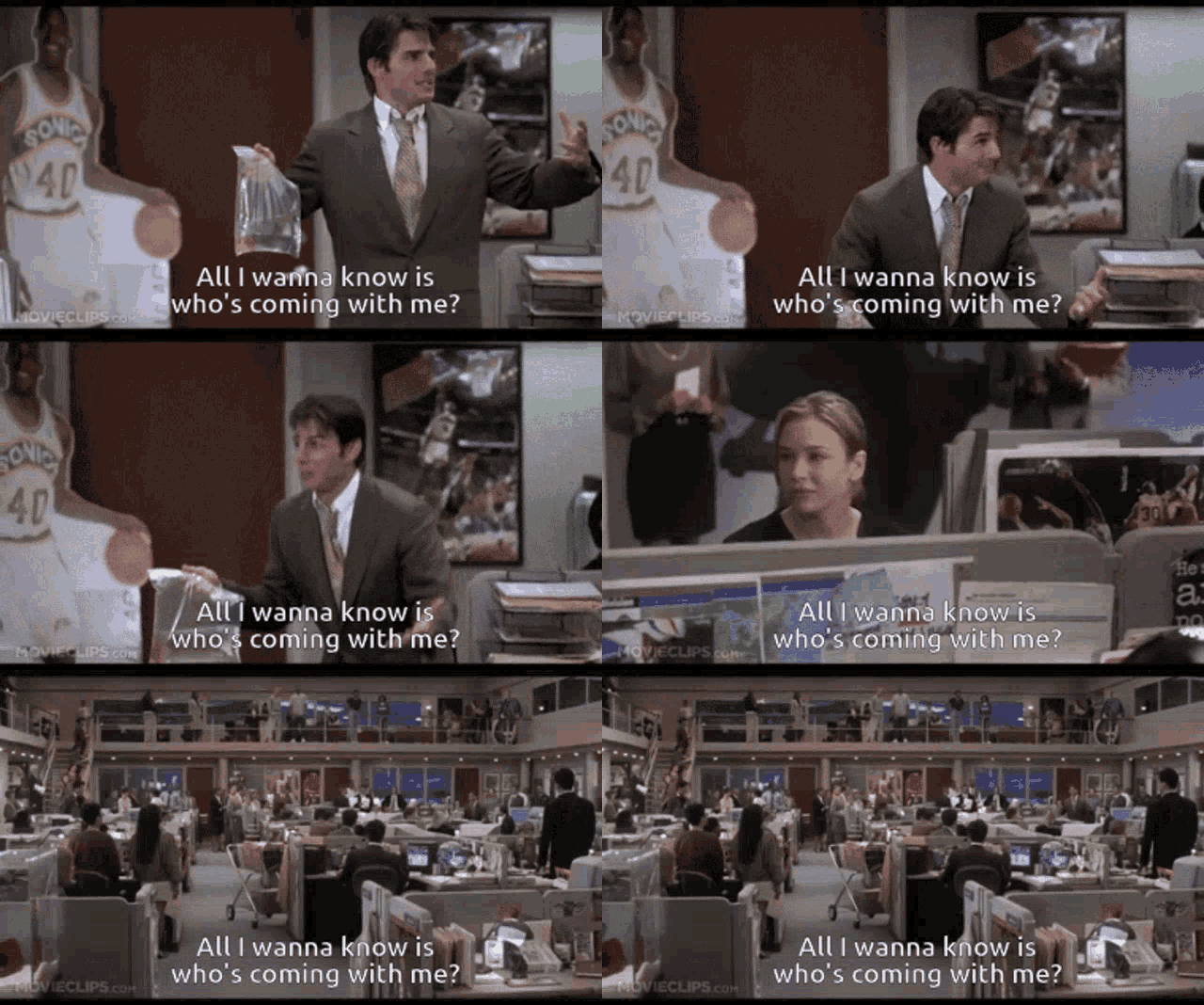
Right. Who’s coming with me?
People of my generation may associate that line with Tom Cruise’s character in the 1996 film Jerry Maguire.
Jerry is flying high in Sports Management International, a large, successful sports agency. He experiences a crisis of conscience and has a revelation that he ought to be doing things differently. He writes a mission statement with a vision for the company’s future and sends a copy to everyone in his agency. He describes it as ‘touchy feely’. The mission statement is critical of the way things are being done, and—worse—calls on the company to take on fewer clients and focus less on making money. While his colleagues praise the ethics of the mission statement to Jerry’s face, it is clear they have no intention of doing anything differently. Unsurprisingly, Jerry is fired. In a memorable scene he stands in the middle of the office floor and asks his uncomfortable colleagues, ‘who’s coming with me?’ Silence…. In the end, only Dorothy Boyd from Accounts (Rene Zellweger) agrees to go with him. The moment they leave, the office activity resumes and all returns to normal.
Lessons numbers 1 and 2: if you want people to come with you, don’t start by telling them they’re doing things wrong, and don’t offer an alternative that looks less attractive than what they already have.
Am I saying this to myself or to us?
I suppose it is both, but I intend the point to be outward- rather than inward-facing.
One general problem with confronting people and telling them they are wrong is that often it doesn’t convince them that they are wrong. We do not like to be wrong, and we definitely do not like to be told we are wrong (Schulz 2010). Whether it is an impassioned mission statement or a heated debate, telling people they are wrong often generates effects at odds with the speaker’s intentions. It can prompt the interlocutor to disagree, and even to distance themselves from the speaker and/or dislike and dismiss them.
This is important, full stop. And it is very important in political contexts, as democratic theorists highlight. It might be wonderful if all we cared about was getting to the truth of the matter on whatever subject, regardless of how that truth is delivered. But that doesn’t seem to be the case.
As I mentioned, in philosophy settings, we are primed to be told we are wrong, to tell other people they are wrong, and to disagree.
Even though arguments are our stock in trade, philosophers are alive to the fact that arguments may not be the best way of convincing people who disagree.
As Catarina Dutilh Novaes puts it:
… a wealth of empirical and anecdotal evidence seems to suggest that arguments are in fact not very efficient tools to change minds…. For example, the well-documented phenomenon of polarization… suggests that, when exposed to arguments supporting positions different from their prior views, people often (though perhaps not always) become even more convinced of their prior views rather than being swayed by arguments…. Frequently, argumentative encounters look rather like games where participants want to ‘score points’… rather than engage in painstaking consideration of different views for the sake of epistemic improvement. (2023, 173–4)
Now in our typical philosophy context, where we are primed to disagree, do we feel open, receptive, and welcoming to fresh ideas and ways of doing things?
I have put that as a question, because I don’t want to assume that you feel the same way as I do. But let me propose that, without an audience that approaches the encounter with a kind of openness to the new experience, the speaker/writer has to work extremely hard to bring the listener/readers even to a point where they are even really listening/reading, rather than just waiting to spot a trigger for their formulating of an objection.
Why does this matter?
Political philosophy and ethics are interesting examples on which to reflect.
These are subject areas which deal with controversial issues. They aim to invite us to think deeply about what to believe and what to do. As philosophy, though, they often engage in that enterprise by telling people how, why, and to what extent they are mistaken. That kind of conflict and adversarialism is not especially appealing to everyone.
Of course it has its place. But it is not the only way.
Think back to how you felt when I mentioned Theodor Herzl, a central figure in the development of modern Zionism. That always has been a contentious topic, and it is a particularly fraught one now. For some of you it might not be a subject that immediately gets your hackles up, whereas for others it will prompt very difficult feelings.
There are different ways for me, as speaker, to attend to that. If I don’t want you to feel alienated, to switch off, to assume something (possibly incorrect) about me and about the direction in which we are heading, or to become unreceptive to what follows, then I need to be aware of how I approach the subject matter.
So we are back to feelings.
Nowadays I often go to art galleries with my young(ish) children. It is an experience, but I would not say it is an altogether relaxing one.
However, when I go by myself or with other adults, I find it almost meditative (as long as the gallery isn’t too busy). It is peaceful. It is calming. Often the galleries are designed with the visitor experience in mind.
I don’t suppose I would find it quite so calming if I were visiting as an art critic. Part of the appeal of the experience for me is that it is not really my job, and that I can ‘switch off’ my work mind. Even when I am there for things that are more about my job, I still find the context far more calming than a university lecture theatre.
But the key point here is that the set-up is designed at least in part with the audience’s experience in mind: to bring us in, to welcome us, to engage us, to help us navigate the space.
Of course they can be deliberately confronting, eery, alienating. Directors, curators, choreographers can make spaces hostile and so forth. But that is usually conscious and intentional. They think about how to receive us, what will meet us, and which kind of feelings they would like to provoke in us.
So how we are encouraged to feel as we enter a space, a session, a discussion is important.
Some things can turn us off straight away. Others can welcome us in and spark our interest.
One of things I am inviting us to reflect on is how we bring our readers, listeners, students into a space, a session, a discussion, a set of reflections.
Are we fostering atmospheres conducive to openness and curiosity and wonder?
A second thing I am inviting us to reflect on is how and why that openness and curiosity and wonder itself might matter.
If, in a given space, a speaker wants to invite openness and curiosity, she may want to resist, or think very carefully before, using some of the language we find in philosophy seminars, e.g. describing an opposing view as ‘ridiculous’ or ‘crazy’ or ‘monstrous’ or ‘trivial’ or ‘facile’ or ‘dangerous’.
But in addition, while in seminar contexts on controversial topics we can be very quick to dismiss, we can also be very cautious. For example, on the ethics of migration, we are encouraged to be pragmatic, think about ‘feasibility’, take seriously the everyday concerns of voters, etc, etc. We are conscious of objections. We pre-empt them. In response we can find ourselves making our proposals smaller and smaller.
Fostering an atmosphere that is conducive to openness and curiosity and wonder might allow us to think bigger and bolder and more creatively in that space.
When I wondered whether we, here, today, could will something into existence, did you feel excited? Or at least intrigued? Isn’t it empowering and energising to imagine that we might be able to do and make something together?
This might sound fanciful, but there is a serious point in it.
When we look closer, a number of the ostensibly intractable political crises out there in our world seem to be tractable after all. They are often failures of will.
For example, the so-called migration crisis? At base it is really failure of political will to allow refugees to travel safely in order to seek asylum.
We know that will really matters in politics, both for good and ill. It matters for causes you support, and for projects you oppose.
And of course we know that willing matters in our day to day lives. As I said, I needed to will this very talk into existence!
In short, I think reflecting on the power of willing is potentially philosophically and politically productive.
And we can reflect by doing.
So let’s try something together.
At the beginning of this session I distributed blank pieces of paper to everyone.
Their moment has come.
We are going to think through three things.
Is there some piece of work that you’ve really, really wanted to do? Perhaps there is an innovative approach you’d like to take, a fresh topic you’d like to tackle, an argument you want to construct, some unorthodox material you’d like to use, but you have been deterred, for some reason. Perhaps you are worried people will think it’s too ‘out there’, too ‘bold’, too different, too optimistic, too weird, too dreamy, too off the beaten track, not ‘proper’ philosophy. Is there something that you would like to try, but you need that extra bit of encouragement? Perhaps you’re just not sure how to do it?
Do you have something like that in your life?
Could you distil that work idea into a sentence?
Please write that one sentence on your page.
Still on the theme of that piece of work:
What is holding you back? Why haven’t you done it?
Have a think about it.
Can you distil your obstacle into one word?
Please write that one word on your page.
Do you have anyone in your life who is the sort of person that makes things happen? A do-er? A go-getter? They have an idea and they bring it to fruition. They tell you they will set up new course or a reading group, and they do it. They say they are going to start a podcast, and you know they will. They mention they will raise large sums of money for a charitable cause, and you are convinced they will make it happen. They want to become a local counsellor, a part-time photographer, a half-marathon runner, and lo and behold….
Maybe in your life that person is you!
Anyway, please think for a moment about that do-er. What is it about them that makes these things happen? Imagination? Commitment? Energy?
Can you distil the essence of that do-er it into one word?
Please write that one word on your page.
So now on your page you should have:
You have yours.
It’s all yours. You have made that. We have all made one.
Every one of you will have something different.
But we have created those pieces today, here, at the same time, in this space.
So now for the willing part.
I wonder whether we, here today, can will your piece of work into existence?
For the next 30 seconds, we will close our eyes and imagine how wonderful it would feel for that piece of work to exist in the world. That piece of work is doable. Even the doing could be enjoyable. You can make it happen.
Now, you need to go away after this and do the rest of the work!
But I feel confident you can do that!
Why do I feel that confidence?
Well, look at my own piece of paper:
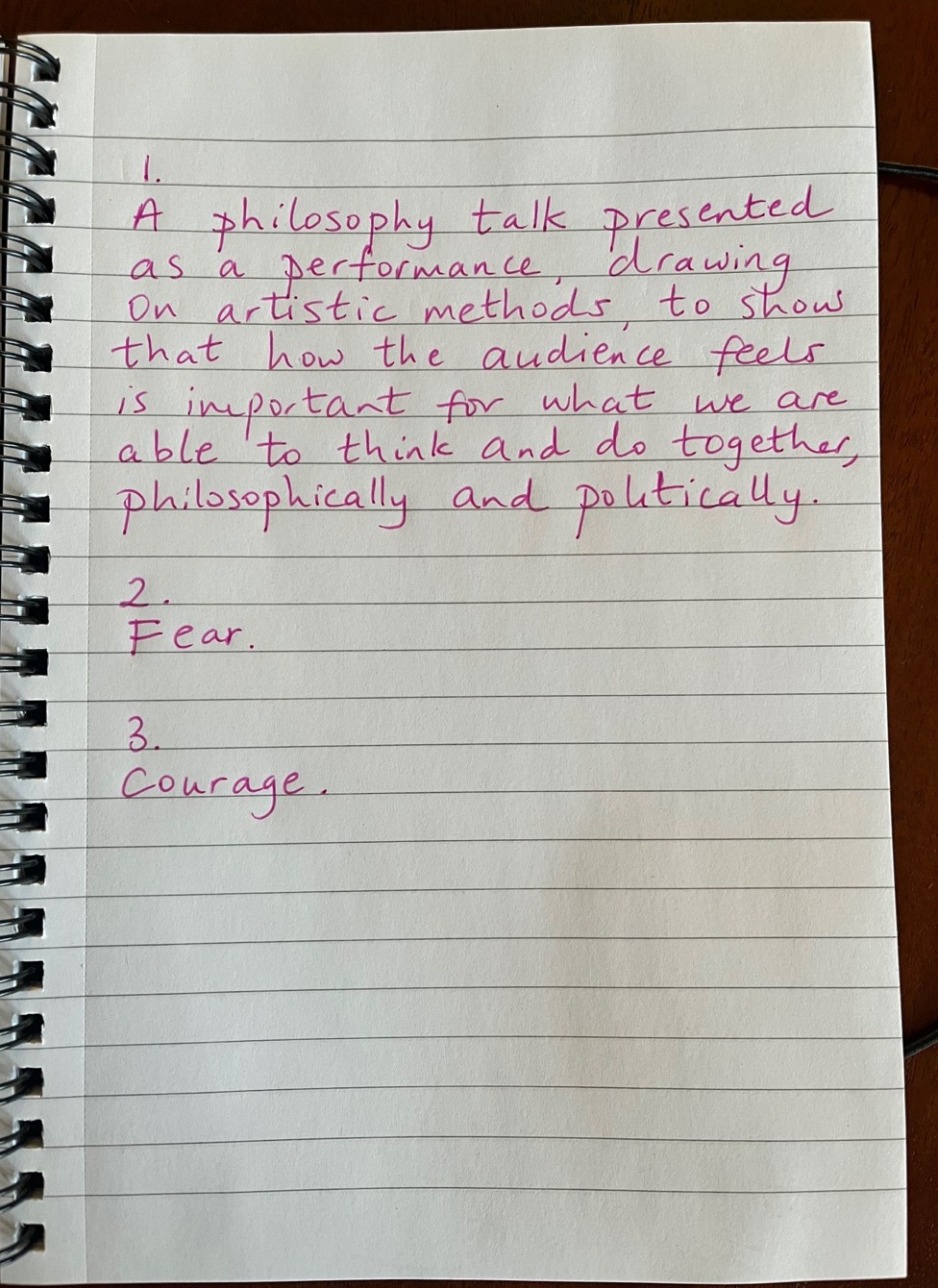
I did it.
We did it.
We shared in that moment.
So, how are you feeling?
And now feel free to pick up your phones and computers, reengage those critical faculties, and continue about your day as normal.
Thank you.
As with ordinary academic talks, there is a Question and Answer (Q & A) session after the performance.
For a live event, the lecture performance is scripted (exactly as above), and the Q & A session is unscripted. Audience members ask whichever questions it occurs to them to ask, and the speaker responds to those questions, off the cuff.
The audience’s spontaneous questions in response to what they have seen and heard are an integral part of this piece of work. It matters that we were all together, experiencing the same thing, and that the work itself will be different when experienced with and by different people.
The following stylised Q & A combines a) the kinds of questions I was asked on the occasions I performed this talk, b) the kinds of questions I wish I had been asked, c) related questions I have been asked on other occasions, and d) questions based on feedback from academic reviewers of the written piece. The answers are my own.
Why am I including a stylised Q & A in the paper/script even though a live Q & A is unscripted and is part of the work?
I am taking this as an opportunity—as in an ordinary Q & A—to continue the conversation in a different form, and to fill in some of the philosophical gaps.
I think the Q & A might be particularly useful following a lecture performance, as it enables the audience to ‘peer behind the curtain’, and it enables the speaker to do some of the contextualising and theorising and analysing that readers ordinarily expect in an academic talk/paper.
Why do you think we academic audiences, perhaps especially philosophy audiences, tend to be quite so critical? Why don’t we raise our hands to tell the speaker that we loved the talk and that we agree with them?
Thank you very much. I expect there are multiple reasons, and I think one of those is simply ‘convention’. We do what we see others do, and we have seen others doing it this way for a long time.
Conventions do evolve, however, and over the course of my career I have seen what I regard as positive movements on this front. One highlight for me was watching Professor Miranda Fricker deliver a keynote lecture in Australia in 2018. On receiving what I read as an antagonistic question from an audience member, Fricker responded in a collaborative and open manner. In this way, she invited the questioner to contribute constructively to the conversation. It had the subtle effect of shifting the tone in the room, and the remaining Q & A proceeded along those collaborative lines.
On the previous occasions when I delivered this talk, some people asked questions in the style of a conventional philosophy Q & A. I experienced some of those as confrontational, antagonistic, defensive, and so on. I am accustomed to that. Some of it is reasonable and robust disagreement. Sometimes it is an explicit signal that the questioner did not like the material and/or its delivery. Not everyone will like it. I should add, the questioner may appreciate the ambition but may not rate the execution. They may think I didn’t do a good job. That’s absolutely fine.
Some questioners took the opportunity to defend academic style and substance conventions, which is also perfectly reasonable. They argued, for example, that it is the best way to test out arguments and to make progress on a topic. They said that we should not shy away from being frank in response to what we see as erroneous, trivial, non-starters etc.
As there are multiple forms for disseminating our ideas, no doubt there is space for many different approaches—and in my view that means making space for exploratory lecture performances, too!
By the way, when discussing the Miranda Fricker example, I said that ‘I read’ a question as antagonistic, and that on previous occasions ‘I experienced’ some questions as confrontational. That bears repeating, because my reading and reception of a question may diverge from those of other attendees, including the questioner. As Rajni Shah puts it so perfectly, questions ‘land differently in different bodies’ (in Schmidt et al. 2023, 18).
This was fun and I enjoyed it. But what will you do with it now? Normally we give talks and then try to publish the material in paper or book form. Is that what you will do? If you do, isn’t there an irony in arguing that there are various, valuable forms philosophy can take, including a lecture performance in front of a live audience, and then choosing to go down the conventional article publication route?
This is an important question. I do want to share this piece of work somehow. Initially I hoped to share it in a range of different formats, including live performance. To be honest, though, when I am invited to speak at academic conferences, seminars and workshops, the hosts usually wouldn’t be expecting me to give a talk like this one…. I love the idea of producing a video recording of the performance and ‘publishing’ that online somewhere, maybe alongside the written text. In its current form it is not a traditional paper (and it probably isn’t even a non-traditional paper).
Part of the joy and the challenge for me in experimenting this way is to see whether it will be ‘accepted’ as philosophy research. At present it is difficult—not impossible, but difficult—for work to be accepted as ‘proper research’ in philosophy unless it is published in written form. Will it ever see the light of day in written form? (If you are reading this, then the answer is: Yes!)
In addition, I like Jess Richards’ (2018) description of a live performance as ‘a multi-layered text’ with assorted strata of meaning. That also blurs the lines between this piece as performance and this piece as text. It is both. In a way, we can think of the written paper as continuous with—rather than as a break from—the live performance.
There is a further reason for wanting to ‘publish’ the work (no matter what the format). Here I take my lead from comedian Stewart Lee, and his account of why he likes to film his stand-up shows:
I really wanted it filmed, because I knew that if you filmed it, that kind of finishes it as a piece of work, so you can stop doing that material. Whether it sold or not, it was really useful to draw a line under it. I was trying to think like an artist or musician who creates a body of work and then moves on to the next thing.[3]
I like to think of publishing in a similar way. The work is released into the public domain, which draws a line under it for now, and I can move onto the next thing. That doesn’t mean the work is ‘complete’ or ‘finished’ and never to be revisited, but I agree with Lee that some kind of closure is an important part of the creative process.
I have seen art students and colleagues deliver lecture performances, but the format didn’t strike me as an obvious one for presenting philosophical research at the time. Their performances tended to be quite freewheeling and unstructured, whereas I detected a tight structure in your talk. So, could you say more about why you chose to convey your ideas in this particular mode, and why it works for you?
That is really interesting. There were a number of reasons and inspirations for me to try this. First, I think the format fits perfectly with my aims in the piece. I initially encountered the idea of a lecture performance in the process of collaborating with human rights theatre company, ice & fire, to develop a theatre piece about the ethics of migration restrictions.[4] One of the original collaborators, interdisciplinary artist Rhiannon Armstrong, suggested presenting the piece as a lecture performance. In the end, the show took a different direction, but I was keen to learn more about lecture performances, as they sounded like a fruitful mixing of theatrical and academic media. Lucia Rainer (2017) proposes that ‘lecture performances adhere to two frames that never entirely blend’ as ‘the concept is always situated between lecture and performance and academia and art—to which they are traditionally affiliated—without entirely being one or the other’ (76). That picture appeals to me.
In the course of working with Rhiannon, we attended an academic talk together. As I watched the speaker, I was only (consciously) thinking about the lecture’s content, but Rhiannon pointed out various aspects of the ‘performance’ and the space which would have escaped my attention otherwise. She highlighted the hierarchical organisation of the room, with the speaker on a platform behind a lectern, talking into a microphone. She discussed the lighting, the seating, and the speaker’s style of answering (and not answering!) questions. It was really enlightening and exciting to see things from Rhiannon’s perspective, and to reflect on the performance side of academic presentations and lectures. What might be bread and butter for performance researchers and practitioners came as a revelation to me. Once I noticed those features I couldn’t stop thinking about them. I started to wonder why many of us pay so little attention to the performance of the academic talk/lecture—and, along with that, to the audience experience. Much of what you saw today has its roots in that collaboration. I really learned a lot from working with Rhiannon, and with other theatre-makers through ice & fire, as well as from other performers and performance researchers. I continue to learn from interdisciplinary conversations and research, especially with my long-term collaborator, artist Sivan Rubinstein (whose beautiful voice you heard welcoming you into the space). It is from Sivan that I learned about the true importance of welcoming people into a space. This piece is all about exploring, learning and sharing. I recognise that those well-versed in performance research might find it frustrating to watch that learning happen in real time or on the page, and for that I apologise. I hope it is still instructive to see that those with different disciplinary backgrounds have so much to learn from you.
In addition to the lecture performance considerations, and connectedly, I am big fan of stand-up comedy and I am very interested in it as an art form. For example, it is wonderful to observe the ways in which a single performer captures and maintains the attention of an audience. Coming back to the example of comedian Stewart Lee, in How I Escaped My Certain Fate: The Life and Deaths of a Stand-up Comedian (2011), he wrote that ‘since 2004, I’ve always thought very carefully about pre-show music. It’s all part of set and setting. A show begins the moment the audience walks into a venue’ (56). I think entrances and atmosphere are crucial, and you’ve seen that today. In fact, that Lee book plays an important background role in this piece. In the book, Lee publishes a series of his stand-up routines, and includes his own commentary in footnotes, analysing and explaining his own jokes and his process. I thought that would be a great model for this lecture performance, where the Q & A functions in the manner of Lee’s footnotes. Lee writes, ‘I just think it’s funny to take a joke and show the working out in the margins’ (100). For me, it’s both funny and illuminating. Furthermore, you see from Lee’s commentary that he is thinking through and reworking every line of his show, and even the parts that look quite spontaneous often are carefully scripted. The pieces are very tightly structured, and nothing is baggy or irrelevant. I’ve tried to do something similar here. I’m also trying to use humour to maintain audience attention, switch up the mood and tone, and sometimes to defy expectations, for example.
While I am thinking about art and performance, a primary concern for me in this piece is also to share ideas and to ‘show my working’. Again, the lecture performance is an excellent fit for this. As Clio Unger (2021) has written (in the context of watching the lecture performance series ‘My Documents/Share Your Screen’, curated by Lola Arias), ‘by sharing their work processes as artistic form, the practitioners of the lecture performance not only let audiences observe the intellectual labour they perform to make their art, they allow these modes of labour to become the artwork themselves, blurring the boundaries between “process and product”’ (487). This blurring of process and product is exactly what I had in mind when preparing today’s lecture.
Another reason is partly contextual. I originally prepared this talk for a British Society of Aesthetics conference on the theme of ‘Aesthetics and Political Epistemology’ (Liverpool, 2023). I hoped that the audience might be receptive to an experimental, arts-based-methods piece, and I thought the format suited the conference theme. That context gave me the courage to try it. I was very nervous, because I knew it wasn’t what people were expecting, and I wasn’t sure whether the audience would be amenable to it. But the audience did engage with the material, and I found it a really energising experience, so that gave me the confidence and motivation to try again.
I would love to present a talk in this kind of format, or at least I would like to experiment with different styles of delivery, but I feel I am not in a position to do that, because I am a student and in a precarious position. I need to write standard academic papers and give conventional talks at this point in my academic career. In a way, isn’t this a display of your privilege, in that you have much more freedom and security as a tenured academic?
I take this very seriously, and it is absolutely right that there are far greater pressures to conform to a variety of norms and work within established disciplinary constraints when you are a student and if you don’t have a secure academic post. That is a really important point. I am at a career stage and institution where failure isn’t quite so crushing. I can’t deny that it still hurts, though. While the pressures have not vanished altogether for me (I’m mid-career), they are both easier to resist and less significant. Nothing terrible will happen if audiences don’t like what I’m doing, and it isn’t a disaster if I am not able to do anything further with this work. So, yes, I acknowledge the privilege, and I wouldn’t want to give the impression that it is easy to do this, and/or that everyone should start presenting their work in this way.
At the same time, I feel a responsibility to try to make space for creativity and experimentation, precisely because I am in a position to do that now. In philosophy, and in academia more generally, there is so much potential to innovate, to be adventurous, to push boundaries, and yet it is somehow systematically discouraged. But the more it happens, the more examples we have of different ways of doing things, and the more we increase the options for everyone.
If we want things to change, how do we precipitate change? How do we push boundaries? After watching me try something new during a workshop, and seeing me receive some ‘vigorous’ criticism in response, another academic wisely said to me: ‘Remember that when you push at the boundaries, the boundaries push back.’ I have found that to be true. And when you offer something a bit different, you/I have to be prepared for the usual responses, including the familiar and painful, ‘Is this even philosophy?’
Something I believe (and have heard it said by a number of people, including Kate Manne in her discussion of misogyny and male entitlement) is that philosophy is what philosophers do.[5] Think of the parallel with art. Early in her career, when Tracey Emin produced pieces such as My Bed (1998), some critics would ask, ‘Is this even art?’ But now that Emin is an established artist people just tend to accept that what she produces is art because she definitely is an artist. Now, to paraphrase Stewart Lee paraphrasing someone else, it is not for me to draw parallels between Tracey Emin and me… But you see my point!
Moreover, I think I’ve reached a stage where I care about the experimentation enough not to mind about unfavourable reactions. Sometimes my answer to the question ‘is this even philosophy?’ is ‘I don’t really mind, but I’m enjoying myself doing it.’
Academic norms have their role, and often I follow them. But what happens if I don’t? For example, there is a norm that in philosophy papers you really get into the nitty gritty of one relatively small idea. However, I have lots of ideas and sometimes I want to stick a load of them together and play around a bit. And sometimes I don’t want to make an argument following the usual rules. Sometimes I just want to provoke thoughts, or share some ideas, and see how that goes. I think those are valuable exercises. Why shouldn’t they get out there? So, yes to the power, but I’m hoping to use it responsibly….
The questions around power and privilege raise another issue that I am trying to show with this piece. In the style of the performance, in the sharing of autobiographical details, in the experimental format, I am aware that I am making myself vulnerable to you. I am opening myself up, and I am inviting you to open up to me and to each other, to the extent that you may be willing to try something together. I am being explicit about that. Although we may not notice and name it, we are mutually (not equally, but mutually) vulnerable as speaker and audience in any lecture/seminar context. Speakers may feel unworthy of the invitation, unsure of their material, anxious about their delivery, and nervous about the audience reception, among other things. As I touched on briefly in the talk, audience members may feel worried about the prospect of participating, feel out of place in the space, fear that they have misunderstood, etc. In academic settings, I think this combined sense of vulnerability in lecturer and audience often pushes us to put up our defences. To run with the metaphor, we feel we must be battle-ready and we don our armour. I may need to shield myself against hostile fire, and you may need to ward off attacks with countermoves. But when we recognise this mutual vulnerability, instead we can choose to acknowledge it, reflect on it, consider its effects, and decide how we would like to engage with it. Rather than playing offence and defence, we could try to explore our mutual vulnerability with sensitivity. That is not to pretend away the realities of power relations and hierarchies, which the question rightly highlights. What is more, since live audiences for this particular piece are not given advance notice that it may be a little different from a conventional philosophy research presentation, I need to be particularly attentive to relations of power.[6]
Following on from that discussion, at one stage in the talk you said that you wanted us, the audience, to feel comfortable and relaxed. But I felt very uncomfortable and out of my comfort zone. Actually, I think you wanted us to feel uncomfortable! You know that your live audience here is a bunch of philosophers and that many of us won’t be comfortable with the music, genre-crossing, interaction, and participatory elements. Did you have that in mind when you prepared the piece?
This is a great point. I am paying attention to how ‘the audience’ feels, and there were times when I really was attempting (even if failing) to make you all feel comfortable. I wanted you to try something with me. I wanted you to relax. And though I was attending to your feelings, I can’t make you feel the way I would like you to feel.
Now, I must emphasise that the idea is not to manipulate you or to engage in dark arts so as to accomplish something behind your back without your realising it. Rather, my intention is to highlight that how you feel matters for what we are able to achieve here, and that you matter in the making of the work. I say that in order to distinguish between what I am trying to do—attend to and draw attention to how you feel with a view to opening up space for exploring ideas together—and something I am not trying to do, which is to play with your emotions to push you, say, to change your mind in the absence of careful reflection. I suspect one reason many philosophers remain near-exclusively committed to the ‘philosophy research as reasoned argument in plain language’ format is related to the longstanding belief in a clear distinction between ‘philosophy’ (good) and ‘rhetoric’ and ‘sophistry’ (generally bad, and/or at odds with philosophical goals). The basic idea is that philosophy is supposed to be oriented towards understanding and to discovering truths, whereas rhetoric and sophistry prioritise other goals, especially winning, by means of persuasion, deception, concealment, and other disreputable methods. Of course, as ever, in reality things are far more complicated than that, but I think some such concern might lie behind the resistance to alternative formats.[7] I am not seeking to pull the wool over your eyes. I want you to see what is happening. I want it to be transparent. I want us to do philosophical work together.
Meanwhile, one of the things I’m trying to explore is the potential for creative and open modes of ideas-making and sharing to work effectively not just in philosophical conversation but also in political conversations. There I’m trying to attend to feelings of discomfort (e.g. at the mention of something politically controversial/divisive) and to think about how to make common space for discussion even in those challenging contexts.
Attending to feelings of discomfort is different from ignoring them, and it is also different from wishing those feelings away, or attempting to mollify or placate. There are times—in philosophy, politics, art, and life—when we have to sit with difficult feelings.
You probably detected that I change tone here and there, sometimes speaking of solemn subjects in sombre style, and then moving to gentle humour. This is deliberate. It is not to make light of what is serious. It is to try different ways into difficult topics, both for me and for us. One or other of those ways might not work for you, but might help another member of the audience to continue with the conversation.
Interestingly, I think many people are sceptical of comedy’s powers to ‘effect social change’ and think of it more as a kind of consolation for the harsh realities of the human condition (Setiya 2021). Yet Scott Sharpe, J-D Dewsbury, and Maria Hynes (2014) have studied the ways in which humour (and specifically Stewart Lee’s comedy) ‘can operate as a kind of micropolitical intervention’ and they highlight how ‘the performative cusp of humour functions as a generative political act, which can subtly modify dominant social norms and structures of anticipation’ (116, my emphasis). There are various factors here, and an important one is how performer and the audience cooperate together in the production of ‘new sensibilities’ (117). Lee presupposes an ‘active audience’ (Carroll 2014). The audience is an active part of the creative practice, and the performance space becomes a sort of laboratory for change. Sharpe et al. (2014, 121) point out that Lee keeps ‘the audience on their toes’ and gets them to ‘do a lot of the work’, and that ‘something occurs in the witnessing of the event of a performance that does not occur elsewhere’. I think we can do something similar in and with our philosophical microinterventions. That may require some disruption and discomfort along the way, but it has a lot of potential.
The previous questioner said ‘you know that your live audience … is a bunch of philosophers’, and you seem to be addressing yourself to an anticipated audience of philosophers. For a given live performance your audience may well be composed of philosophers. However, there may be multiple, different audiences of/for your piece, and those audiences may be quite diverse. Are you taking sufficient account of that diversity?
This is a challenging issue to navigate, and thank you for raising it.[8] As you say, there may be plural—temporally, spatially, socially diverse—audiences for this piece. The audience is ‘polyvalent’ (Alston, 2013). There are the different live audiences at different live events. Live performances may be in person, online only, or ‘hybrid’ formats (some people attending online and some in person). Then there are audiences watching recorded versions of what once was a live event. In addition, if this is published in written form, there are readers of the text. (Hello! That’s you.) Furthermore, each collective audience is constituted by diverse individuals.
I have mentioned that the piece was written in the style of a lecture performance, and that the first live audience for the performance were the attendees of the aforementioned ‘Aesthetics and Political Epistemology’ conference in Liverpool in 2023. Some of the attendees were online, tuning in from different locations and timezones. For that event, the audience really was expecting a philosophy paper, and I really was expecting an audience of philosophers (at all career stages, including students), and mostly from the so-called ‘analytic’ tradition. I was envisaging this mode of delivery as novel and experimental for most of that audience, but even then I expected it to be less unusual for them, as an ‘aesthetics’ group, than it might be for a different group of philosophers. All the same, for understanding the thrust and motivation of the piece, it is helpful to know that it was addressed to an audience of philosophers, real and imagined.
For the lecture performance part of the written text, I really wanted to continue addressing ‘the audience’ as though it were a live event audience, even though you readers are also ‘the audience’. The idea was to maintain the structure and immediacy of a performance. But I don’t want you to feel excluded! The piece offers something different for each spatial and temporal audience, as well as for spectators and readers, and it involves audiences through a variety of dimensions. For example, some audiences do not experience the co-presence or the ‘smells and atmosphere’ of the live in person audience (Richards 2018, 17),[9] but then the live in person audiences do not get the thrill of seeing the footnotes and the bibliography reserved for you readers…. More seriously, you readers are party to more of the behind-the-scenes analysis.
Once the piece moves from live performance to published text, it takes on a ‘life of its own’, in the apt words of one reviewer. If it is published in an academic journal, in some sense it will ‘sit’ in that journal, but in this online and open access age it is effectively unmoored. Among other things, to put it bluntly, that means you could be anyone, anywhere, and any time from this point forward! I want us to connect, and for this to connect with you, yet I don’t know how much or how little we share. Now, a perennial risk for anyone anticipating an audience is that they will misunderstand or misread the audience. And since we have already noted that audiences are internally diverse, we can misread any part of that audience. Similarly, the audience can receive things in unintended ways. In short, I should try my best not to assume too much about you, and vice versa. But I make mistakes and missteps, and despite my sincere efforts I will have assumed too much.
The formal event draws to a close, and informal conversations commence.
Sincere thanks to Eve Katsouraki, Diana Damian Martin, and Theron Schmidt, the co-editors of this issue, and to two enormously helpful reviewers for their constructive suggestions and their openness to this piece. Thank you to Performance Philosophy for offering a space for experimentation and exploration. An extra thank you to Laura Cull Ó Maoilearca, whose boundary-crossing practice and community-building work are an inspiration.
Hearty thanks to the warm and receptive audiences at the British Society of Aesthetics conference, Aesthetics and Political Epistemology, University of Liverpool 2023; the Warwick Graduate Conference in Political and Legal Theory 2024; and the London Aesthetics Forum 2025. Special thanks to Sivan Rubinstein (the recorded voice, and all-round wonderful collaborator), Rhiannon Armstrong, Christine Bacon, Vid Simoniti, Duncan Bell, the Cambridge FWG, and the 1756 group.
I would like to acknowledge the support of the Good Integration project, The Research Council of Norway, 313846.
[1] On the role of autobiography in philosophy, see Fine (2022).
[2] The post is no longer online as De Cruz left the platform, but it was once available here: https://twitter.com/Helenreflects/status/1646509845527375872.
[3] See the full interview here: http://www.mustardweb.org/stewartlee/.
[4] Here is further information about the project: https://iceandfire.co.uk/project/wltmimi/
[5] Manne says it during her podcast interview with Nigel Warburton on Philosophy Bites, here: https://open.spotify.com/episode/5Xv05YBGsxY9tnh0smSBRS
[6] For a very interesting treatment of risk and mutual vulnerability in theatre performance, see Alston (2012, 2013).
[7] For further discussion of rhetoric and philosophy, see for example McCoy (2008) and Potkay (2017).
[8] Thank you, reviewers! As one of you noted, Emma Bennett (2017) has an excellent discussion of audience spatiotemporal plurality, examining Stewart Lee’s ‘grammars of address’ as he moves between ‘you’ the live audience and ‘you’ the television viewers.
[9] Thank you, editors! There is a fascinating series of interventions on the subject of ‘presence’ in performance studies, particularly in the aftermath of Covid-19 lockdowns, in a special issue of TDR: The Drama Review edited by Jannarone et al. (2022).
Alston, Adam. 2012. “Damocles and the Plucked: Audience Participation and Risk in Half Cut.” Contemporary Theatre Review 22 (3): 344–354. https://doi.org/10.1080/10486801.2012.690742.
Alston, Adam. 2013. “Audience Participation and Neoliberal Value: Risk, Agency and Responsibility in Immersive Theatre.” Performance Research 18 (2): 128–138. https://doi.org/10.1080/13528165.2013.807177.
Bennett, Emma. 2017. “You, The Public: Grammars of Address in Stewart Lee’s Stand-Up.” Performance Research 22 (3): 98–104. https://doi.org/10.1080/13528165.2017.1346984.
Carroll, Noël. 2014. “The Creative Audience: Some Ways in which Readers, Viewers, and/or Listeners Use Their Imaginations to Engage Fictional Artworks.” In The Philosophy of Creativity: New Essays, edited by Elliot Samuel Paul and Scott Barry Kaufman. Oxford University Press. https://doi.org/10.1093/acprof:oso/9780199836963.003.0004.
Cohen, G. A.. 2001. If You’re an Egalitarian, How Come You’re So Rich? Harvard University Press. https://doi.org/10.4159/9780674029668.
De Cruz, Helen. 2021. Philosophy Illustrated. Oxford University Press.
Dotson, Kristie. 2023. “XIII—Dear Octavia Butler.” Proceedings of the Aristotelian Society 123 (3): 327–346. https://doi.org/10.1093/arisoc/aoad011.
Dutilh Novaes, Catarina. 2023. “VII—Can Arguments Change Minds?” Proceedings of the Aristotelian Society 123 (3): 173–198. https://doi.org/10.1093/arisoc/aoad006.
Edmonds, David. 2023. Parfit: A Philosopher and his Mission to Save Morality. Princeton University Press. https://doi.org/10.1353/book.111375.
Fine, Sarah. 2022. “Political Philosophy and Autobiography.” In Political Philosophy, Here and Now: Essays in Honour of David Miller, edited by Daniel Butt, Sarah Fine, and Zofia Stemplowska. Oxford University Press. https://doi.org/10.1093/oso/9780198807834.003.0013.
Hobbes, Thomas. 1651. Leviathan or the Matter, Forme, and Power of a Common-Wealth Ecclesiastical And Civill .
Jannarone, Kimberly, Elise Morrison, and Tavia Nyong’o. 2022. “Presence, 2019–2022: Introduction.” TDR/The Drama Review 66 (4) 22–27. https://doi.org/10.1017/S1054204322000533.
Lee, Stewart. 2011. How I Escaped My Certain Fate: The Life and Deaths of a Stand-up Comedian. Faber & Faber.
McCoy, Marina. 2008. Plato on the Rhetoric of Philosophers and Sophists. Cambridge University Press. https://doi.org/10.1017/CBO9780511497827.
Nussbaum, Martha C. 1990. Love’s Knowledge: Essays on Philosophy and Literature. Oxford University Press.
Potkay, Adam. 2017. “Rhetoric and Philosophy.” In The Oxford Handbook of Rhetorical Studies, edited by Michael J. MacDonald. Oxford University Press.
Rainer, Lucia. 2017. On the Threshold of Knowing: Lectures and Performances in Art and Academia. Verlag. https://doi.org/10.1515/9783839438046.
Richards, Jess. 2018. “Performance as Text. Text as Performance: Love Like Salt, a Collaboration between a Writer and an Artist.” Performance Research 23 (2): 13–20. https://doi.org/10.1080/13528165.2018.1464721.
Schmidt, Theron, Diana Damian Martin, Mick Douglas, Reza Mirabi, Ellen O’brien, Rajni Shah, Val Smith, Lizzie Thomson, and Julie Vulcan. 2023. “The First Thing We Make Is the Conditions of Our Meeting: A Gathering on Gathering.” Performance Research 28 (2): 14–25. https://doi.org/10.1080/13528165.2023.2260691.
Schulz, Kathryn. 2010. Being Wrong: Adventures in the Margin of Error. Granta.
Seeley, John Robert. (1883) 2010. The Expansion of England: Two Courses of Lectures. Cambridge University Press. https://doi.org/10.1017/CBO9780511783159.
Setiya, Kieran. 2021.”Can Comedy Change the World?” New Statesman, 22 July. https://www.newstatesman.com/ideas/agora/2021/07/can-comedy-change-world.
Sharpe, Scott, J-D Dewsbury, and Maria Hynes. “The Minute Interventions of Stewart Lee.” Performance Research 19 (2): 116–125. https://doi.org/10.1080/13528165.2014.928527.
Unger, Clio. 2021. “Share Your Work: Lola Arias’s Lecture Performance Series and the Artistic Cognitariat of the Global Pandemic.” Contemporary Theatre Review 31 (4): 471–95. https://doi.org/10.1080/10486801.2021.1976166.
Sarah Fine is Associate Professor of Philosophy in the Faculty of Philosophy and Fellow of Corpus Christi College at the University of Cambridge. Her work is primarily in social and political philosophy and ethics. She specialises in issues related to migration and borders, well as methodology in philosophy. She is also interested in work connecting philosophy with the arts. She has been involved in a range of research-led collaborations with artists and arts institutions, across a variety of media, including visual arts, theatre, and dance.
This work was funded by The Good Integration project, The Research Council of Norway, 313846.
© 2025 Sarah Fine
Except where otherwise noted, this work is licensed under a Creative Commons Attribution-NonCommercial-ShareAlike 4.0 International License.