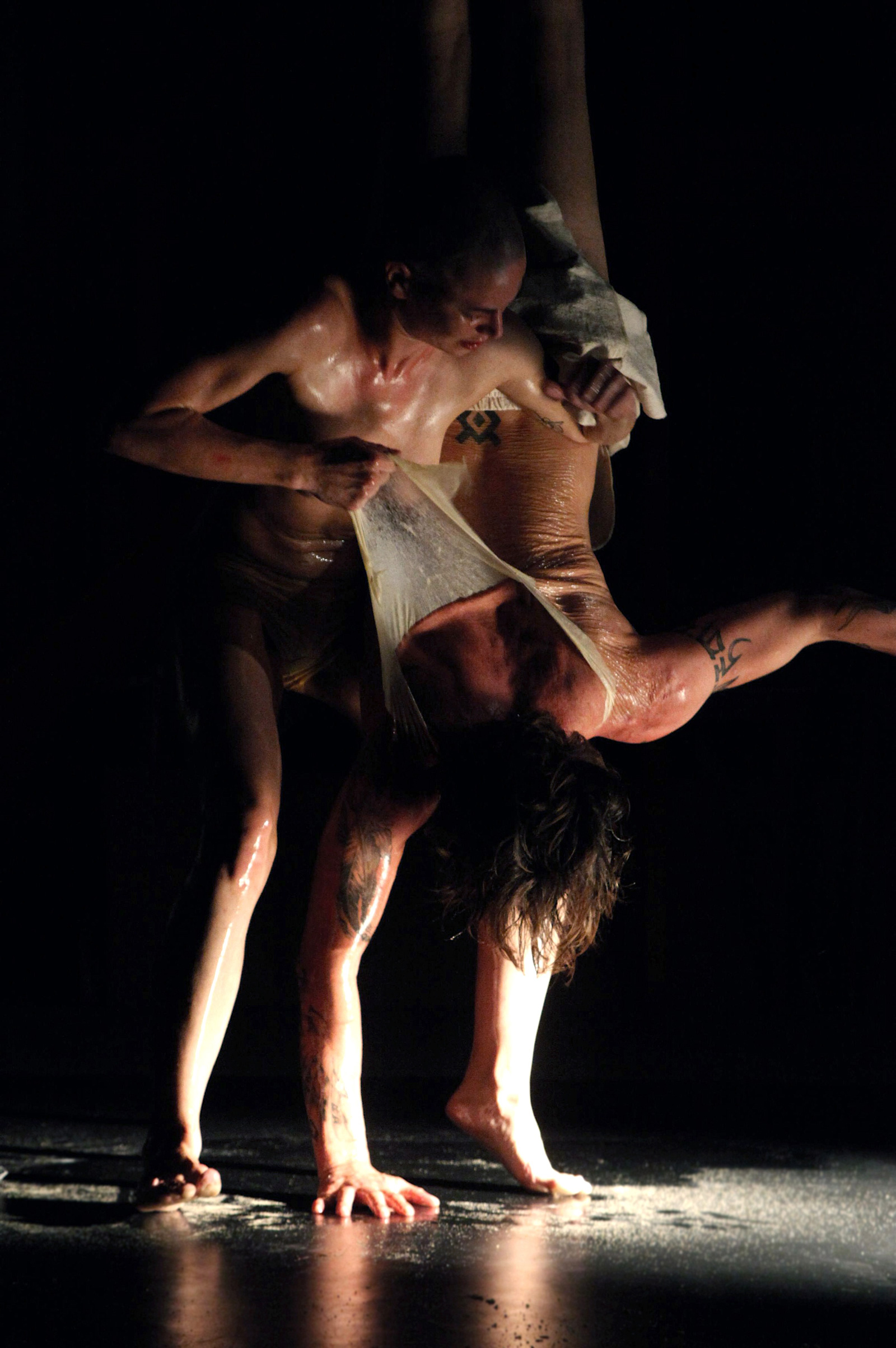
Yu-Chien Wu, Johannes Gutenberg University of Mainz
This article presents a dialectical debate among artists and philosophers by examining the act of wounding—both on the artist’s skin and latex—in the performances of Franko B, SUKA OFF, and VestAndPage. I argue that wounds in these performances do not transmit trauma or pain as an inward, privately held experience; rather, they operate as hyperreal painfulness—pure representations that enact pain. This is contrary to Peggy Phelan’s interrogation of the limits of representation where vision, love, and subjectivity resist containment by skin and form, making the wound a traumatic vanishing point for the unrepresentable. These visual portrayals of pain are independent of an autonomous subject undergoing suffering. The wound becomes an opening for encountering pain as a source of creativity and a mechanism of reversion, generating unforeseen possibilities. By turning “I love you” into “I love to you” through the addition of a preposition, Luce Irigaray (1983) advocates for the irreduciblity of each subject within relation, stressing the reciprocity and mediation so that both participants retain their subject positions without being appropriated. In contrast, in the order of simulation that Jean Baudrillard proposes, strategy belongs to the object, pushing the subject “back upon its own impossible position” (144). Despite their differences, Irigaray’s use of the preposition “to” introduces ethical reconsiderations to Baudrillard’s theory of seduction, showing how their ideas can complement one the other. The wounded surface takes on ethical weight beyond intention, desire, or will, through its seductive force, which is itself both relational and transformative.
Bernadette Wegenstein devotes a chapter to “Body Performances from 1960s Wounds to 1990s Extensions” in her book Getting Under the Skin: Body and Media Theory, where she examines the shifting role of the body in performance art alongside the evolution of media technologies. In her chapter, Wegenstein situates the “wounded” body of 1960s–70s performance within what Jay David Bolter and Richard Grusin call the “double logic of remediation”: the paradoxical desire to “multiply” media while “erasi[ing] all traces of mediation” (2006, 38). In happenings and actionism, this drive toward engineered immediacy takes the form of dissolving “the frame of spectacle”—integrating performance into everyday spaces and thereby blurring the boundary between art and life (Wegenstein 2006, 38, 49). Within this context, artists such as Gina Pane, Chris Burden, and the Viennese Actionists use their wounded bodies to confront the aesthetic and political norms, their wounds—despite the intended erasure of mediation by emphasizing sacrifice and authenticity—remain mediated. By contrast, the 1990s introduces another representational paradigm, in which, as demonstrated by artists Stelarc and Orlan, the body—no longer staged as a raw material—became a fragmented interface shaped by digital mediation. According to Wegenstein, this transformation reflects a broader cultural reconfiguration of the body—from a site of unmediated presence to “a disembodied frame, or a mere instance of mediation”—embedded within the logic of networked information flow (2006, 66).
Where the wound once symbolizes a rupture in artistic conventions, the body in the digital era is held together not by the entirety of its physical form, but by “the frame through which one experiences it” (Wegenstein 2006, 40). Thus, both the wound and the technological extension function as historically situated modes of mediation, shaping presence and absence, materiality and abstraction in and through the body. While Wegenstein’s comparative focus maps the reconfiguration of corporeality across the two periods, this article approaches the wound from a different angle. I pick up where her analysis leaves off, tracing the persistence—and reinvention—of self-mutilation performances after the 2000s. By focusing primarily on the work of performance groups SUKA OFF and VestAndPage—in which acts of wounding are carried out on both skin and latex—I invite a rethinking of the relationships between pain and wound. To frame this inquiry, I draw on Jean Baudrillard’s concept of the hyperreal, in which the distinction between representation and reality collapses. This framing positions the wound as a surface that ensures the maneuver of painful (hyper)reality and, at the same time, enforces engagement from which ethical dimension arises.
SUKA OFF is a Poland based artist collective founded by Piotr Wegrzynski in 1995 and joined by Sylvia Lajbig in 2003. Their performance Die Puppe premieres in December 2010 in Katowice, the birthplace of Hans Bellmer. His booklet of the same name published in 1934 “contains ten black-and-white photographs of Bellmer’s first doll arranged in a series of tableaux vivants” and a poetic prose introducing “his inspirational fantasies for the dolls and their origins” (Lichtenstein 2001, 22). These images obsessively expose disfigured pubescent female bodies, highlighting dismembered limbs and exposed cavities. As Bellmer confesses, the dolls are “an erotic liberation,” a rejection of adult reality in favor of childhood fantasy (qtd. in Taylor 2002, 23). Susanne Baackmann observes that Bellmer’s “photographic narrative unfolds the drama of the male infant in the throes of castration anxiety,” revealing both fascination with and fear of the female body (2003, 69). The fragmented or missing parts intensify this fear, functioning as both lure and threat. Whether through the exposed abdomen or the layering of female and male traits in a single body evoking the figure of the phallic mother, Bellmer’s fetishism operates through a visual language of depth, seeking to penetrate and contain what remain elusive.
SUKA OFF’s Die Puppe redirects Bellmer’s fetish from depth to surface. In the 2015 version, as documented in performance footage, the performance begins with a table holding a tape recorder and a glass of red wine. Lajbig sits beside them, her head wrapped in bandages. Wegrzynski, dressed in a boiler suit and goggles, removes the tape and exits. Lajbig rises, walks to the back of the table, and slowly undresses, revealing a white latex suit clinging tightly to her body. She climbs onto the table, her striped stockings echoing Bellmer’s signature imagery—the photograph Striped Stocking where a woman squats on a stool placed before a framed mirror. Yet, instead of psychosexual interiority, the scene asserts refusal of depth. Latex is beloved in fetish fashion due to its dual nature of reinforcing bodily boundary while “restricting access to it” (Steele 1996, 193), is used here, I suggest, to signify a resistance to the desire for penetration into the depth. Both performers have their vision obscured—Lajbig by bandages, Wegrzynski by goggles—mirroring what Sue Taylor (2002) calls Bellmer’s crisis of vision: the anxiety of “seeing and not seeing” (40). From a Freudian perspective, the recognition of sexual difference in the Oedipal drama is mediated through sight, and SUKA OFF’s staging suspends this recognition. The sealed opacity of latex stretches tension across the surface: depth is replaced by layers of skin.
Later, Lajbig returns to the table, still wrapped in white latex and wearing striped stockings. On either side of her hang two suspended head models, delicate and pallid, and slowly rotating. Two assistants enter. With wine glasses held by the assistants beneath her arms, blood flows silently, drip by drip, through long blood-collection tubes threaded along her skin. After the two assistants leave, Wegrzynski enters. He holds Lajbig from behind and rips open the latex over her chest and slipping water balloons beneath the latex. Her body does not flinch. Instead, she gently caresses the swollen surface, distorting her silhouette without any sign of pain or resistance. Then, with sudden force, Wegrzynski tears away the remaining latex from her chest. The balloons slip free, and her skin is revealed. What is exposed is no hidden essence, only one surface beneath another. The metamorphosis, condensed at the level of skin, becomes a pure play of tactile and visual effects. The peeling appears uncomfortable but not intensely painful; the bleeding, despite resulting from fleshy incisions, is not theatrically violent. What lingers is the question of where the sense of pain could be located.
VestAndPage, a performance duo founded in 2006 by German artist Verena Stenke and Italian artist Andrea Pagnes, integrates self-harm practices and blood rituals into their works to navigate the aesthetics of wounding on stage. In our interview, Pagnes emphasizes that the wounds in their performances are not intended as demonstrations of skill or spectacle, but rather as re-enactments of everyday movement within an anesthetized world. “As an artist,” he asserts, “I collect images and recreate them” (Pagnes 2024). Regarding the creation of wounds in performance, Pagnes adds, “[w]hen you cut yourself, at the moment, you open up.” Drawing on Theodor W. Adorno’s reading of mimesis in Gustav Mahler’s music, Pagnes further explains: “[Art] seems to imitate the reality, but it does not. Mahler’s music is an art of protest actually; it breaks through the reality to become protest. It is a cut.” This notion of the cut as a disruptive opening—a mimetic fracture that does not imitate reality but pierces it—resonates with the poetic imagery of suffering in VestAndPage’s performances. These images, I argue, stage a realm of the hyperreal in which painful sensation is not recovered but relocated. Through acts of self-harm, the duo critically interrogates “what ‘authenticity’ means in this century, a time where humankind’s needs are increasingly artificial and induced” (Pagnes 2015, 1). They argue that “authenticity is not determined by anything prior,” but rather “by the embodiment of the action—action made, filtered, and given back through the body of the performer, which makes the performer feel alive, and gives full meaning to their ideal of life as a human being” (2015, 12).
For me, this formulation calls to mind Jean Baudrillard's hyperreal—an order in which distinctions between origin and copy, real and imaginary, dissolve as simulation constitutes a world perceived as more real than reality itself.[1] In a world structured by simulation, representations no longer merely reflect or distort reality—they actualize it. In other words, hyperreality names this seamless emergence of a new form of reality in which mediated signs and embodied experiences are inextricably linked. Addressing common misconceptions of Baudrillard’s concept, Rex Butler (1999) clarifies that “[t]he aim of simulation is not to do away with reality, but on the contrary to realize it, make it real”. He further explains: “[s]imulation in this sense is not a form of illusion, but opposed to illusion—a way of getting rid of [the] fundamental illusionality of the world” (1999, 23–24). That is to say, simulation does not conceal some hidden truth; instead, it generates a reality that exists solely through appearance and enactment. Applied to the self-harm actions in VestAndPage’s performances, they—as Pagnes writes—“liberate aesthetics from the justification of sacrifice,” instead of aiming to represent pain per se (Pagnes et al. 2019, 267). Thus, the scenes of self-mutilation they create can be said to inhabit the register of the hyperreal—presence asserted through surface. Just as simulation realizes the real without recourse to illusion, VestAndPage’s anesthetized imagery of suffering render real what they are: the surface of the act becomes the reality. They embody Pagnes’s conviction that “only the act is true, for nothing that was ever said, is said, or will be said is truth” (Pagnes 2013).
This aesthetic logic finds concrete expression in Panta Rhei VI: Time, performed in Seoul, South Korea, in September 2012. In this piece, Pagnes presses a knife into his chest, his body sheathed in a nearly invisible layer of transparent latex. As the blade glides across the surface, no blood immediately appears. Meanwhile, in another part of the room, Stenke squeezes suspended plastic bottles filled with oily liquid, letting it spill over her body. As the slick substance spreads across the floor and her skin, she struggles to stay upright, repeatedly slipping and falling before eventually reaching Pagnes’s suspended body. Cradling him, she carefully makes a tear in the latex and slowly peels it away, revealing a deep, visible laceration on his back. Both the oil and the almost invisible second skin—slick, glossy, and seemingly impermeable—initially appear to seal the body. Yet each breaks, through collapse and rupture, drawing focus back to the layer where perception takes shape without depth. In these moments, the surface becomes the site where reality is actualized. Here, I interpret the act of wounding not as an expression of pain but as a hyperreal event in itself—a superficial appearance that exceeds the distinction between real and fake skin.
VestAndPage. PANTA RHEI VI: Time. Seoul Art Space, Seoul (SK), 2012. Photograph HeiJi Park. © VestAndPage
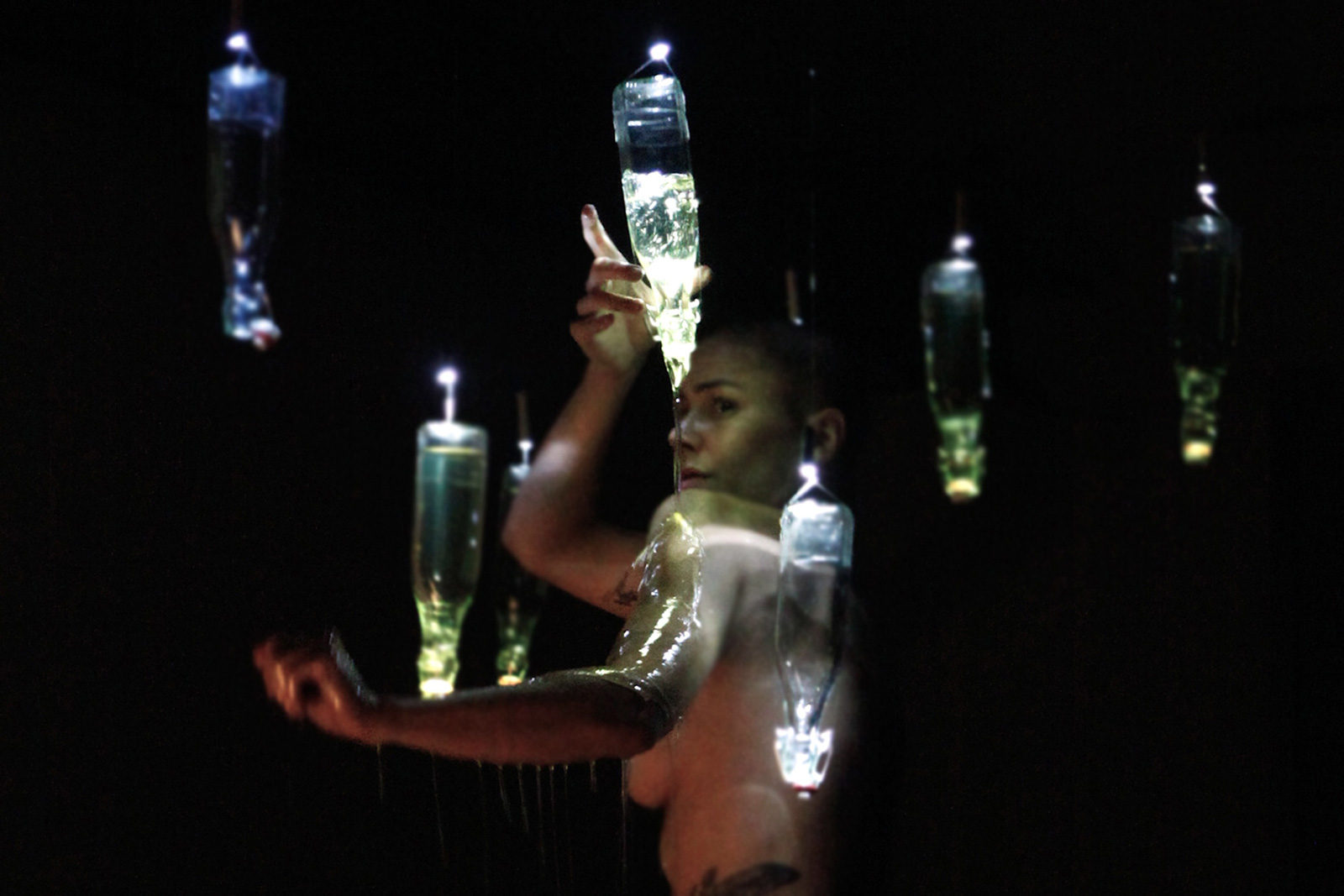
VestAndPage. PANTA RHEI VI: Time. Seoul Art Space, Seoul (SK), 2012. Photograph HeiJi Park. © VestAndPage
VestAndPage’s self-harming performances are poetic, affective, and politically charged, yet they resist a logic that frames pain as an inner referent. This recalls Ludwig Wittgenstein’s critique of private language in which he challenges the idea that sensations like pain can be meaningfully named in isolation from their socially learned expressions. As Claude Imbert (2012) explains, a central move in Wittgenstein’s thinking is “the elimination of the concept ‘pain’ to make room for pain expression” (266). Pain, in this view, is not a self-contained perception but is acquired through interaction and participation in shared linguistic practices. Wittgenstein refers to a child who, after an injury, cries out and is then taught by adults to express pain through language, remarking that “the verbal expression of pain replaces crying and does not describe it” (§244). He extends his critique by imagining someone insisting that a picture of a pot with rising steam must contain something literally boiling inside (1958, §297). As Marie McGinn (1997) clarifies, the meaning of the “picture of a boiling pot” arises from how viewers respond to “the juxtaposition of the steam and the pot” rather than from any imagined content inside the pot (165). This understanding finds a conceptual parallel in Baudrillard’s theory of simulation in which representations collapse into a reality that exceeds the distinction between sign and signification.
As Butler (1999) explains, in Baudrillard’s thought, “no object has any meaning in itself but only in its relationship with other objects” (27). Wittgenstein (1958) similarly frames “signifying” in context, defining the “language-game” as “the whole, consisting of language and the actions into which it is woven” so that meaning is produced through the “kind of use” a word has, not through any inherent essence it is assumed to possess (§8–10). Both Baudrillard and Wittgenstein reject the notion of an underlying substrate to which expression refers; instead, they conceptualize reality as constructed through processes of signification. If, as Baudrillard (1994) asserts, the hyperreal is “nothing more than operational” (2), then pain, within this context, emerges as an effect of wound imagery, an effect that, in my argument, constitutes the painful (hyper)reality in itself. In ORLAN surgical performances, she famously insists on “no pain” during or after the procedures (43). Yet as I watch the presentation slides during her speech—images of her incised, bruised, and swollen face—I feel an unease that persists. This disjunction between cognitive knowledge and somatic response supports Wittgenstein’s insight that the “image of pain” is not a representational picture to be interpreted but something that “enters into” the ordinary use of “pain” as an immediate, “not replaceable” responsiveness (§300). He further argues that saying “I am in pain” does not “identify” a sensation “by criteria” but merely “repeat[s] an expression,” which is “not the end of the language-game: it is the beginning” (§289-290). In this view, pain is recognized through its outward manifestations, not through verification of inner sensation. ORLAN’s refusal of suffering does not negate the signs through which pain is culturally and visually registered, and the audience's response is shaped less by her verbal denial than by their encounter with the affective forms through which pain becomes intelligible. Her surgical and post-operative photographs, especially those showing her flayed face, produce the effect of pain much like the latex skin being torn discussed earlier: a wound, whether on skin or latex, creates a felt sense of pain.
Trauma, as both a psychic wound, and wound as the corporeal trauma, are used interchangeably in everyday language and theoretical contexts, functioning as metaphors for one another. In psychoanalysis, this symbolic interplay is exemplified by Sigmund Freud’s reading of the myth of Tancred in Tasso’s epic Gerusalemme Liberata. To capture repetition compulsion, Freud recounts how the hero Tancred unknowingly kills his beloved Clorinda in a case of mistaken identity. After her burial, he ventures into a forest that fills him with dread. There, he slashes at a tree with his sword—whereupon blood seeps from the cut and he hears Clorinda cry out from within, lamenting that her soul is trapped inside and that he is wounding her again (qtd. in Freud [1920] 1990, 24). The bleeding wound on the tree emerges as a potent emblem of the rupture through which repressed memory returns—an image that captures the recursive nature of trauma. Embedded here is the proposition that what is concealed in depth can be heard only when the outer layer is cut open; that is, the wound appears as the external manifestation of an internal trauma.
This alignment between wound and trauma—as well as between trauma and imagined depth—is elevated to an ontological level in Peggy Phelan’s book Mourning Sex where trauma becomes a metaphor for the structural failure of embodiment in representation. This failure confronts the epistemological desire—exemplified by the probing finger in Caravaggio’s The Incredulity of Saint Thomas—to penetrate the surface in search of interior truth. For Phelan, Caravaggio’s depiction of Christ’s pierced wound compels the viewer to recognize not a revealed interior, but a vanishing point—“a hole in the viewer’s body”—marking what vision “cannot show, cannot see” (1997, 33). Though the surface appears torn open, this gesture toward depth yields no access. Instead, it stages a confrontation with absence: “the visible hole the vanishing point gives us activates our attention to the holes we do not see” (1997, 36). As Phelan writes, “the skin suffers as it tries to contain the form of drama in which we love,” since it “lacks the depth, the interiority, we want it to give us” (1997, 41). Christ’s bloodless wound thus testifies not to pain made visible, but to the radical disembodiment of love and subjectivity—the moment where the body, like vision itself, resists full presence captured by representation (1997, 42–43).
Phelan describes this failed search for interiority—endlessly reenacted across visual and embodied forms—as “the catastrophe of living (in) skin” (1997, 42), where skin functions as an interface through which subjectivity is mediated, yet inevitably frustrated. It bears the agony of insufficient embodiment. While Freud and Phelan both mobilize the wound as a metaphor for trauma—each invoking a relation to interiority, whether as a site of reemergence or an ungraspable disappearance—these framings risk foreclosing other ways of engaging with the surface’s affective and relational potential in acts of wounding or bleeding. In what follows, I examine SUKA OFF’s Red Dragon and Franko B’s I Miss You, shifting the focus from the unbearable depth the skin can neither contain nor yield to the surface itself—where dripping blood, or torn latex, though visually evocative of trauma, arrests the viewer not through the compulsion of rupture or the lure of inaccessible loss, but through surface intensity: a seductive force that circulates affects, solicits painfulness, and occasions response.
SUKA OFF’s Red Dragon, presented at the ARENA Festival in Erlangen, Germany, on June 2, 2011, stages a slow, emotionless and meticulously paced enactment of bodily transformation. The performance begins in near stillness: the male performer, Wegrzynski, sits silently on a red chair, immersed in red light. His entire body is covered in a thick layer of red latex, painted over itself five times to form a synthetic skin that clings tightly to his body. Under the saturated hue and taut latex, the contours of his face and body remain sharply visible—his features are sculpturally defined, his abdominal wrinkles pronounced, evoking the visual impression of dried blood on a flayed body. Female performer Lajbig is dressed in a long skirt of the same red tone, her upper body bare, and her face wrapped in red fabric—leaving only her eyes visible. She approaches him with deliberate movements; her gestures are composed yet intimate, exuding a sense of careful possession, infused with a lingering caress. When she touches his head, it becomes an assertion of quiet dominance, almost claiming him. The first incision is made on the right side of his neck, running downward toward his shoulder. Attentively, Lajbig slides her hand between the latex and his skin, creating a pocket of space. This action repeats rhythmically: she cuts a strip of latex, attaches a red string to it, and fastens the other end to the railing beside the chair. Piece by piece, his body becomes increasingly immobilized by the red strings. This sequence unfolds approximately over forty minutes with minimal variation, while Wegrzynski remains motionless throughout, fully subject to Lajbig’s manipulation. The repetition builds a quiet yet escalating intensity as his latex skin is gradually stripped away, still attached to his body, and affixed to the space around him. Only in the final minutes does he begin to move, struggling against the latex to free himself from the fragmented shell. He exits the stage nude, his pale skin standing in stark contrast to the blood-red latex remnants suspended in his absence—an anonymous residue lasting where the body once was.
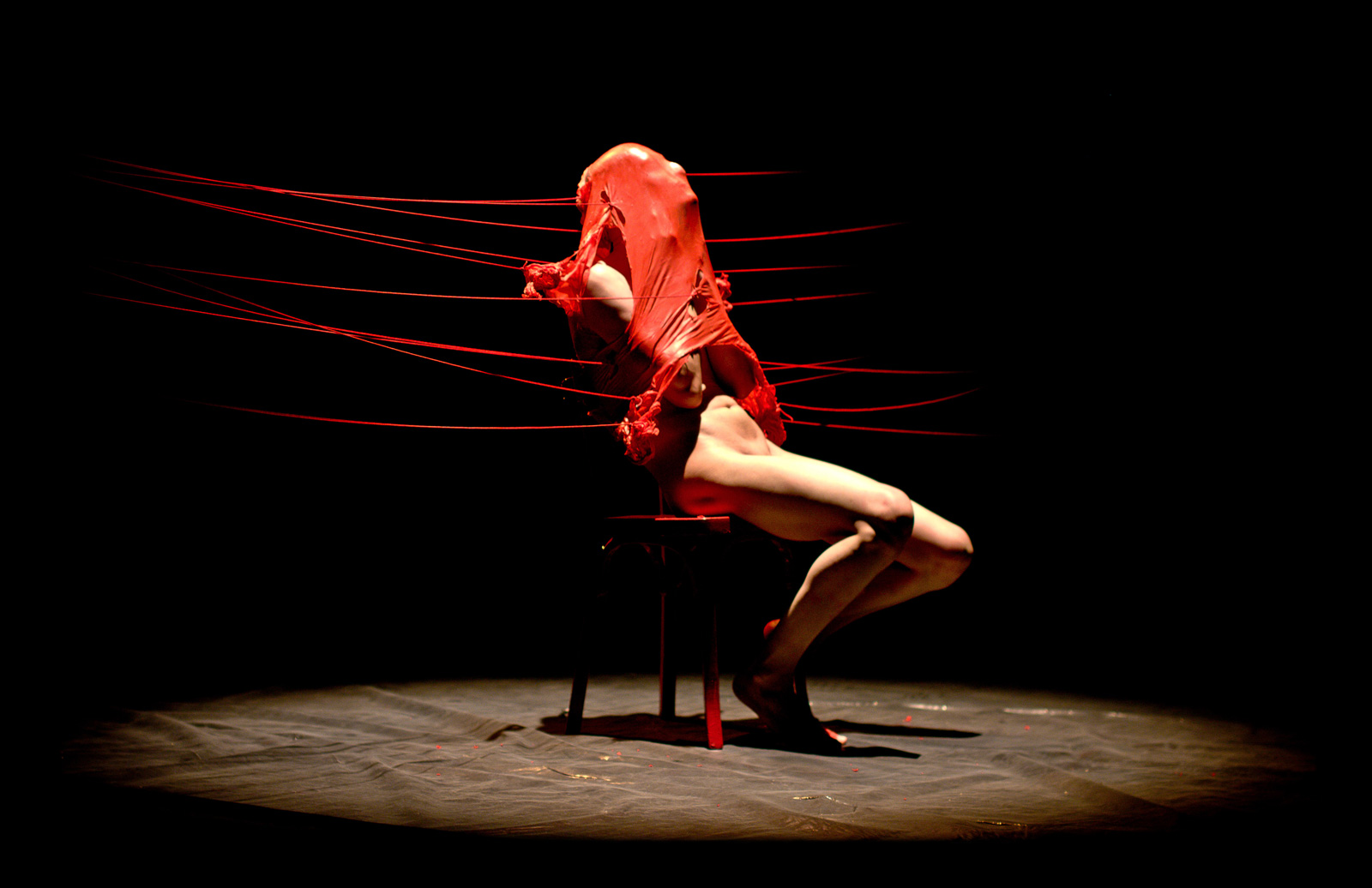
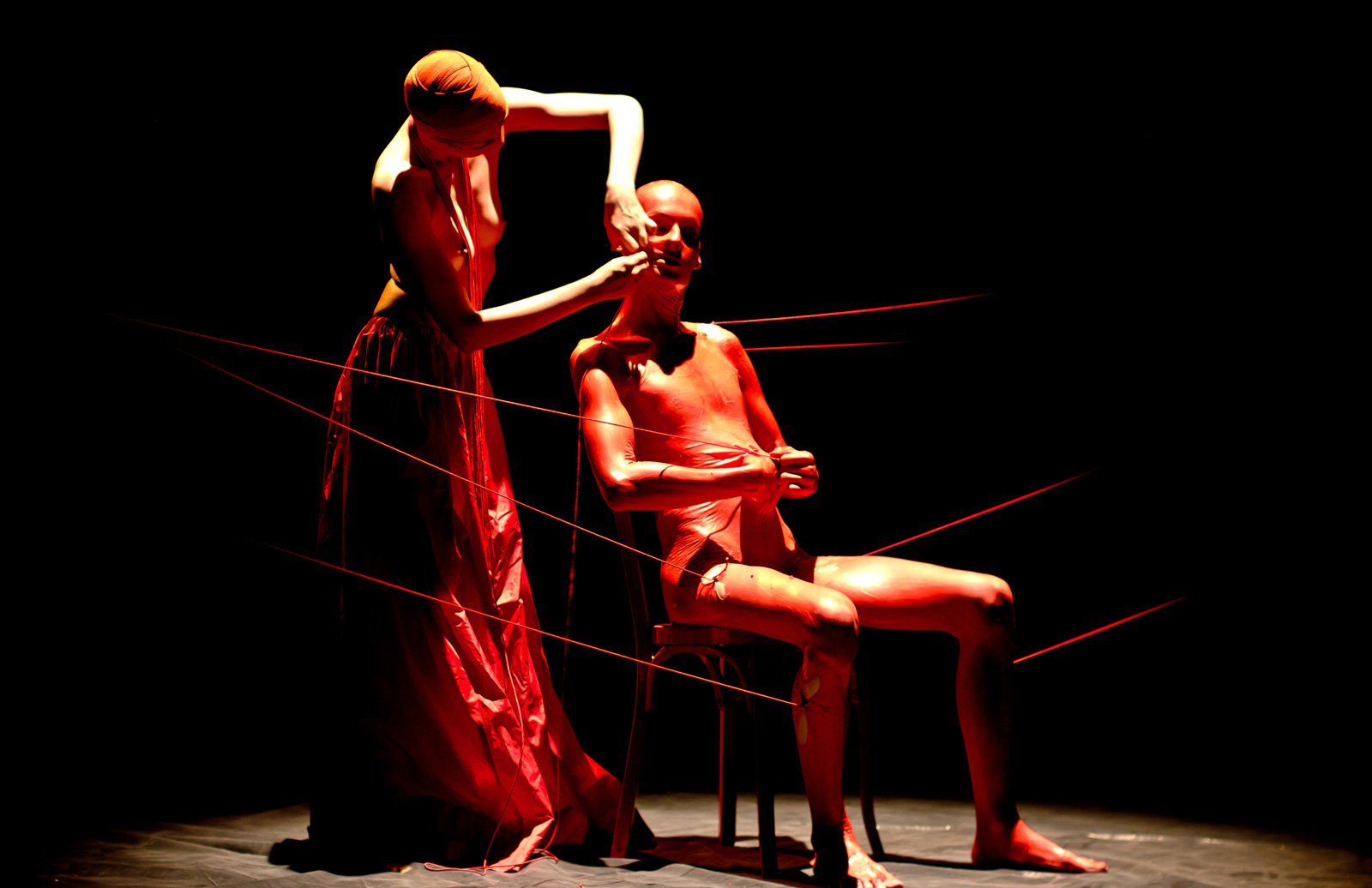
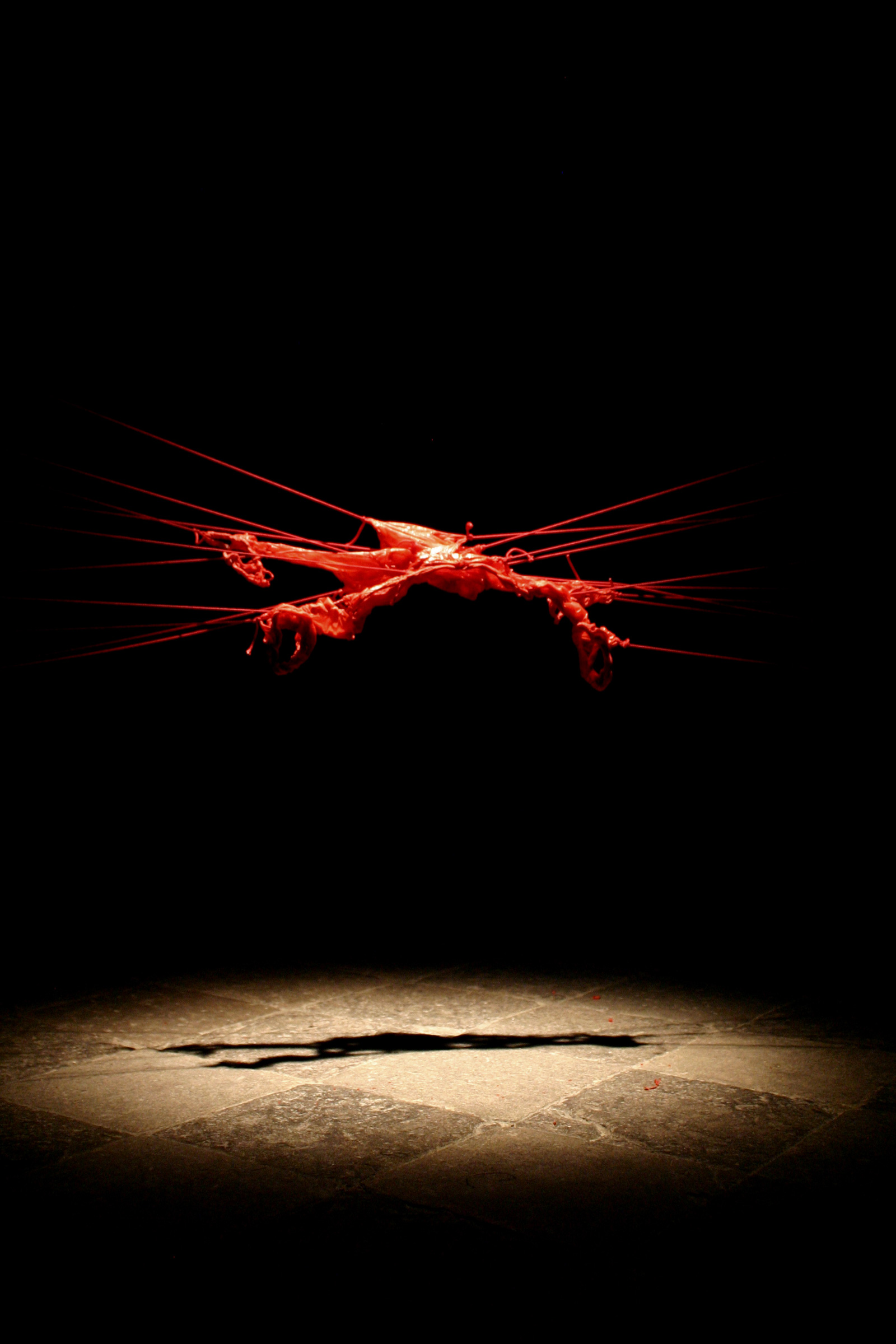
SUKA OFF, Red Dragon (2011). Photos courtesy of the artists.
Watching a body peeled open from its second skin under an all-red mise-en-scène—red light, red skirt, red chair, and a layer of red latex—is, first and foremost, visually arresting. Even as I know the latex is not the performer’s skin, I find myself momentarily caught in uncertainty, touched by the unfolding scene. I witness a shedding, a slow unveiling, yet no trace of agony or suffering is discernible. The body, drained of emotion, remains impassive, yet an underlying unease lingers. The act of being skinned in Red Dragon resonates with earlier visual traditions of flaying, particularly those centered on the myth of the Greek satyr Marsyas. As Claudia Benethien (2002) observes, Marsyas, in a series of sixteenth-century engravings, appears as an “interchangeable écorché devoid of identity” (78). By the seventeenth century, as seen in Giovanni Stradanus’s Apollo Flays Marsyas (ca. 1580–1600), flaying becomes “an act of peeling something out of its (false) form,” transforming skin into “a separate, second figure, an alien alter ego” (Benethien 2002, 78–79). In both cases, flaying is compellingly depicted as a painful, cruel and bloody act—foregrounding suffering as a visual and emotional register.
The act of shedding in Red Dragon is deeply sensational and affective. Yet, despite the visual motif of flaying, I question whether this scene of wounding necessarily demands to be read through the lens of trauma. While the wound undoubtedly produces a painful effect, as I have argued earlier, Red Dragon draws upon the visual lineage of flaying—such as the figure of Marsyas—yet stages a scene where affect emerges at the surface rather than from within any personal or traumatic memory. In one sequence, the latex covering Wegrzynski’s face is stretched and distorted: the synthetic skin warps only partially, obscuring the contours of his facial identity. And yet, his features remain unreadable, denying access to either expression of pain or personhood. In my reading, the wound is not the spectacle of trauma, but rather a surface remnant of affective labor that holds, distributes, and captures the viewer through the force of its sensory presence. Before fully shifting away from trauma, I briefly draw on Jill Bennett’s (2005) theory of affect in Empathic Vision: Affect, Trauma, and Contemporary Art to foreground the dynamics engendered by sensory images—an approach that, while grounded in trauma-related art, highlights the “motility” of affective transaction “rather than its origins within a single subject” (10). This conceptual move away from the interiority of the subject serves as a steppingstone for the ethical foundation of my analysis, positioning the site of wounding or bleeding as a surface that compels response without relying on subjective intention. Bennett challenges a dominant strain in trauma studies that defines trauma as “beyond the scope of language and representation” (2005, 3) and, in contrast, proposes a form of philosophical realism that addresses art’s capacity to convey embodied experience (2005, 3). For Bennett, affect bypasses narrative identification, enabling “a direct engagement with sensation as it is registered in the work” (2005, 7). This encounter does not seek to communicate the meaning of trauma but instead prompts what “grasps us, forcing us to engage involuntarily,” provoking thought and ethical reflection through what she calls “affective responses” (Bennett 2005, 7). Within this framework, she adopts affect as a means of relating to trauma—or to affective imagery that unsettles without placing the viewer inside trauma—by emphasizing how affect operates beyond bounded identification or representation (2005, 35).
During the performance, tension accumulates through the repetitive peeling of layers, the slow incision, the binding gestures, and, finally, the exposure of pale flesh beneath. As Bennett argues, “affect is not pre-coded by a representational system that enables us to read an image as ‘about trauma’” but rather induces “automatic responses” that, in her words, lie “not inside trauma” (2005, 35). As a viewer, I am immersed in the saturation of red as a sensory field that engulfs the body, without feeling the need for symbolic decoding. My breath quickens under the pressure of the scene; I am drawn into a charged space where shredded latex and repeated gestures build an atmosphere of quiet intensity, even though no one is physically harmed. Repetition within the dense red expanse and the ruptured, skin-like latex—juxtaposed starkly against Wegrzynski’s bare flesh—collectively deepen the emotional impact of the performance. This intensification reaches a tipping point in the final minutes, when Wegrzynski begins to twist and tear himself from the red membrane that encases him. His restrained, affectless presence cultivates a tension that eventually erupts, spilling into a moment of instability: the red latex, now emptied and suspended, collapses into a limp husk. It remains on stage—an ambiguous object, resembling a newborn creature or discarded skin—contrasting Wegrzynski’s body that exits. The final tableau conjures both aftermath and birth, culminating in a state of uncertainty. Lajbig, who has enacted a gesture of dominance, now appears to facilitate a metamorphosis—ushering a new being into existence. Yet the question of origin remains unsolved: the new creature appears to either emerge from Wegrzynski’s body or precede and exceed him. The scene suspends the chain of becoming, leaving haunting questions: who creates whom, what holds power, and how affect is mobilized precisely at the site of a wound created by latex—where pain is not only simulated but felt.
I Miss You! is a live performance by Italian-born, UK-based artist Franko B, presented on March 30, 2003, as part of a four-day live art program at Tate Modern in London. The performance takes place in the museum’s Turbine Hall where a long strip of white fabric extends the length of the space, transforming it into a runway-like stage lined with fluorescent lights. The audience is positioned on both sides of the runway, either sitting or standing, while a group of photographers gathers at the end, as if awaiting the next model at a fashion show. According to Tate Modern’s performance documentation, the body presented on the runway is not a “slim body of a supermodel, but the completely nude, bald, stocky and eventually bleeding body of Franko B” (Gormley 2015). His entirely white-painted body conceals his tattoos and heightens the visual contrast with the blood. For about fifteen minutes, the artist walks back and forth along the catwalk-like canvas, blood trickling slowly and steadily from the cannulas inserted into the folds of each arm. As he moves in silence, the blood drips onto the fabric below, leaving behind a trail of red stains. At the end of each lap, he pauses briefly before turning, reinforcing the arranged visual and sonic rhythm of a fashion show, punctuated by the clicking of cameras.
In Because of Love, Tim Etchells (2018) references I Miss You! by describing Franko B’s body as initially appearing “more as mere image than as a person—a sign or icon, spectacular, operatic,” yet ultimately undone by “his eyes, breathing, and the bleeding itself, [which] all very much belied that iconic surface” (8). The blood that falls drop by drop seeps from controlled cannulas—an aestheticized release that neither guarantees visual violence nor implies unbearable pain. Yet, the slow leak from his body, its quiet porosity, insists on his aliveness. The contradiction Etchells identifies—between the iconic image and the fragile human presence—becomes the threshold where a painful (hyper)reality takes hold. It is this unresolved tension between surface and substance, artifice and vulnerability, that draws in the audience. Jennifer Doyle (2006) experiences a similar affective pull. As she watches Franko’s slow procession, she becomes unexpectedly worried: “Still, I thought, indulging the spectator’s need to feel special—maybe Franko needs me.” Her reaction extends beyond empathy; it emerges from a projection of care, identification, and a longing to be needed—an emotional entanglement requested not by the truth of physical pain but by the demand issued through its representation. As blood slowly traces a path along the white canvas, Doyle (2013) reflects that the scene resembles a wedding more than a fashion show—“a union with an absence, for an audience,” enacted as Franko B walks down the aisle alone in a ritual of love and loss (83). “The scene was marital, but rather than celebrate the couple, we bore witness to the artist’s isolation,” she writes (2013, 76). Internal narratives take shape in response—“Love me, or I’ll die. Love me, or you’ll die. I miss you. You think you know what love is? I know. It is me bleeding for you (2006).
By presenting his white-painted body in the context of a fashion show, Franko B aligns himself with a longstanding tradition of using the body as a canvas, pointing to “a history of people who use a body as a canvas as a set of presentations and representations of what affects us – pain, love, lust, desire” (Ludmon 2003). His body does not cry out; it bleeds silently. It offers no confession, no catharsis, and no fixed representation. He does not confess, but leaks. This corporeal condition becomes the locus of an uneasy intimacy—a structural address. It compels not through dramatizing pain but through ambiguity: Is this for me? Am I being addressed? As Doyle writes, “[t]hat ambiguity is the very thing that seduces us—in our hearts we hold onto the possibility that someone might be crying for us” (2006). Where the red drops appear is a surface upon which blood is neither “a simple appearance,” nor is what is lost or desired “a pure absence” but a site where absence “eclipse[s]” presence and vice versa (Baudrillard 1979, 85). Furthermore, the gesture of showing folds into a recursive dance of gaze, as positions—speaker/witness, requester/responder—shift fluidly in a scene where roles reverse before they ever stabilize. Doyle reflects on this disorientation: “[t]he risk one takes in the critical turn towards confession and autobiography is the reproduction of the lover’s passive aggressive affection for her own martyrdom and suffering—in which case we simply mirror the position Franko B adopts before us” (2006). Her observation underscores how Franko B’s bleeding entangles the viewer in a structure of desire and compelled response that precedes intention—an entanglement that is, at its core, seductive.
In Baudrillard’s theory, seduction marks the internal limit of the simulated hyperreal. The system of simulation sustains itself by continually reproducing differences—opposing others—so that its effect of “reality” is naturalized (Baudrillard 1994, 12). Yet no critical stance can be maintained from outside the system, as simulation steadily absorbs all externality and resemblances cease to be recognized once meaningful distinctions have collapsed. Butler addresses this paradox, arguing that the only way to engage simulation is to simulate it, to “double” the world hypothetically (1999, 73). This doubling, like a mirror, evokes a reflexive play in which a gap or distance can only be imagined, never verified. This, Baudrillard argues, is the play of seduction. William Pawlett (2007) elaborates that seduction, when operating at the level of meaning, “involves a play of appearance or surface, of signs that do not and cannot be related back to signified” (104). Meaning emerges anew—not through resignification, but in suspense, always ready to reverse. Victoria Grace (2000) describes this as “the reversion of signs”—a process that “annuls meaning through returning the sign to the immediacy of its site of action” (2000, 143). “Everything must respond by subtle allusions, with all the signs enmeshed in the trap,” as Baudrillard writes (1979, 102). Discussing their use of latex, Pagnes reflects on its paradoxical nature, noting that it is a material secreted by trees to repair their wounds (Pagnes 2024). While it can heal, it also hurts; while it holds, it can break. The bleeding or wounded surface—performed on skin or latex—can be regarded as seductive, occupying the threshold where the reconfiguration of the wound’s reality, reframed within the economy of the hyperreal, reshapes the understanding of pain. These surfaces seduce not through “a simple appearance” or “pure absence,” but through what Baudrillard calls “the eclipse of a presence” (1979, 85).
There is, in Baudrillard’s theorization of seduction, “a duel and agonistic relation” in which all parties involved are bound as participants in an interwoven dynamic (1979, 146). As he affirms, “[o]ne cannot seduce others, if one has not oneself been seduced,” underscoring the mutual commitment and unilateral attraction central to seduction (1979, 81). Grace explains, “[s]eduction is a movement of reciprocal engagement, where each term is in play but never fully defined or fixable” (2000, 52). Being drawn into seduction does not mean that one ceases to be what it has been; rather, it marks the emergence of new ways of being in the world, shaped through the encounter with others. Grace continues exploring this notion later, deepening it as “implicitly a challenge in which each engages the other in a reciprocal obligation to respond” (2000, 145). Thus, to engage with the seductive surface—both for the performer and the viewer—is to be pulled into a political interplay of allure where response is inevitable and escape impossible. Such an encounter entails an ethical dimension, one defined by both compulsion and reversibility.
VestAndPage begins a cycle of performance project titled DYAD in various cities during 2014 and 2015. The project explores “what divides and separates us, and how divisions are applied socially and politically as mechanisms”; they “look into the dangers of dichotomy, attachments to dualism, and the paradox of Ego” (VestAndPage 2014–15). At Solyanka State Gallery in Moscow, they perform the DYAD IX: Open and Closed in 2015. In the midst of Pagnes' recitation, their bodies are enveloped in milky white latex, making them appear both human and non-human. As they gently caress their faces, the hands that stroke the latex surface seem to touch another person other than themselves. Pagnes kneels, while Stenke places her hand on his head. Slowly, Pagnes leans into her, resting his head on her chest, and she bends down to kiss his head. It appears they are gazing into each other’s eyes, but the latex makes such a connection impossible. Sometimes they stand side by side, at other times they embrace, holding each other’s hands. Through the torn latex, a sliver of skin on a finger is revealed. In this performance, there are no violent tears or bleeding wounds; the white latex both separates and connects their bodies, making them appear alike and serving as the link between them.
While I have discussed the wounded and wounding surfaces through seduction, certain features of this performance invite another theoretical inflection. Specifically, the dynamic between the two performers provides an entry point for incorporating Irigaray’s preposition into the reading of seductive surface, framing it as an interval, which safeguards the other from appropriation. This performance is figurative in that it foregrounds the role of the surface—separated from but never independent of the body. Much like Irigaray’s insertion of “to” into the expression “I love you,” the latex becomes integral to the relationship between this “Jedermann” couple, who “confront their inner conflicts reciprocally and suffer through expressions of radical tenderness and unconditional love as an antidote to their suffering” (Pagnes et al. 2019, 274). For Irigaray, the “to” in “I love to you” functions as a guarantor of indirection, preventing relationality from collapsing into ownership or absorption and ensuring that the other remains irreducible (1996, 109). It preserves ethical interaction, maintaining a necessary distance that resists fusion and appropriation. Moreover, this subtle linguistic shift carries profound philosophical weight: “to” resists closure, refusing to collapse the space between self and other into possession or erasure. As Irigaray writes, “to” “maintains intransitivity between persons,” marking speech and gift as acts of approach—“I speak to you, I ask of you, I give to you”—rather than appropriation (109). In this articulation, the preposition does not merely link subjects; it sustains a relational interval, a spacing that preserves alterity while enabling reciprocal proximity. The address remains open, directional but not possessive, allowing for response without subsumption.
In this sense, latex acts as a mediator—Irigaray’s linguistic insertion—emphasizing both interdependence and the necessary space that enables intimacy without dissolving individuality. This point is restated in another metaphor of caressing each other that Irigaray depicts: “I caress you, you caress me, without unity—neither yours, nor mine, nor ours” (Jones 2011, 162). Rachel Jones (2011) contends, “[t]he spacing between the lips that allows woman to relate to herself thereby opens up a spacing between men and women that allows each to relate to the other without negation, assimilation, or appropriation. Instead, this spacing shelters an irreducible difference” (213). The surface, both linguistic and physical, becomes the site where relationality is enacted: a space of encounter that neither fuses nor fully separates, but maintains the dynamic tension of reversibility. VestAndPage often uses blood that Pagnes (2019) describes as “juice of life” in their performances (281). “Working with blood is a way of making connection,” she explains in our interview. Blood, described in their own words as both a “carrier of suffering and an expression of life” is a material whose dual nature abolishes assigned meaning through a cycle of reversion (Pagnes et al. 2019, 284). As they state, “to sacrifice is also a way of becoming more consistent, compatible, and no longer in opposition to others. [It is seen] as an opportunity to inhabit a space where inner conflicts can be reconciled with external differences, re-establishing a more harmonious relationship between the Self and its opponents” (Pagnes et al. 2019, 274).
In a similar vein, the dialogue between VestAndPage and Franko B further investigates how love, and vulnerability give form to a space of interconnected exposure. Franko B reflects, “[l]ove is generosity. Love is kind—kindness from people you don’t know. Love is why, I suppose, you get out of bed in the morning” (Pagnes 2021). Pagnes extends this, affirming that “we are all made of the same substance: love and suffering,” and that art becomes “a quest for liberation pursued through the inextinguishable power of love, radical empathy, and existential creativity” (Pagnes 2021). Their language of vulnerability and relational openness articulates a shared ethical orientation—one that embraces exposure as liberation, suffering as a site of connection, and love as a generative force binding creative impulse to empathy through a willingness to be affected. In this register, generosity is not a mood but a practice of risk: it invites contact, relinquishes mastery, and allows the self to be transformed by encounter. Their being in the world names a concrete hospitality—showing one’s wounds to others beyond any contract. Reflecting on bleeding in performance, Franko B emphasizes: “it is not about Franko B. I am a human being in front of you, showing you what it is like—showing you life, really” (Pagnes 2021). Exposure here is not confession but a bodily address, where the other is invited to share and be accompanied. To show, then, is to witness rather than to claim; it keeps the relation open, refusing to turn the other into a proof, a prop, or a cure. Franko continues: “[t]he artist, I think a true artist, is one that is a monster, un mostro… from the Latin demonstrate, which is somebody that shows… ‘This is what I saw, this is what is happening.’ I think so, that is what is being vulnerable” (Pagnes 2021). Vulnerability, in this sense, is not theatricalized weakness but a lucid readiness to be seen—and to let seeing do its work. This is precisely the posture Pagnes names: “[a]ccepting our vulnerability means also [being] willing to stay open, show our wounds, accept our imperfection, and work on them, or make a work of art out of them” (2021).
In Irigaray’s formulation, the preposition “to” institutes a structural distance that renders both unmediated fusion and the erasure of otherness impossible. I argue that this ethical spacing—irreducible and non-assimilative—underwrites the logic of Baudrillardian seduction: a gap that demands response while resisting incorporation. Even as Irigaray and Baudrillard converge on the necessity of relational distance, their philosophical trajectories diverge. As Grace observes, Irigaray affirms “the positivity of the subject—a feminine-specific, desiring subject” (55), whereas Baudrillard’s non-essentialist critique suspends such affirmation, insisting that “the essence of the relation is as much to be questioned as the essences of the subject and the object” (71). What Irigaray frames as a political relation becomes, for Baudrillard, a reversible game in which “power can only be understood as challenge,” sustained through exchange rather than fixed antagonism (Grace 71). This divergence need not be disabling. If we read Irigaray’s “to” not as metaphor but as grammatical safeguard—an address—it becomes legible as the very structure of seduction: a challenge that inaugurates relation and obliges return. Butler’s clarification helps align these perspectives: seduction is “not simply opposed to simulation,” but a distance “that both enables simulation and ensures there is always more to simulate” (73). Because simulation offers no exterior vantage from which to refute it, one must engage it from within; this doubling is seduction’s work. As Butler glosses, even when simulation attempts “to cross the distance between the original and the copy,” seduction is both the instance that permits resemblance and the distance that resurges when it is crossed; “seduction is the necessity of taking the other into account when trying to produce resemblance” (72). Precisely here, Irigaray’s “to” inscribes seduction as a relational distance—one that already presupposes the participation of the irreducible other.
In the performances this article examines, pain is not treated as residing in the artist’s body and perceived by the viewer; instead, it crosses the boundary between the artist and the audience, shared as a hyperreal painfulness. This reconceptualization necessitates moving beyond the autonomous subject. Rather than aiming at the fulfillment of desire, love, for Baudrillard, thrives on indeterminacy where seduction manifests as a reciprocal invitation—“to be seduced is to challenge the other to be seduced in turn,” a call to which a response is always already entangled (1979, 22). Arguing that challenge lies “at the heart of seduction,” Baudrillard defines it as “that to which one cannot avoid responding” (1988, 57). In this sense, the wounded skin bleeds not to confess, nor to demand care, but to draw the other into relation—to reopen the body, marked by histories of domination, into a fissure, like the “to” Irigaray insists on, where signs, sliding over one another, and proximity, returning contours, together enable transformation to appear. Moreover, the blood that moves across Franko B’s skin—an invitation to encounter that is grounded in vulnerability—finds a parallel in Baudrillard’s conception of love, which he theorizes within the logic of seduction, distinct from the conception of sex as a biological drive, as “a challenge to the other to return the love,” in which each side raises the stakes without closure (1979, 22). Blood, in the context, as a seductive surface, strains lure and love into tension, making the ethics of becoming-with inseparable from the allure of being-called. Thus, both the audience and the artist, enter a relation in which one accepts without being subsumed, responds without collapsing into over-identification, and stays with the shimmering interval where love persists.
As I have shown, the seductive surface—bleeding skin and wounded latex—is the mechanism through which painfulness is reimagined across biological and synthetic skins, thereby actualized as an intersubjective, painful (hyper)reality. At the site where wounds occur, an endless cycle of request and return emerges. Ethics appears as love continues to challenge without anchoring itself in an originative speaker or listener; no voice is centered, and none is appropriated.
[1] VestAndPage’s use of the term “authenticity” is grounded in “true inner characteristics” and a “spontaneous and genuine interiority,” with authenticity secured through coherence between inner disposition and outward action. Yet their account also concedes that authenticity is never assessed “prior,” it is judged “by means of senses and knowledge” and is inflected by motivational and emotional state in the here and now where “sensorial information” received could be “incomplete, fragmented, and fluctuating” (Pagnes 2015, 12). My reading leans into this fault line: rather than treating authenticity as the expression of an isolated interior truth, I understand it as an effect that emerge through the relay between action, image and reception—close Baudrillard's notion of simulation as interpreted by Rex Butler that reality is not abolished by “realize[d]” (1999, 23).
Baackmann, Susanne. 2003. “Symptomatic Bodies: Fascism, Gender and Hans Bellmer's Dolls.” In Writing Against Boundaries: Nationality, Ethnicity and Gender in German-Speaking Context, edited by Barbara Kosta and Helga Kraft. Rodopi.
Baudrillard, Jean. 1979. Seduction. Translated by Brian Singer. Editions Galilee.
Baudrillard, Jean. 1983. Fatal Strategies. Translated by Philippe Beitchman and W. G. J. Niesluchowski. Semiotext(e).
Baudrillard, Jean. 1988. The Ecstasy of Communication. Translated by Bernard and Caroline Schutze. Semiotext(e).
Baudrillard, Jean. 1994. Simulacra And Simulation. Translated by Sheila Faria Glaser. The University of Michigan Press
Bennett, Jill. 2005. Empathic Vision : Affect, Trauma, and Contemporary Art. Stanford University Press.
Bennthien, Claudia. 1999. Skin: On the Cultural Border Between Self and the World. Translated by Thomas Dunlap. Columbia University Press.
Butler, Rex. 1999. Jean Baudrillard: The Defence of the Real. Sage.
Doyle, Jennifer. 2006. “Critical Tears: Franko B’s I Miss You.” Franko B. Accessed March 5, 2025. https://www.franko-b.com/critical-tears#publication.
Doyle, Jennifer. 2013. Hold It Against Me: Difficulty and Emotion in Contemporary Art. Duke University Press.
Freud, Sigmund. (1920) 1990. Beyond the Pleasure Principle. W.W. Norton & Co.
Grace, Victoria. 2002. Baudrillard's Challenge: A Feminist Reading. Routledge.
Irigaray, Luce. 1996. I Love to You: Sketch for a Felicity Within History. Routledge.
Imbert, Claude. 2012. “Pain: A Philosophical Borderland.” In Wittgenstein and the Philosophy of Mind, edited by Jonathan Ellis and Daniel Guevara, 259–276. Oxford University Press.
Jones, Rachel. 2011. Irigaray: Toward a Sexuate Philosophy. Polity.
Lichtenstein, Therese. 2001. Behind Closed Doors: The Art of Hans Bellmer. University of California Press.
Ludmon, Mark. 2003. “Franko B Pushes Live Art to Bloody Extremes.” September 24. Accessed April 2, 2024. https://markludmon.com/2003/09/24/feature-franko-b-pushes-live-art-to-bloody-extremes.
McGinn, Maria. 1997. Wittgenstein and the Philosophical Investigations. Routledge.
ORLAN. 2010. ORLAN: A Hybrid Body of Artwork, edited by Simon Shepherd. Routledge.
Pagnes, Andrea, and Franko B. 2021. “How to Live Because of Love? Andrea Pagnes in Conversation with Franko B.” October 8. https://www.youtube.com/watch?v=eKOJ0sQ6HDU.
Pagnes, Andrea, Felipe Henrique Monteiro Oliveira, Amber Rose Ellis, and Aisha Ryannon Pagnes. 2019. “Considerations on Pain and Suffering in VestAndPage’s Performance Art.” Repertório 22 (32): 266–300. https://doi.org/10.9771/r.v1i32.26578.
Pagnes, Andrea. 2013. “My Body Asking Your Body Questions: Interviewed by Valeria Romagnini & Karlyn De Jong.” Personal Structures 2: 281–296. https://www.vest-and-page.de/interview-personal-structures.
Pagnes, Andrea. 2015. “Two Bodies in Space: The Quest for Authenticity in the VestAndPage Experience.” Research Catalogue. Accessed March 8, 2023. https://www.researchcatalogue.net/view/206891/206892Two.
Pagnes, Andrea. 2024. Interview by Yu-Chien Wu.
Pawlett, William. 2007. Jean Baudriilard: Against Banality. Routledge.
Phelan, Peggy. 1997. Mourning Sex: Performing Public Memories. Routledge.
Steele, Valerie. 1996. Fetish: Fashion, Sex, And Power. Oxford University Press.
Taylor, Sue. 2000. Hans Bellmer: The Anatomy of Anxiety. MIT Press.
VestAndPage. 2014–15. “Dyad.” https://www.vest-and-page.de/dyad-cycle-2014-2015.
Wegenstein, Bernadette. 2006. Getting Under the Skin: Body and Media Theory. MIT Press.
Wittgenstein, Ludwig. 1958. Philosophical Investigations. Macmillan.
Yu-Chien Wu is a researcher at the Institute of Film, Theatre, Media and Cultural Studies at Johannes Gutenberg University of Mainz. Her research explores wounding in performance art, using surface as a conceptual lens through which understandings of the body, gender/sexuality, and sensation are reexamined within broader debates on authenticity and cultural representation.
© 2025 Yu-Chien Wu
Except where otherwise noted, this work is licensed under a Creative Commons Attribution-NonCommercial-ShareAlike 4.0 International License.